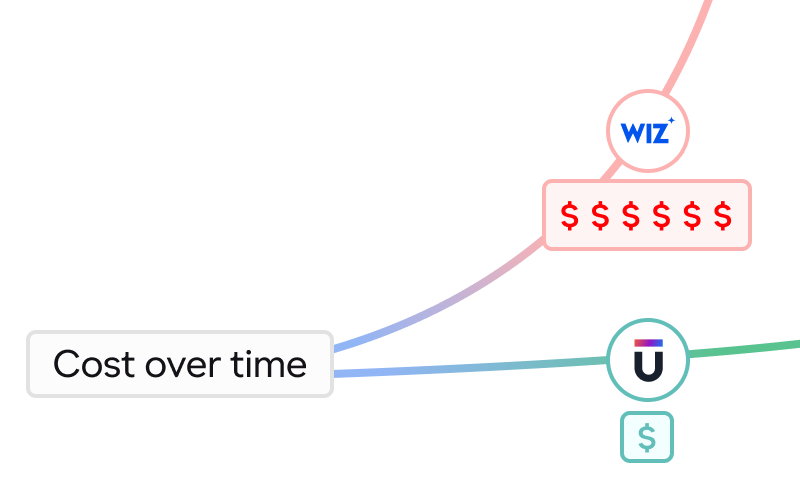
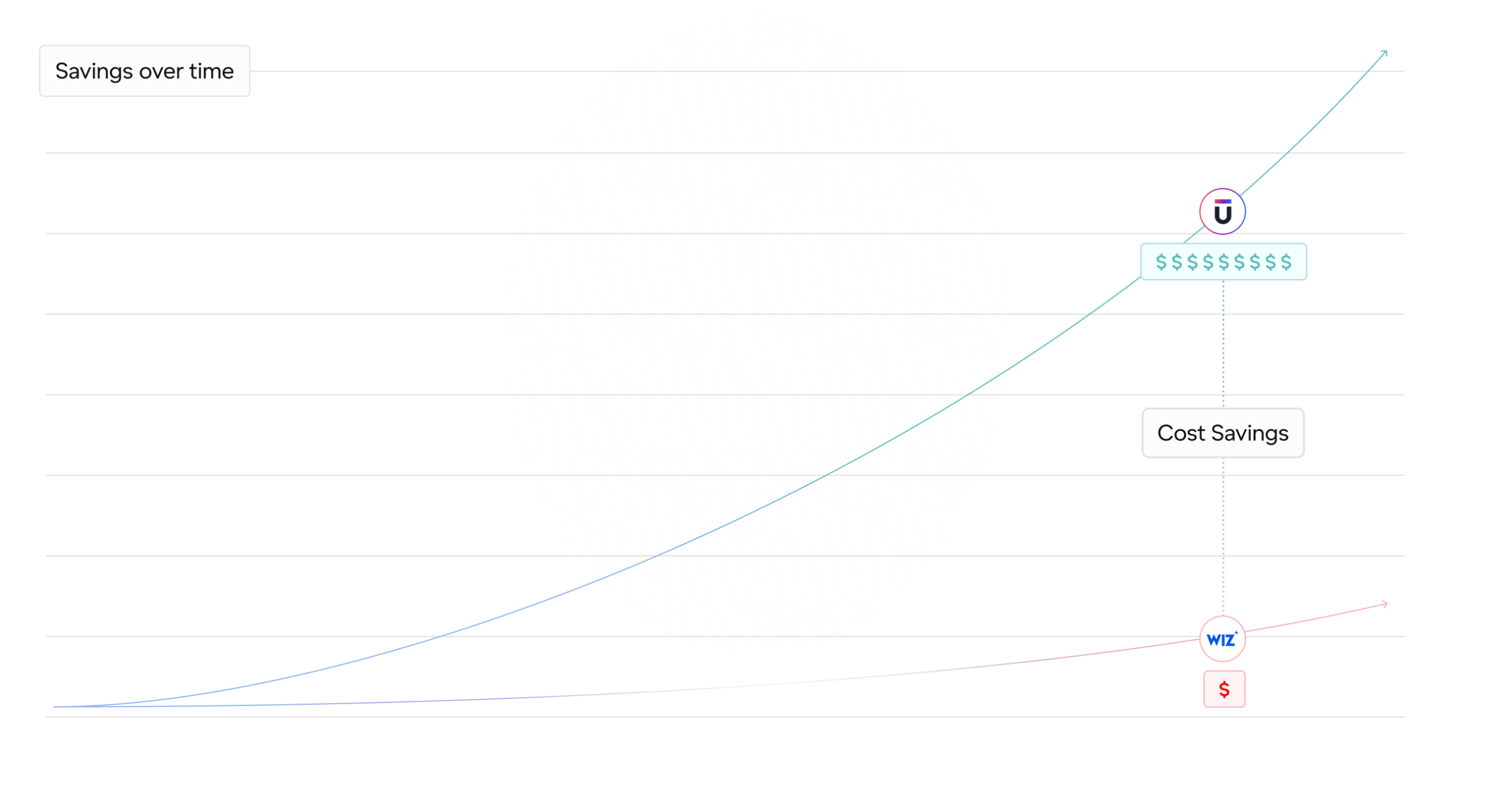
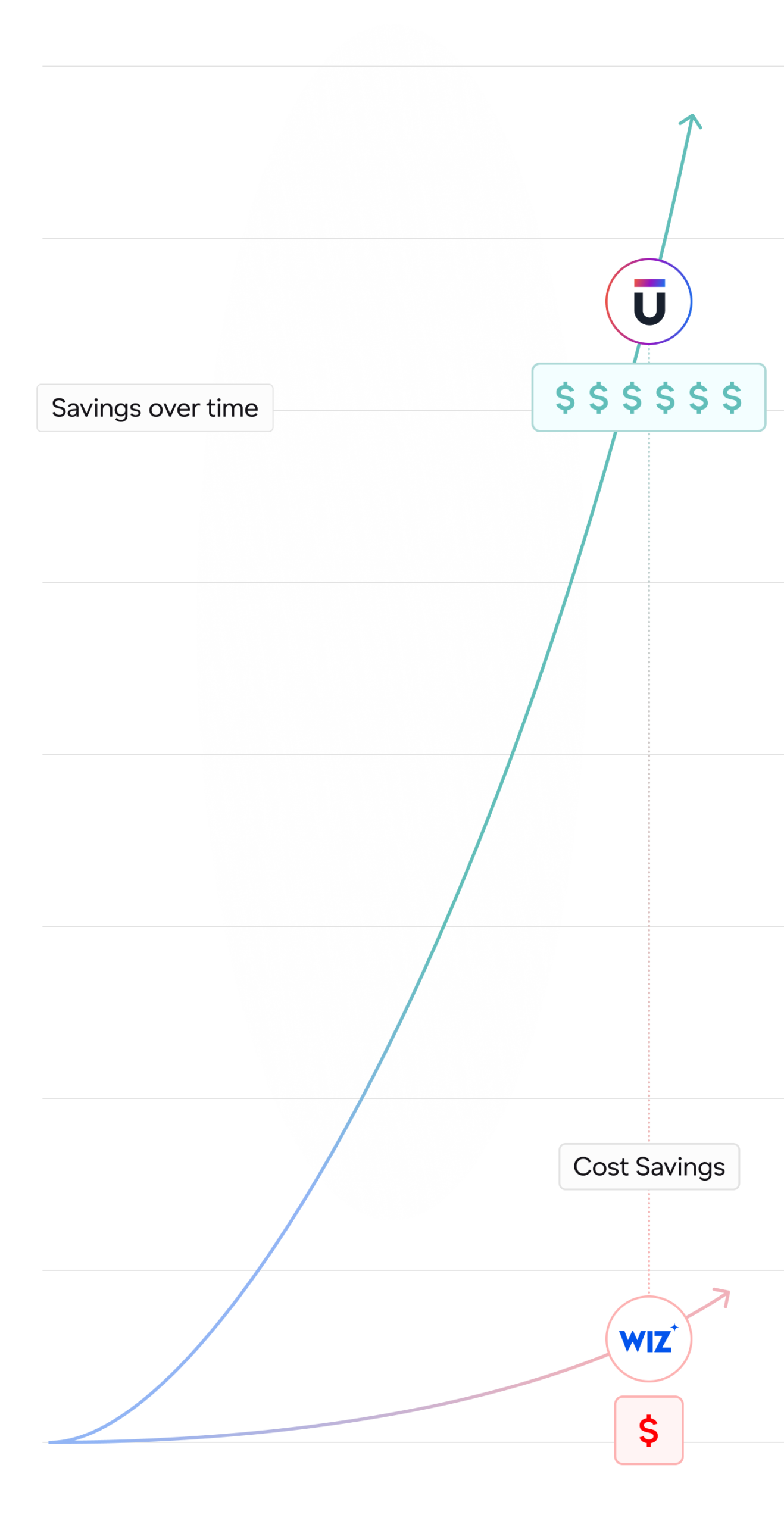
What is the difference between Upwind and Wiz?
Upwind's architecture is built on realtime intelligence, Wiz's on agentless scanning, and Upwind's foundation is what makes it effective in scanning large scale cloud infrastructure. One data model runs the whole platform, while Wiz adds runtime and code scanners onto its scanning core as separate data sets & products.
One Architecture vs. a Collection of Scanners.
That foundation shapes everything downstream as posture, workloads, identity, data, detection, and AI security are views onto the same picture rather than separate products. Put another way, an architecture that already sees everything can be offered as one platform, while a collection of scanners is offered as separate SKUs. The economics follow the design, which is why a more efficient foundation reaches you at a better, more predictable price.
In short:
Built on runtime intelligence.
Upwind pairs agentless scanning with a runtime sensor and reads your cloud from the inside, prioritizing real threats in running services using internal signals like network traffic and API calls. That single data model is the foundation of everything else, including the price.
One SKU, not a stack of them.Upwind includes the full CNAPP (CSPM, Runtime sensor, Code scanning, and Data security) in one price.
Wiz sells a core platform and prices code scanning (Wiz Code), runtime (Wiz Defend), and data security as add-on modules billed on top, as a separate per-workload charge, so coverage cost rises as you stack modules.
No double-counting.
Upwind counts one workload per node. Wiz's per-resource model counts a Kubernetes node as two billable units, the VM plus the container host, and that’s just for the basic SKU.
Independent across every cloud.Google completed its $32 billion acquisition of Wiz on March 11, 2026. Upwind stays independent, with a runtime fabric built to secure any cloud and the AI running on it.
Upwind vs. Wiz at a glance
Across the dimensions that decide a CNAPP purchase, Upwind leads on realtime intelligence based architecture, detection efficacy, data accuracy, pricing predictability, contract flexibility, and cloud independence. The table summarizes each.
Agentless scanning plus a runtime sensor for inside-out visibility into what's actually running and actively at risk. Runtime intelligence enhances the whole platform.
One SKU with full CNAPP included:
- CSPM
- Runtime sensor
- Code scanning
- Data security
- AI Security
How a workload is counted
One VM / Host counts as one workload. Containers running on it add nothing. Tens of Fargate tasks or hundreds of Lambda functions roll up rather than counting one by one.
Tiered pricing that lowers the per-workload rate as you grow.
24/7 support included at no extra cost, with a 2-minute SLA for a live human response. Dedicated technical account manager included.
AI Security connects the dots from endpoint to cloud and structured around Visibility, Exposure, and Threats included in the price.
Ownership and cloud neutrality
Independent, multi-cloud by design.
Agentless scanning plus a runtime sensor for inside-out visibility into what’s actually running and actively at risk. Runtime intelligence enhances the whole platform.
One SKU with full CNAPP included:
- CSPM
- Runtime sensor
- Code scanning
- Data security
- AI Security
How a workload is counted
One VM / Host counts as one workload. Containers running on it add nothing. Tens of Fargate tasks or hundreds of Lambda functions roll up rather than counting one by one.
Tiered pricing that lowers the per-workload rate as you grow.
24/7 support included at no extra cost, with a 2-minute SLA for a live human response. Dedicated technical account manager included.
AI Security connects the dots from endpoint to cloud and structured around Visibility, Exposure, and Threats included in the price.
Ownership and cloud neutrality
Independent, multi-cloud by design.
How is Upwind's pricing different from Wiz's?
Upwind sells one SKU with the full CNAPP included and counts workloads without double-charging, while Wiz splits coverage across separate SKUs and counts cloud resources one by one, so the Wiz bill grows on two axes at once. That difference sounds small in a demo and gets very large in production.
Upwind includes the runtime sensor, code scanning, and data security in the base price, so one number covers the platform.
Wiz sells a core platform and prices code scanning (Wiz Code), runtime (Wiz Defend), and data security as add-on modules billed on top, as a percentage uplift or a separate per-workload charge. Coverage cost rises as you stack modules, and full coverage can run 2 to 7 times the entry price.
Then there’s how a workload is counted, which is where the gap really opens:
- Upwind counts the node, not everything on it. One VM or container node is one workload. The containers running on that node add nothing. Tens of Fargate tasks roll up into a single workload, and hundreds of Lambda functions do the same, so serverless and containerized scale doesn’t multiply your count.
- Wiz counts the resources, and stacks the modules. Cost scales with workload volume, where VMs, containers, serverless functions, databases, and data stores all add to the total, and for that same node the runtime and code coverage Upwind includes are separate paid modules.
Then there's how a workload is counted, which is where the gap really opens:
Wiz starts from more billable units and then asks you to add modules to reach the coverage Upwind ships in the base. So even an aggressive per-unit discount is working against a higher starting count, with more paid modules stacked on top.
How do Upwind and Wiz count workloads?
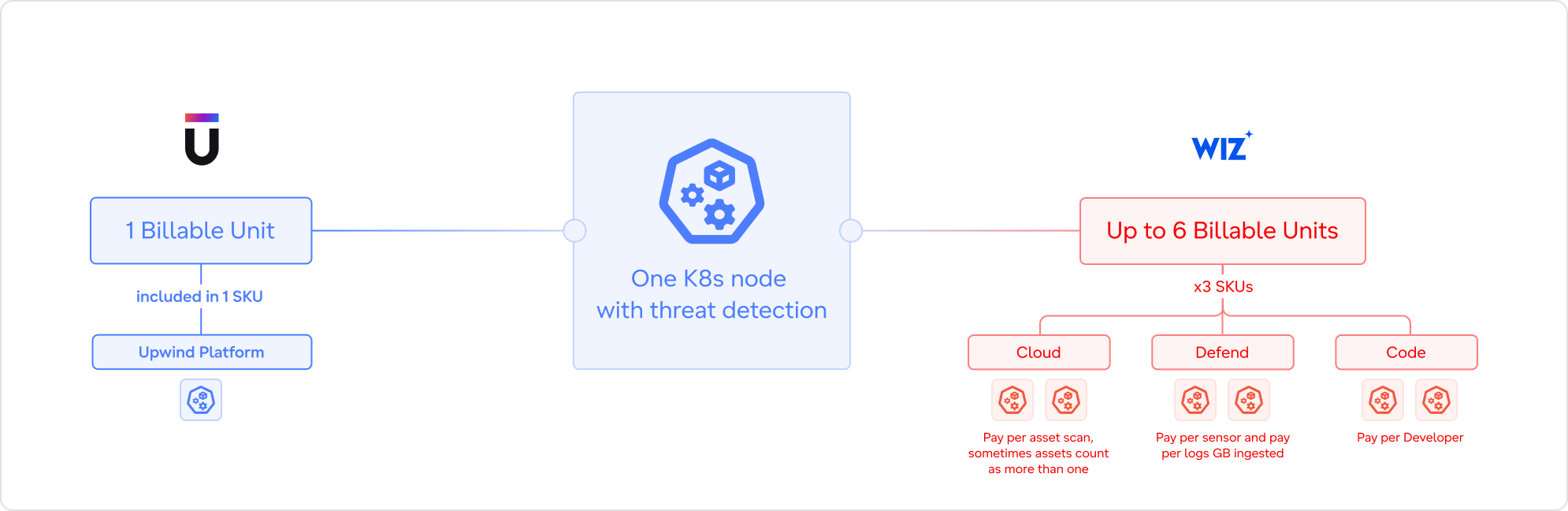
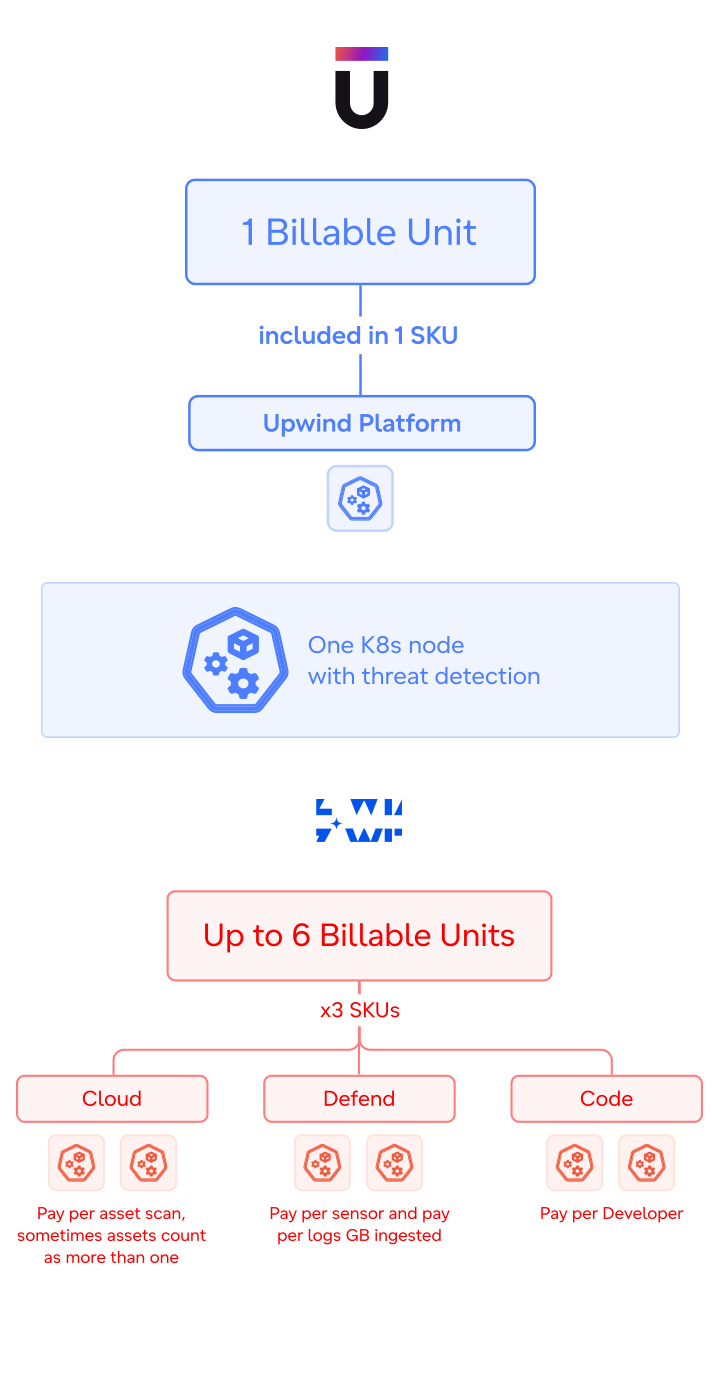
To watch a single Kubernetes node for configurations, vulnerabilities and threats, Upwind counts one workload with detection included, while Wiz meters the same node as four separate billable lines. Threat detection is where the two models separate most clearly. Detecting threats takes a runtime sensor and the log data it analyzes, and Wiz bills for each separately, while Upwind includes both.
Cost example: 1 Kubernetes node with threat detection:
Billable lines for that one node
1 VM, plus 1 container host
Logs related to the container
Additional log ingestion cost
Scan Image pre-deployment
Required Wiz Code Module, billed on top
Billable lines for that one node
1 VM, plus 1 container host
Logs related to the container
Additional log ingestion cost
Scan Image pre-deployment
Required Wiz Code Module, billed on top
Securing one node for threats remains a single workload on Upwind, with the sensor, the detection, and the logs it reads all included. On Wiz the same node becomes four lines on the invoice: the VM, the container host counted on its own, a runtime sensor unit, and the log ingestion that detection runs on. That is just one node of a whole environment.
Which platform is better for AI security?
Both have moved aggressively into AI security, but Upwind ties AI risk to live cloud context across Endpoint, code, cloud, and runtime, while Wiz's AI Application Protection mostly relies on static data. This is the area where the category is being defined right now, so the foundation underneath matters.
Upwind AI Security connects AI usage to real-time cloud context, giving teams a practical way to see where AI runs, what it can access, and which risks need action. It's organized around three jobs: Visibility, Exposure, and Threats. On the Visibility side, AI-Inventory catalogs what AI is actually running and AI-BOM breaks down what each workload is built from. On Exposure, the Upwind Red Agent proves which exposures are reachable rather than theoretical, while the Blue Agent investigates and the Green Agent remediates, all coordinated by Choppy AI. On Threats, AI-Sensor captures the runtime telemetry and AI-DR correlates the signals to catch multi-step attacks like prompt injection that configuration scans miss.
Does Google's ownership of Wiz change anything?
Usually after large acquisitions, roadmap priorities, integration depth, and procurement paths all tend to follow ownership. While
Wiz says it will keep its brand and multi-cloud support across AWS, Azure, and Oracle Cloud, confirming those paths ahead of multi-year renewals is a sensible precaution.
Upwind's position is simpler to reason about: an independent platform whose only incentive is to secure your cloud and your AI wherever they run. That’s it.
FAQs
Is Upwind a Wiz alternative? Yes. Both deliver CNAPP covering posture, workload protection, identity, data, and detection. Upwind differentiates on real-time intelligence throughout, predictable pricing, and independence from any cloud provider.
Is Wiz cheaper than Upwind? No, once you account for both how coverage is sold and how it's counted. Upwind includes runtime, code scanning, and data security in one SKU, while
Wiz prices those as add-on modules (Wiz Defend, Wiz Code) on top of the core platform. On top of that,
its cost scales with workload volume across VMs, containers, serverless functions, and data stores, so the count climbs as your cloud grows. Even when Wiz discounts the per-unit rate, it's discounting a larger, multi-module number.
Does Upwind do AI security? Yes.
Upwind AI Security connects AI usage to real-time cloud context across code, cloud, and runtime, organized around View, Protect, and Validate, with capabilities including AI-Inventory, AI-BOM, AI-Sensor, AI-DR, and the AI Agentic Pack.
Can I run Upwind alongside Wiz during a migration? Yes. Both platforms can run in parallel for a seamless migration.
Predictable cost, by design.
Security spend shouldn't be a penalty for growing your cloud. Two things drive that penalty with a per-resource model: paying for coverage in separate modules that stack, and counting every resource individually. Upwind does neither. One SKU includes runtime, code scanning, and data security, and one node counts as one workload no matter how many containers run on it.
Wiz prices runtime (Wiz Defend) and code (Wiz Code) as add-on modules on top of the core platform, and
its cost scales with workload volume. You confirm the value first through a free trial, then size the commitment to your environment.