

As organizations scale, managing who can access sensitive security data inside a platform becomes increasingly complex. More users, more teams, and more environments often lead to fragmented permissions, limited visibility, and unnecessary friction between security and engineering. When access controls aren’t designed for enterprise collaboration, organizations are forced to choose between speed and control.
At Upwind, we believe access management should enable growth, not slow it down. That’s why we built Role-Based Access Control (RBAC) with fine-grained Scopes, a modern, platform-level access management model that gives enterprises precise, contextual control over who can see and do what inside Upwind, without compromising usability or agility.
What is Role-Based Access Control?
Role-Based Access Control (RBAC) is a security model that simplifies access management by assigning permissions to roles, then assigning users to those roles. Instead of managing permissions on a per-user basis, RBAC enables centralized, consistent control aligned with job functions and responsibilities
Each role is defined by a specific set of actions a user is authorized to perform. When a user is assigned a role, they automatically inherit those permissions, making onboarding, role changes, and offboarding faster and more reliable. RBAC provides several critical benefits for modern enterprises:
- Controlled Access and Reduced Risk. RBAC enforces the principle of least privilege by ensuring users only have access appropriate to their role. This minimizes unnecessary exposure to sensitive data and reduces the risk of accidental misuse or data leakage. A reduced attack surface is a natural outcome of this controlled access model.
- Operational Efficiency at Scale. By managing permissions through roles rather than individuals, RBAC simplifies administration across large, distributed teams. This makes it easier to onboard new employees, support role transitions, and maintain consistent access as organizations evolve.
- Enterprise Collaboration and Workflow Compatibility. RBAC supports collaboration across security, engineering, and operations teams by aligning access with real-world responsibilities. It integrates cleanly with existing enterprise identity systems and workflows, ensuring teams can work efficiently without constant permission changes.
- Compliance and Audit Readiness. Many regulations, including HIPAA, FedRAMP, and PCI DSS, require strict access controls and clear accountability. RBAC supports these requirements by enabling structured access reviews and providing clear visibility into who can access what.
- Auditability and Monitoring. Because permissions are tied to roles, it’s easier to monitor access patterns, investigate anomalies, and audit platform usage. In the event of an incident, security teams can quickly understand which roles – and users – had access to relevant data.
Understanding Access Control in the Upwind Platform
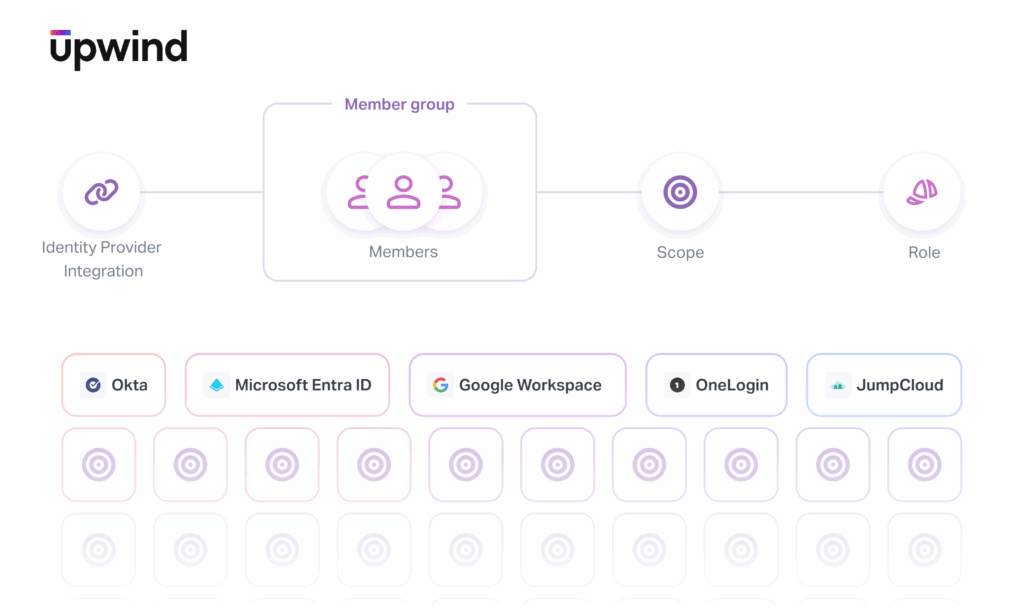
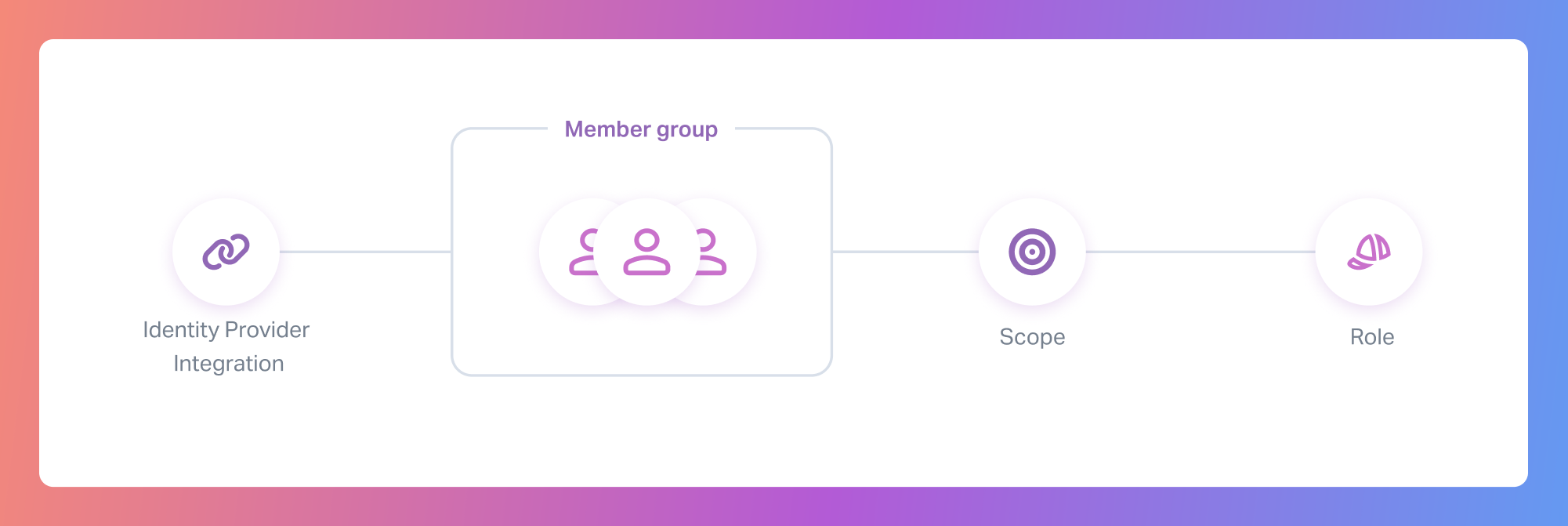
Upwind implements RBAC through a structured, scalable access model designed for enterprise environments. The platform is built around four core components:
- Members: Individual users who have access to the Upwind platform
- Groups: Collections of members who require similar access, such as security or engineering teams
- Roles: The actions users are permitted to perform within Upwind
- Scopes: The specific resources and environments users can access
For example, a user may have an administrative role but be scoped only to specific AWS accounts or environments. This separation of what a user can do (role) from where they can do it (scope) enables precise, contextual access control without role sprawl.
Together, these components provide flexible, secure, and scalable access management across the Upwind platform, supporting both security and compliance requirements.
Why RBAC Often Fails to Deliver at Scale, and How Upwind Delivers
Many platforms offer basic RBAC, but traditional implementations often struggle as organizations grow. Roles multiply, permissions lose context, and access management becomes difficult to reason about, especially in multi-cloud, multi-team environments.
Upwind was designed to address these challenges from the ground up. By pairing RBAC with fine-grained Scopes, Upwind enables organizations to define clear access boundaries aligned with their infrastructure, teams, and operational realities. Scopes allow access to be constrained by account, environment, region, or project, ensuring permissions remain relevant and manageable as the organization scales.
This approach reduces the need for hundreds of static roles while still enforcing least privilege. Combined with Upwind’s runtime intelligence – understanding how workloads behave and what data is accessed – access control stays aligned with how environments actually operate, not how they were originally designed.
Using Access Control in the Upwind Platform
To utilize Upwind’s RBAC capabilities, begin by integrating your Single Sign-On (SSO) service using Security Assertion Markup Language (SAML). Integrating your SSO not only adds users but also enables you to create groups. For organizations who use System for Cross-domain Identity Management (SCIM), Upwind also supports automatic group and user provisioning.
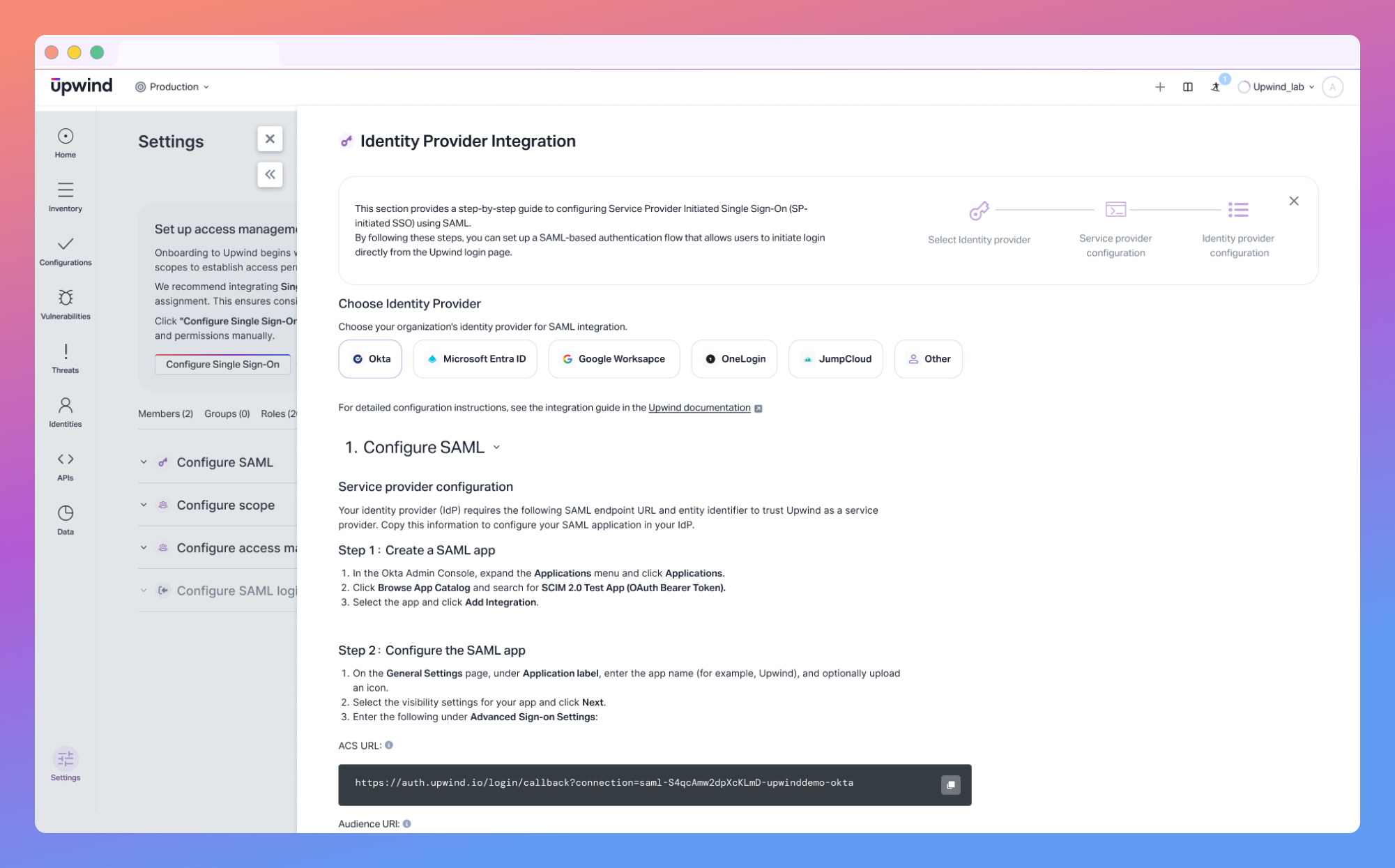
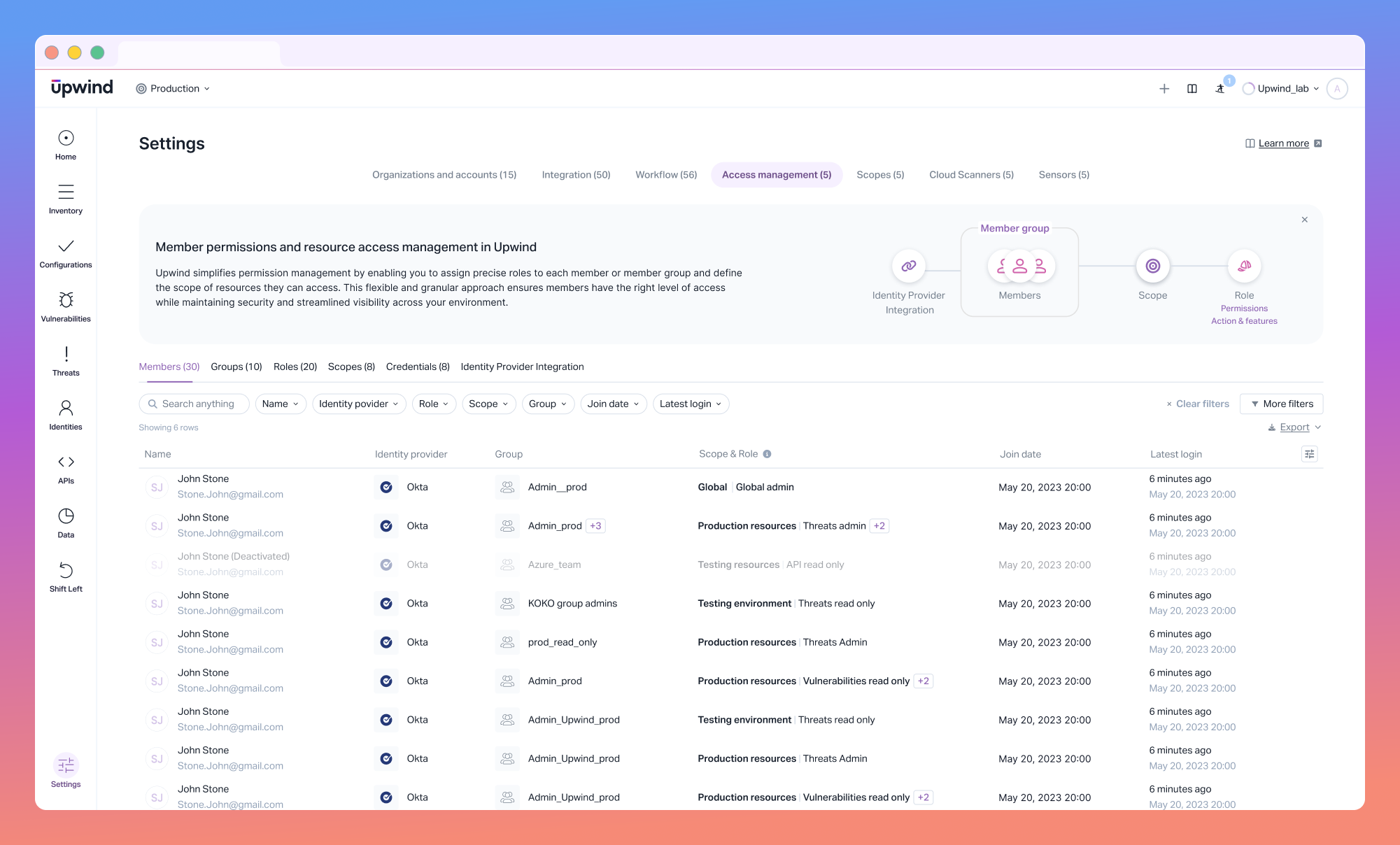
Once SSO has been integrated, you can configure and view groups, roles, and scopes from the settings module and the Access Management tab of the Upwind Platform. In addition, you can drill down into details on every group, role, or scope.
Upwind strengthens and further refines access control with “Scopes”, offering both ready-made and personalized options. To create a custom scope, navigate to the “scopes” area found within the Access Management section and then select “create scope.” A panel will automatically slide out, providing step-by-step instructions for scope creation.
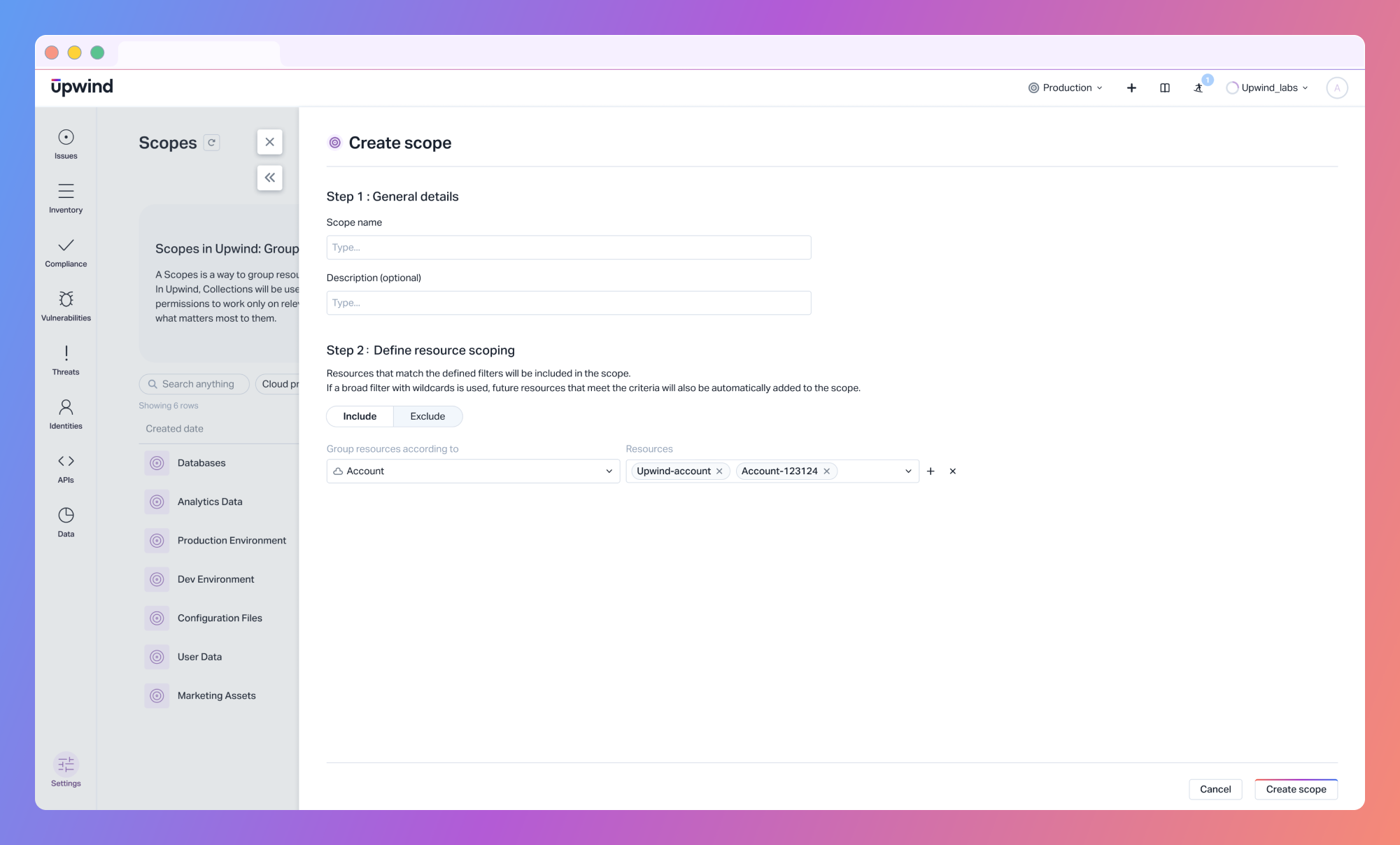
Users associated with a specific scope within the Upwind Platform, will see that scope indicated in the header. Users with multiple scope assignments also have the ability to switch between these scopes directly within the header.

Final Thoughts
Security at scale requires more than basic RBAC, it requires context, flexibility, and alignment with how modern enterprises operate. Upwind delivers a Role-Based Access Control model designed for growth, enabling teams to collaborate securely without unnecessary friction.
By combining RBAC with fine-grained Scopes, Upwind provides precise, dynamic access control that adapts as organizations expand. Whether managing a small number of environments or hundreds of cloud accounts across regions, Upwind ensures users and teams operate with the right level of access at all times.
This is access control built for modern enterprises: contextual, scalable, and designed to work the way teams do.
Learn More
See how Upwind helps enterprises manage access with confidence and precision. Schedule a customized demo with us, or contact us at [email protected].