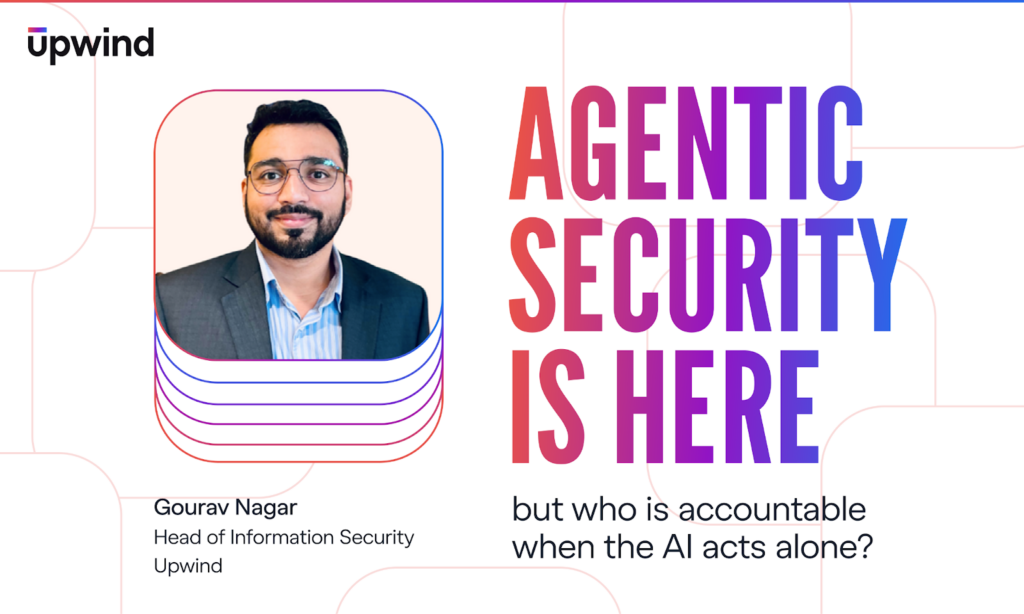

TL;DR: Agentic security is the use of autonomous AI systems that detect, triage, and respond to threats without human intervention, which introduces a new category of operational risk. The most valuable security skill in 2026 is not prompt engineering or AI fluency. It’s consequence engineering: the ability to anticipate what happens when an autonomous system acts on incomplete or incorrect signals, and the judgment to override it when it does.
Introduction
Agentic security has moved from concept to production faster than most of the industry expected. Runtime intelligence can now correlate signals across cloud workloads, containers, and identities in real time and in many cases, act without waiting for a human. An AI agent that detects lateral movement, traces it to a compromised service account, and isolates the affected workload in seconds is operating at a speed where human intervention simply isn’t possible.
That speed is powerful but It’s also where the risk lives.
Early in our agentic security evaluation, someone asked a question that stopped the room: What happens if this fires and it’s wrong?
Not a hypothetical. The agent had real access, real permissions, and real blast radius. It could correlate a suspicious privilege escalation chain and act on it. Isolate the workload, revoke the credential. Impressive capability. But the same action that stops a real attack can take down a deployment pipeline if the signal is wrong.
The guardrails question is harder than it looks. Anomaly detection is only as good as the baseline it’s trained on and a legitimate deployment pipeline running at an unusual hour looks like suspicious lateral movement if the agent has never seen that pattern before. Without explicit boundaries around what the agent is authorized to act on versus escalate, the model makes that call on its own.
The question every team needs to answer before deployment isn’t, can it act? It’s questioning what we have authorized it to act on, what does the anomaly detection treat as ground truth, and what’s the blast radius if it’s wrong.
When your security AI acts autonomously at 2am and kills a production pod, who is accountable? Not in a technical, PR-safe way. Who designed the guardrails? Who defined the boundary between “act” and “alert”? Who validated that the runtime signal being acted on isn’t a false positive caused by a legitimate deployment pipeline? Who decided the confidence threshold that separates automated response from human escalation?
If the answer is “we trust the model,” the organization isn’t running agentic security. It’s running a liability with a dashboard.
What is consequence engineering and why does it matter more than prompt engineering?
Agentic security accountability requires a new discipline that doesn’t yet have a formal name in most organizations. Call it consequence engineering.
Consequence engineering is the practice of designing, validating, and governing the decision logic of autonomous security systems — specifically focused on what happens after a detection, not just whether the detection is accurate.
Detection engineering asks: is this a real threat? Consequence engineering asks the harder question: given that the AI has detected something, what should happen next and what could go wrong with every possible response?
This reframing matters because the failure mode of agentic security is not a missed detection. It’s a correct detection with a wrong response. Or, more specifically, a confident detection that turns out to be a false positive acted on at machine speed.
The shift tracks with a broader pattern. Bernard Marr recently argued in his article Why prompt engineering isn’t the most valuable skill in 2026 that the most valuable AI skill is in fact no longer prompt engineering but the ability to manage and govern autonomous AI workflows. In security, that argument lands even harder: the shift is from detection engineers to consequence engineers — practitioners who understand not just what the AI found, but the blast radius of every possible response.
The hardest part of deploying agentic security is not the detection, it is the consequence model. We learned this at Upwind directly: a scheduled job with elevated privileges triggered a high-confidence lateral movement signature and the system was right about the signal, but the job was a quarterly pipeline with no graceful restart and isolating it mid-run created a partial write condition across three data stores that took two days to reconcile. That experience pushed the team toward what we call consequence engineering: before any autonomous action executes, the system has to answer whether the blast radius of a false positive is acceptable, whether the action is reversible, and whether the target workload has dependencies that make interruption a business event. Those three questions determine whether the system acts or escalates, not the confidence score alone.
How do attackers exploit predictable automation?
Agentic security introduces a paradox: the more consistent and predictable an autonomous system’s responses are, the easier it becomes for a sophisticated adversary to reverse-engineer those responses and move around them.
Adversarial exploitation of security automation is the practice of deliberately probing, mapping, and evading the decision logic of autonomous detection and response systems.
If an agentic security system auto-isolates workloads when it detects high-confidence lateral movement, a patient attacker can use low-confidence activity to map the system’s blind spots and thresholds. The automation’s predictability becomes a vulnerability.
This is not theoretical. In the SUNBURST campaign, the threat actor waited 14 days before initiating its first command-and-control call — specifically so that initial compromise logs would age out or be deleted before post-breach activity began, making automated correlation across those events nearly impossible. That kind of patience and awareness of defender tooling is exactly the adversarial imagination that security teams need to develop internally.
The line between auto-act and escalate is simpler than it sounds: let automation act freely in lower environments where there is no business impact, but the moment an action risks revenue loss or service disruption, a human has to be in the loop. A false positive that takes down an ephemeral dev workload is a non-event. The same action against a payment orchestrator or a customer-facing service is an outage, and an outage you caused yourself is harder to explain than the threat you were responding to. This is the core idea behind the Autonomous Response Boundary: matching detection confidence to action reversibility to operational context. All three have to align before automation acts on its own, and when they don’t, the system escalates, because no confidence score is worth a self-inflicted business disruption.
On my team, we learned that stress-testing your own automation is not optional, it is the job. The most valuable red team exercise is not breaking past detections but triggering them deliberately and then avoiding them, because that is what a patient adversary does. When evaluating any agentic security tool, the first question we ask is what happens when someone probes its decision boundary at low confidence over time? This is an important step because a predictable system can be mapped and walked around.
Why does better visibility make complacency more dangerous?
Here is the uncomfortable nuance: the better runtime intelligence gets, the more tempting it becomes to let it run without oversight.
When a platform can observe process-level behavior, network calls, file system changes, and identity activity all correlated in real time, the signal quality is extraordinary compared to what teams were working with even three years ago. False positives drop and confidence scores climb.
And that is precisely when complacency sets in.
The attacks that break through best-in-class security programs in 2026 are not brute force. They are behavioral, slow, and designed to look normal until they aren’t. They are built by adversaries who understand that modern security stacks are trained on patterns and that novel behavior, executed carefully, won’t trip those patterns until it’s too late.
Runtime security complacency is the operational risk that emerges when high-quality automated detection reduces human scrutiny of the signals and decisions that the system produces.
The human skill that counters this is not prompt engineering. It is contextual skepticism — the ability to look at a clean signal from a highly capable system and still ask: what am I not seeing? What would this look like if someone had specifically designed it to appear clean to my detection layer?
That requires domain depth, adversarial thinking, and institutional knowledge of how a specific environment behaves under normal conditions. It is a practitioner skill, not a model skill.
What skills do security teams need alongside agentic AI?
The conversation in most organizations is about using AI to do more with less — closing the analyst gap, reducing mean time to respond, handling alert volume. That’s a legitimate use of agentic security.
But the parallel conversation that most organizations are not having is about what kind of humans are needed alongside the AI, and what those humans need to be exceptionally good at.
It’s three capabilities:
Workflow architecture. Understanding how agentic security systems chain decisions together, where human judgment is embedded in those chains, and where the guardrails live. The ability to audit the decision logic, not just the outcome.
Failure mode fluency. Knowing, in advance, what a bad autonomous decision looks like, how to detect it, and how to roll it back. Organizations that deploy agentic security without documented failure modes are one high-confidence false positive away from an incident they caused themselves.
Adversarial imagination. The willingness to think like an attacker who knows the target is running AI-driven security. What would they probe? What would they deliberately miscategorize? Where is the automation predictable enough to exploit?
Decision accountability. Knowing who owns an autonomous action after it executes and how to explain it when the outcome was wrong. AI can act in milliseconds. The human accountability for that action does not disappear, and the teams that understand that build very different oversight practices than the ones that don’t.
The real shift
The industry is moving from instructing AI to orchestrating it. But in cloud security, orchestrating an autonomous system that can make real, irreversible decisions about infrastructure is both a technical and an ethical responsibility.
The most valuable security skill in 2026 is not knowing how to talk to AI. It is knowing when to distrust it, when to question it, and being skilled enough to act when you do.
The teams that build that muscle will be the ones that catch the attacks the AI was specifically designed to miss.
Gourav Nagar is Head of Information Security and IT at Upwind, where he leads security operations, incident response, and the development of security programs across cloud-native environments. He writes about cloud security, runtime intelligence, and the evolving relationship between human judgment and automated defense.