API Security Is a Cloud Runtime Problem: Why Endpoint-Only Approaches Fail in Modern Environments

TL;DR: API security was designed for a world where APIs were stable, documented endpoints sitting in front of monolithic applications. In cloud-native environments, APIs are dynamic connective tissue between workloads, identities, and data stores and securing them requires runtime visibility across the full cloud stack, not endpoint-level controls alone.
Introduction
API security has received significant and well-deserved investment over the past decade. Entire product categories emerged around API discovery, governance frameworks matured, and OWASP guidance gave security teams a practical starting point. Those efforts raised the baseline across the industry, and they mattered.
But the incidents keep coming. And when you examine how modern API breaches actually unfold, a pattern emerges: the API itself wasn’t the gap. It was actually the environment around it.
That disconnect is the core problem this post explores and it has implications for how security teams should think about API protection going forward.
Why did traditional API security work and when did it stop?
The original model for API security emerged when APIs were relatively static and predictable. They were documented, managed through gateways, and changed slowly enough that periodic discovery and scanning were effective. Security teams could inventory endpoints, validate authentication logic, and run compliance checks against known vulnerabilities. If an API passed those checks, the assumption was that it was reasonably secure.
Cloud-native architecture broke that assumption.
Today, APIs operate inside distributed systems composed of microservices, serverless functions, ephemeral workloads, and constantly rotating identities. New endpoints appear as services scale, internal APIs vastly outnumber external ones, and deployment cycles happen dozens of times per day, often without any centralized inventory keeping pace.
In that environment, discovery tools chase infrastructure that is constantly changing. Governance programs document APIs that may only exist briefly and periodic scans capture snapshots of systems that look completely different hours later.
This isn’t a failure of the teams implementing those controls, but a reflection of a fundamental shift in how applications are built and how systems behave at runtime.
What makes modern API attacks so hard to detect?
What distinguishes modern API attacks from traditional exploits is that they rarely look like attacks at the request level.
A runtime API attack is a sequence of technically valid requests that becomes malicious only when evaluated against the workload’s behavioral baseline and the relationships between the services involved.
The request is well-formed, the token is legitimate and the endpoint responds exactly as designed. The problem is context and that’s something that endpoint-level tools were never built to evaluate.
Consider two recent examples.
In the 2023 T-Mobile data exposure, attackers used an API to retrieve information on tens of millions of customers. The API accepted properly structured queries and returned expected responses. No obvious exploit was embedded in the request itself. What made the activity malicious was the pattern and scale of the behavior. This is something that becomes visible only when the system understands the broader environment the API operates within.
A similar dynamic appeared in the 2022 Optus breach. A customer data API endpoint was accessible externally without sufficient contextual protections. The requests were technically valid. The failure was not a broken endpoint but a lack of awareness about who should be calling it and under what conditions.
This is increasingly how API incidents unfold. Each individual request appears normal, but the broader behavior is anomalous: a workload calling APIs it has never interacted with before, an identity token accessing data stores outside its historical pattern, or a microservice quietly expanding its communication graph across the environment.
These signals are detectable, but only when security tools can see the relationships between workloads, identities, APIs, and data at runtime.
How does runtime visibility change API security?
To understand why runtime context matters, consider what an API call actually represents inside a cloud environment.
Every API interaction simultaneously connects several components: the workload initiating the request, the identity used for authentication, the network path the request travels, and the data resources the API can reach. The API is the visible interface where those elements intersect.
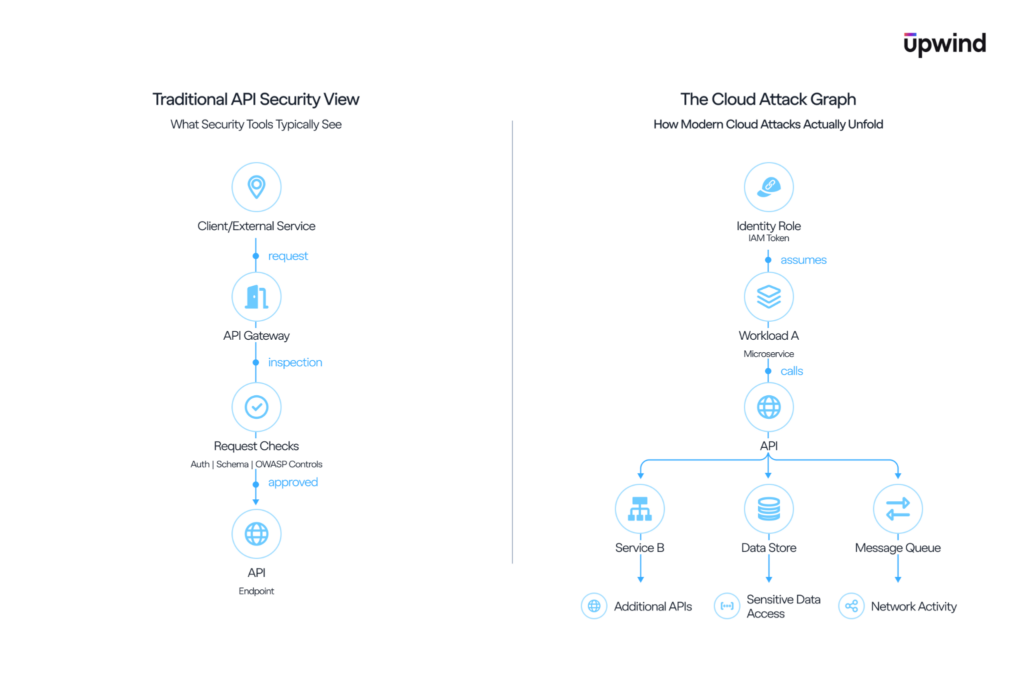
When security tooling focuses only on that interface, it misses the relationships that determine whether the behavior is legitimate.
Those relationships already exist within the cloud security stack. Modern cloud-native application protection platforms (CNAPPs) observe workload behavior, identity activity, network communications, and data access patterns across the entire environment. When API visibility is integrated into that runtime view, security teams begin to see sequences of activity rather than isolated requests.
Runtime API security is the practice of evaluating API behavior within the full context of the cloud environment, including workload state, identity patterns, network paths, and data access, rather than analyzing requests in isolation.
Instead of analyzing a single API call on its own, the system can recognize that a workload assumed a specific identity, called an API it had never used before, and then accessed a sensitive data store outside its normal pattern. That sequence tells a story that none of the individual signals could reveal independently.
This is where API security stops looking like a standalone category and starts functioning as a natural extension of cloud runtime security.
What does the convergence of API and Cloud security mean for teams?
Over the past several years, organizations invested heavily across adjacent security categories: API security tools, CSPM platforms, workload protection, identity security, and data protection technologies. Each addressed a legitimate slice of the cloud attack surface. But when those tools operate independently, they fragment the very context needed to detect real attacks.
Connecting those signals into a unified platform changes the equation. Security teams move from chasing individual alerts to understanding behavioral patterns that span the system. And attacks, almost without exception, are patterns, not single events.
This convergence becomes even more critical as AI-driven applications proliferate. Every LLM interaction, tool invocation, and data retrieval ultimately flows through APIs. The emerging AI attack surface is an API surface with entirely new semantic risks layered on top. Organizations still treating API security as an endpoint problem may find themselves overwhelmed by that complexity. Those treating APIs as part of the cloud runtime graph will have a far clearer view of how their systems behave and where real risk emerges.
The question security teams should be asking
The more useful question for security teams is not whether they have API security coverage.
It is whether their security platform understands what their APIs are connected to. Meaning, which workloads call them, which identities authenticate to them, which data stores they can reach, and how all of that behaves at runtime.
Once those relationships become visible, many of the attacks that currently look like normal traffic start to look exactly like what they are.