Drive Remediation, Show Progress: A New Way to Measure Cloud Security Posture

You’ve invested in security tools and surfaced thousands of findings. Yet, when the board asks if the organization’s cloud risk is improving, the answer is a number without a story. When you need engineering to prioritize fixing issues, your request competes with every other item in an already-strained backlog.
Finding issues isn’t the problem. The challenge lies in driving fixes across teams you don’t directly manage and demonstrating the program’s measurable impact to leadership.
Upwind’s Compliance Score, Security Score, and Security Journey close this gap. They give cloud security leaders the data to prioritize and enforce fixes across engineering, the clear compliance measurements to satisfy auditors and regulators, and the view to show measurable progress to every stakeholder who needs proof that security investment is working.
Compliance Score: The Number Your Auditor Needs
Before addressing risk reduction, you must answer a basic question: how compliant are we? The Compliance Score provides a clean percentage of the ratio of assets free of configuration findings to all scanned and applicable assets, limited to the frameworks your organization cares about. Select one or more frameworks, filter by cloud account, and watch the score update immediately.
View compliance at the organizational level, per framework, or per cloud account. When an auditor asks about CIS coverage across your production accounts, or your GRC team needs SOC 2 posture by business unit, the answer is instantly available without manual spreadsheet work.
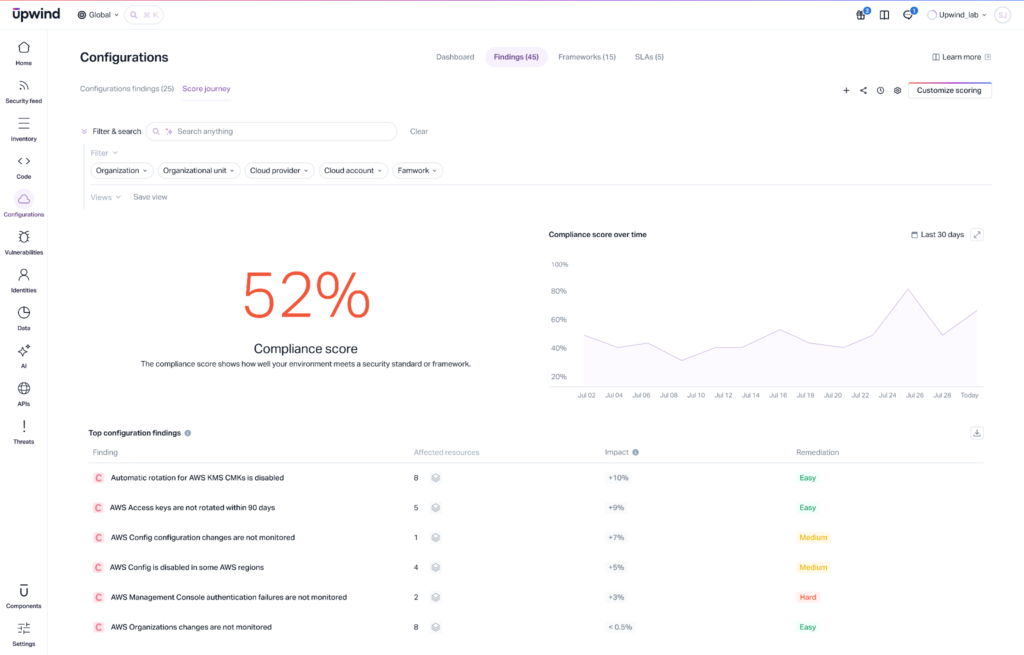
This is a reliable, framework-aligned number you use in an audit, a regulatory review, or a board meeting when the topic is adherence. It perfectly complements the Security Score, which answers a completely different question.
A Security Score Built on What’s Actually Running
Most cloud security tools assign findings to static severity ratings and stop there. These ratings describe the finding itself, but say nothing about the affected resource’s context: Is it external facing Does it handle regulated data? Is it an unused asset in a sandbox account? When every finding is labeled with the same urgency, engineering teams lack the signal to prioritize what to fix first, and your program loses trust because everything is “critical.”
The Security Score changes this calculation. Upwind Research weights each finding by severity, asset context, exposure, and additional risk signals so the score reflects actual risk reduction across your environment.

Each finding clearly shows how many points it costs your score and how much is recovered upon resolution. This gives your teams a shared language for prioritization driving faster remediation for the risk that matters most.
The Security Journey: Show Your Program’s Impact
A score only tells part of the story. The Security Journey tracks your Security Score over time and shows the top findings that held it back at each point. Filter by cloud provider, account, framework, or issue category to look closely at a specific business unit, a compliance framework under audit, or a risk area your program has been actively working to reduce.
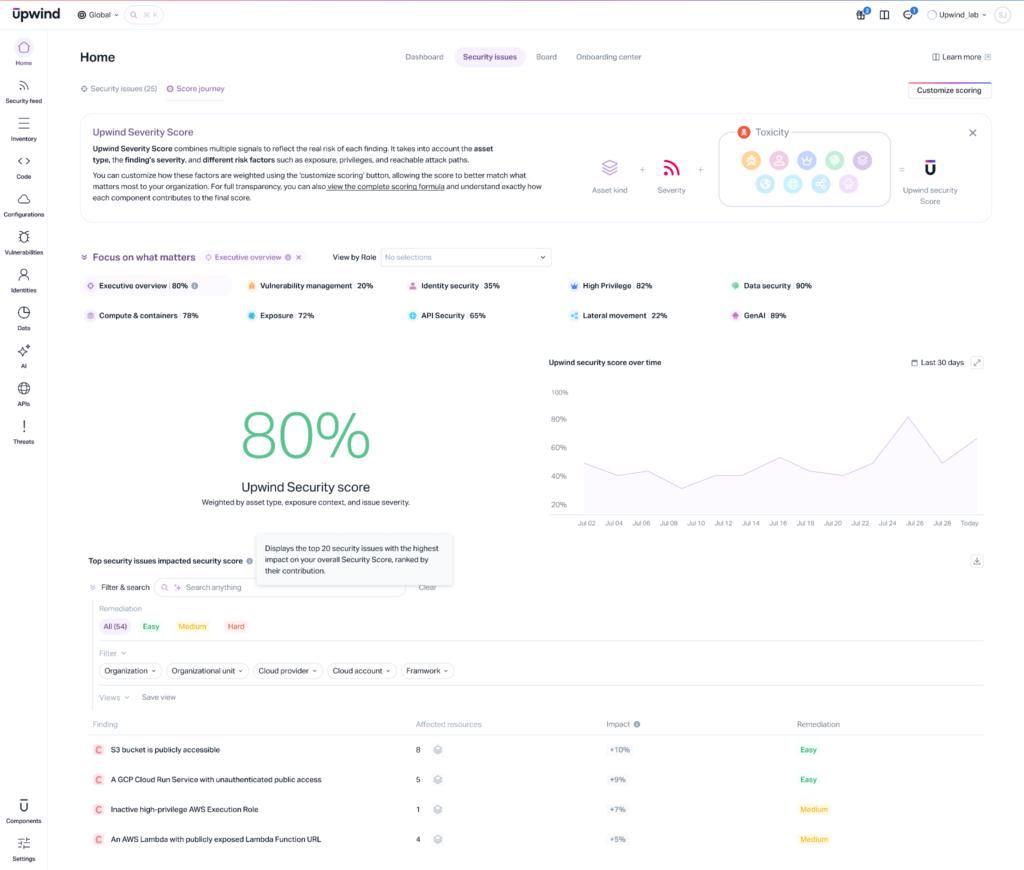
For leaders reporting to the board or justifying next year’s budget, this is the document that turns a point-in-time number into a reliable narrative: Here is where the program stood last quarter, here is what your teams fixed, and here is where you are focused next.
When teams across the organization can see their own contributions reflected in the score, fixing issues shifts from a top-down order to a shared operational priority and your program gains the cross-functional support that sustains long-term improvement.
Why It Matters
Most tools scan periodically, assign static severity, and hand the resulting chaos to security to sort out. Upwind starts from runtime, scores based on real exposure, shows every team exactly what each fix is worth, and gives the entire organization a timeline of progress from the platform engineer who shipped the fix to the executive evaluating the program’s return on investment.
See It In Action
If your current tooling gives you scores without the story behind them or findings without a way to prioritize effectively, see what a runtime-grounded Security Score and Journey look like against your actual environment.
If you’d like to see how this fits into your cloud security program — or explore how Upwind helps you prioritize risk, drive remediation across teams, and demonstrate progress to leadership — schedule a customized demo with us.
We’ll walk through your use cases, integrations, and security goals to show how Upwind delivers actionable cloud security at scale.