


In the past decade, the cloud revolution evolved into a major movement – one that introduced a new and complex attack surface. Attackers are increasingly targeting public cloud environments, leveraging misconfigurations and native cloud features to gain initial access, establish persistence, and achieve their malicious objectives.
In this article, we dive into attack vectors in Azure environments, common exploitation techniques, and the critical role of cloud native logging mechanisms, specifically Microsoft Entra ID and Azure Activity logs.
Understanding Azure Structure
The Azure environment is fundamentally a hierarchy of control and resources, governed by the Resource Manager control plane.
The Azure environment has two main layers, Cloud Infrastructure and Identity Management. These are made up of key Azure-specific components, including:
- Microsoft Entra ID: Manages users, groups, applications, and permissions mechanisms.
- Tenant: The top-level identity boundary in Azure that represents an organization.
- Management Group: A container for multiple subscriptions, managed under the tenant. Controls assigned here grant influence over all contained subscriptions.
- Subscription: A logical container linking Azure services to an account, which defines billing and security boundaries.
- Resource Group: Logical scope for applications, operations and permissions.

Access to all resources is managed through Role-Based Access Control (RBAC), which defines permissions at various scopes. Identity permissions in Microsoft Entra are managed at the tenant level and can impact access across all subscriptions within the tenant.
From Initial Access to Exfiltration: What Does an Attacker’s Path Really Look Like?
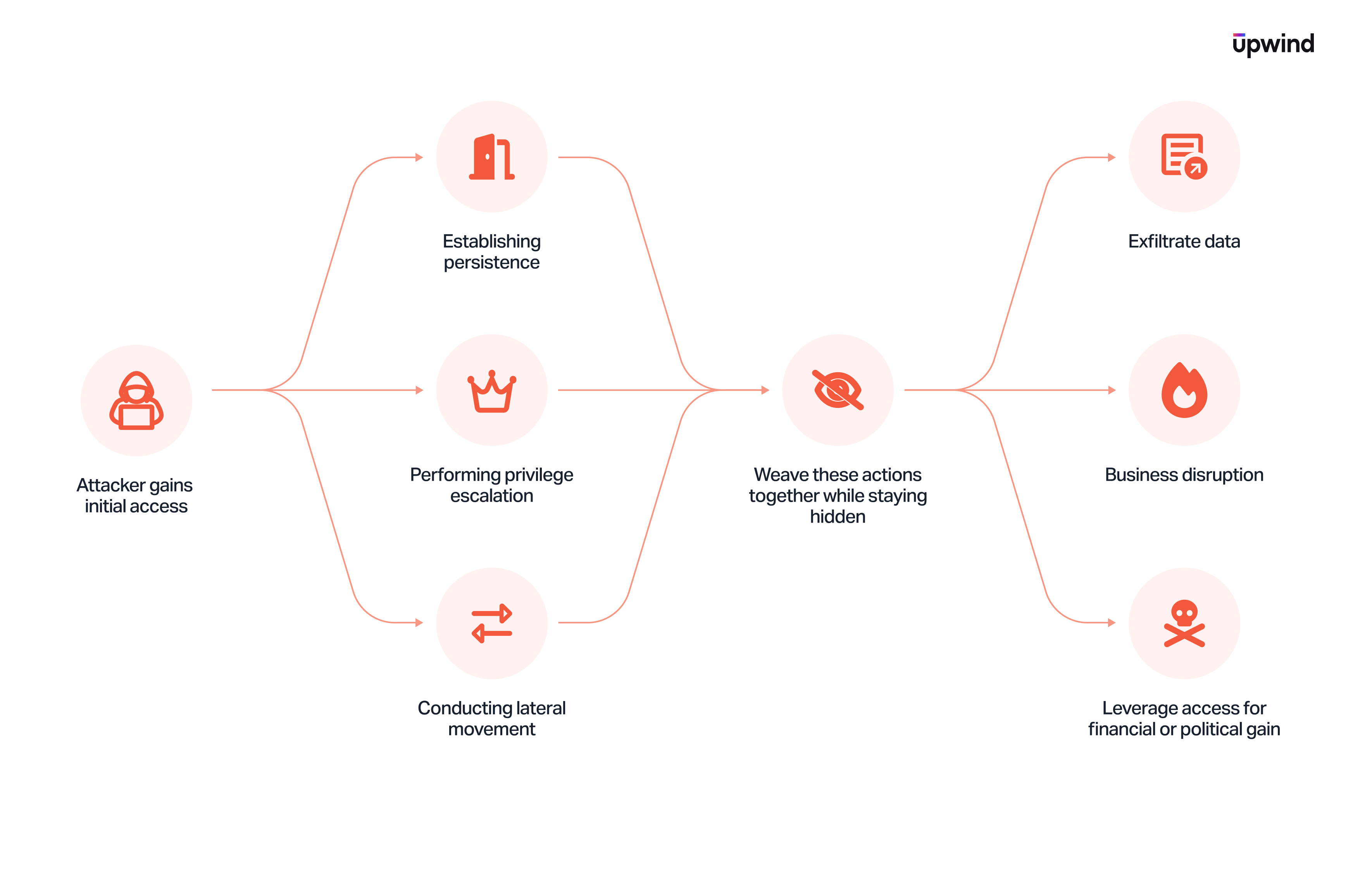
Understanding how attackers progress through an environment is essential for building any real defense strategy. Every intrusion, whether sophisticated or opportunistic, follows a sequence.
First, the attacker must gain initial access.
Once inside, they expand their foothold by establishing persistence, performing privilege escalation, and conducting lateral movement to reach more valuable systems.
Skilled adversaries weave these actions together while using defense evasion techniques to stay hidden.
And while the methods vary, the end goal rarely does: attackers typically want to exfiltrate sensitive data, cause business disruption, or leverage their access for financial or political gain.
A clear example of this full attack path is the DEV‑0537 Group intrusion, also known as LAPSUS$. In this campaign, the actor gained initial access primarily through stolen or compromised credentials, often sourced from brute-force activity, password spraying, or previously leaked credentials. Once inside the environment, they established deeper control by enumerating users and resources, assigning elevated roles, and creating or modifying accounts to grant themselves persistent administrative access.
Lateral movement was achieved by abusing legitimate remote access tools and management interfaces, allowing them to pivot between systems, access additional workloads, and reach high-value targets while appearing as normal administrative activity. Throughout this process, they carefully maintained persistence and minimized detection by blending into expected identity and access patterns. Their ultimate objective was large-scale data exfiltration and destruction, targeting sensitive business data such as intellectual property, financial records, customer information, and internal operational documents, before in many cases deleting backups and disrupting systems to maximize operational impact and complicate recovery.
But not all attacks rely on long, stealthy chains of techniques. Some aim for immediate, large-scale impact. A striking example is the largest DDoS attack ever recorded against Microsoft Azure, where the adversary attempted to overwhelm Microsoft infrastructure with traffic equivalent to streaming 3.5 million Netflix movies at once. In these cases, attackers skip the slower progression of privilege escalation or lateral movement and instead focus directly on service disruption.
Both extremes, complex identity-based intrusions and brute-force infrastructure attacks, reinforce the same reality: defenders must be prepared not only to prevent initial access but also to detect and respond to attacker behavior throughout every stage of the kill chain.
Upwind’s Azure Detection Engine
Upwind’s Azure Detection Engine helps security teams detect suspicious activity and potential threats by continuously analyzing Entra ID operations, RBAC changes, and resource activity across subscriptions and resource groups. By correlating log data with contextual insights and risk prioritization, Upwind enables teams to identify high-risk actions and misconfigurations before they lead to larger breaches.
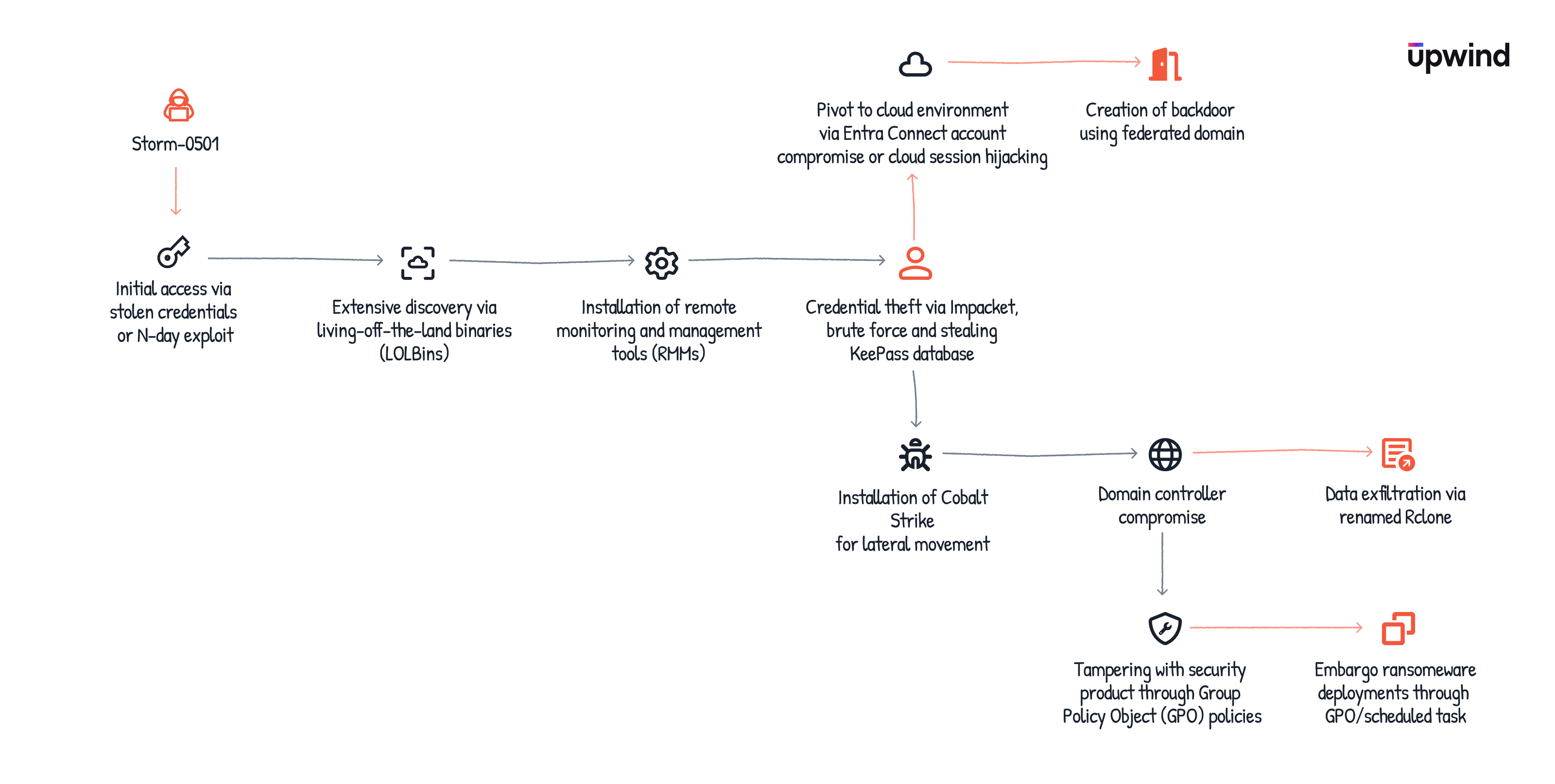
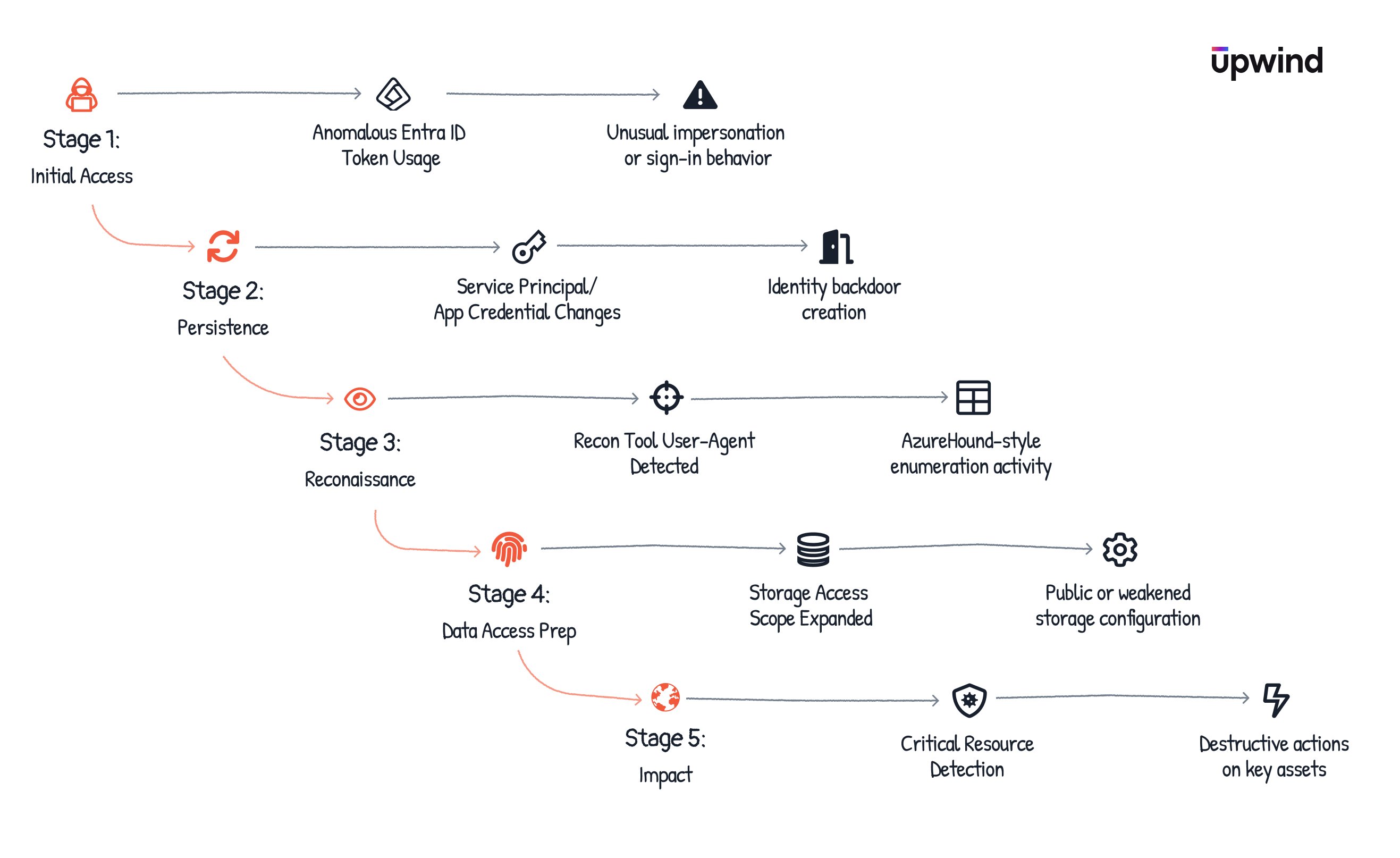
Let’s take the Storm‑0501 attack path and examine how most of its stages could have been detected using the Upwind Azure Detection Engine. Storm‑0501 was a financially motivated threat campaign that targeted Azure and hybrid cloud environments by abusing compromised credentials to gain initial access, followed by rapid reconnaissance, privilege expansion, and exploitation of cloud resources.
This progression, from credential compromise and environment discovery to privilege expansion and data access, closely reflects real-world cloud attack behavior and demonstrates how cloud-native telemetry can be used to identify each phase of the intrusion.
Real-World Attack Detection: Stopping Storm-0501
Stage 1: Initial Access Detection
The attackers gained their first foothold by using compromised hybrid identities and Entra Sync accounts to authenticate into Azure, effectively bypassing many perimeter controls and blending in as legitimate users. Upwind could detect this by flagging anomalous or risky use of Entra ID actor tokens, like sign‑ins or token usage that deviate from normal patterns or occur from unfamiliar IPs or geolocations.
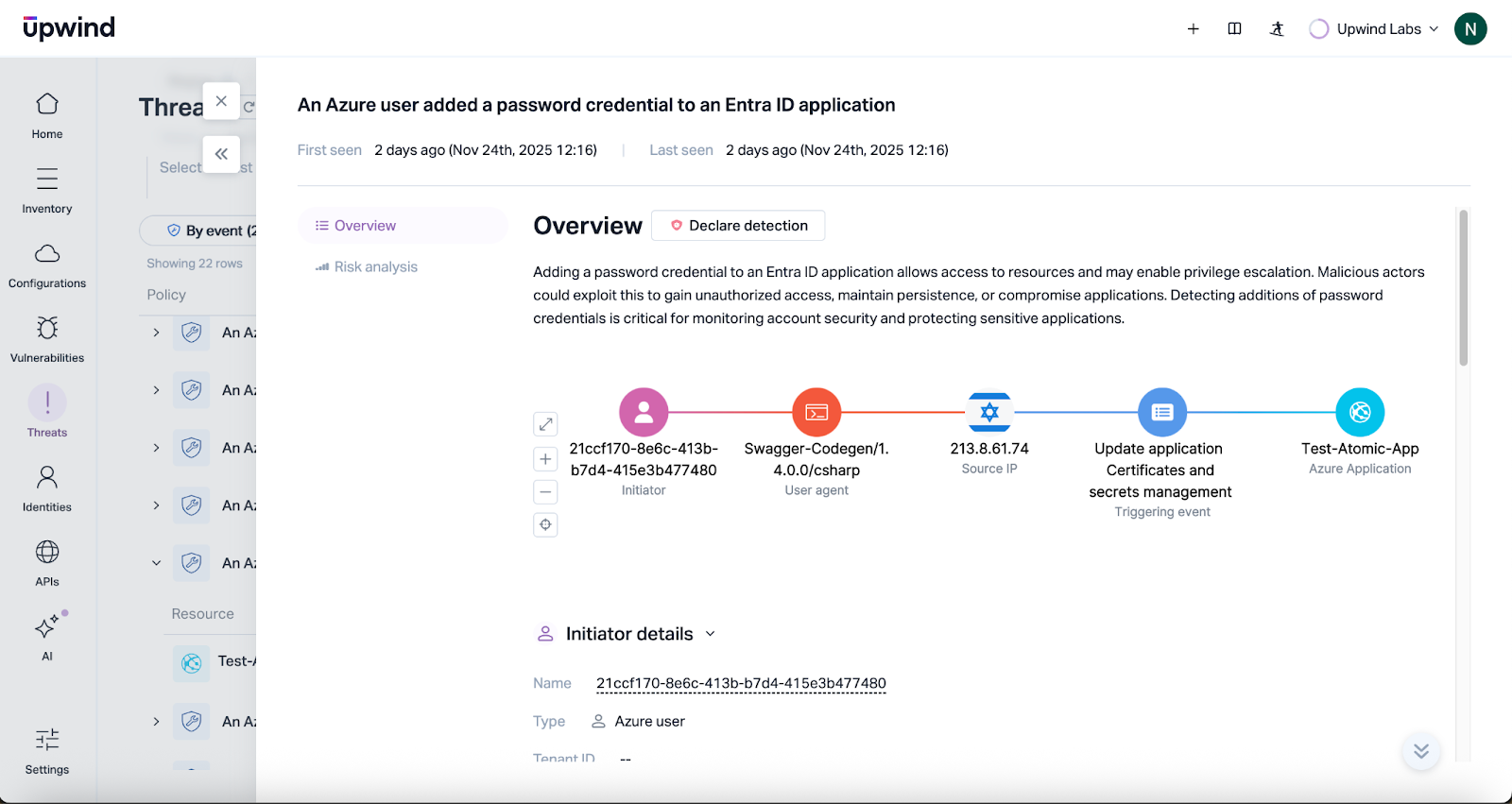
Stage 2: Persistence via Identity Backdoor
To maintain long-term access, the attackers created persistent identity backdoors by modifying service principals and updating identity objects. Upwind could detect such identity infrastructure modifications, like changes to service principal ownership or application-level permissions, helping identify hidden backdoor identities before they are misused.
Stage 3: Environment Reconnaissance
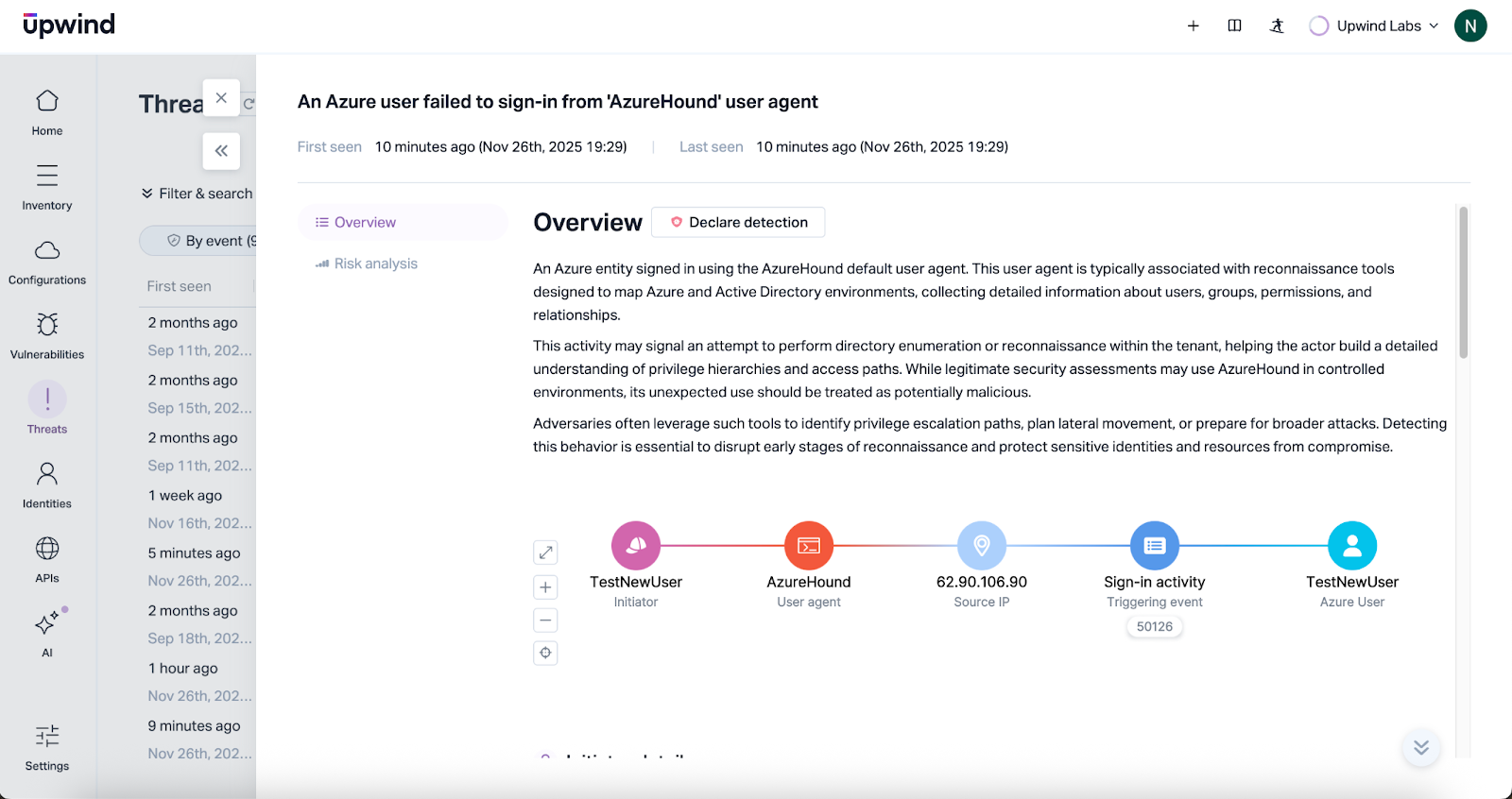
Once inside, the attackers performed reconnaissance using AzureHound, a tool designed to map relationships and permissions in Azure environments and consequently find potential attack paths and escalations. Upwind detects activity characteristic of reconnaissance tools, including AzureHound, marking unusual or bulk metadata queries as potentially malicious.
Stage 4: Preparation for Data Access
The adversaries adjusted storage or resource configurations to make data extraction easier, for example, by weakening access controls or exposing storage accounts publicly. Upwind could catch such misconfigurations or exposure events, like alerting when storage accounts are made public.

Stage 5: Impact and Destructive Actions
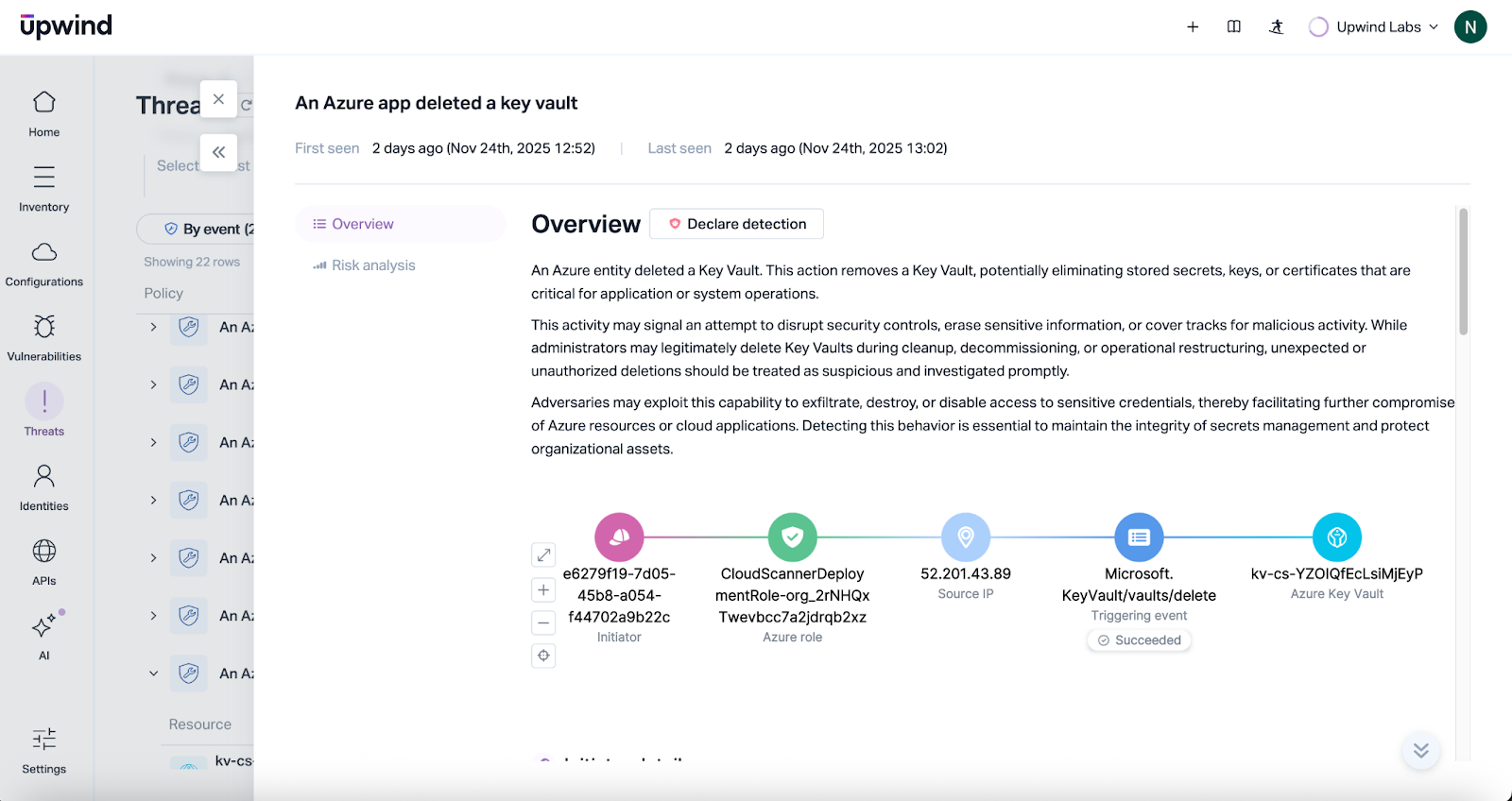
In the final phase, the attackers destroyed critical resources, deleting VMs, key vaults, networks, or other infrastructure, to disrupt operations, hinder recovery, and amplify impact. Upwind detects these destructive operations by tracking deletion or removal events across critical resource types, signaling a probable active attack or ransomware‑style activity.
Safeguard Your Azure Environment with Upwind
The Azure breaches of recent years, including Storm-0501, Midnight Blizzard, and Lapsus$, share a troubling reality: the telemetry needed to detect these attacks existed in Azure logs from the first moment of compromise. Organizations were generating the right data but lacked the capability to transform that data into timely, actionable insights.
Upwind’s Detection Engine addresses this fundamental challenge through purpose-built detections that understand Azure attack patterns, contextual correlation that reveals attack chains hidden in noise, and risk-based prioritization that focuses security teams on genuine threats. The detections described in this article represent real attack techniques used against some of the world’s largest companies, and Upwind is designed to provide the advance warning security teams need to stop breaches before they escalate.
Ready to see how Upwind protects Azure environments from advanced threats? Schedule a demo to experience our Detection Engine in action.