
We’re excited to announce that Upwind now supports the NIST Cybersecurity Framework, giving organizations a faster and more effective path to achieving compliance across their environments. With this release, all Upwind customers can map their entire cloud and containerized infrastructure to NIST controls in a single day, gaining instant visibility into alignment, gaps, and risk.
By combining automated posture checks, configuration mapping, and contextual risk analysis, Upwind helps teams accelerate time-to-value, transforming NIST compliance from a lengthy, manual process into an actionable, continuously validated part of their operations.
What Is NIST and Why is It Hard To Implement?
The NIST Cybersecurity Framework is one of the most trusted and widely adopted standards for managing cybersecurity risk. It’s structured around five key functions, which together provide a comprehensive foundation for understanding, managing, and improving security posture.
For many organizations, NIST is a foundation for broader compliance initiatives such as FedRAMP, ISO/IEC 27001, and SOC 2. However, traditional methods of implementing NIST controls often rely on manual assessments and spreadsheets. These point-in-time approaches fail to keep pace with modern cloud environments, where assets, permissions, and configurations change constantly.
Upwind addresses this challenge by delivering automated mapping and continuous monitoring for NIST-aligned controls.
Within the same day of installation, organizations can:
- Connect their environments
- Run a complete evaluation
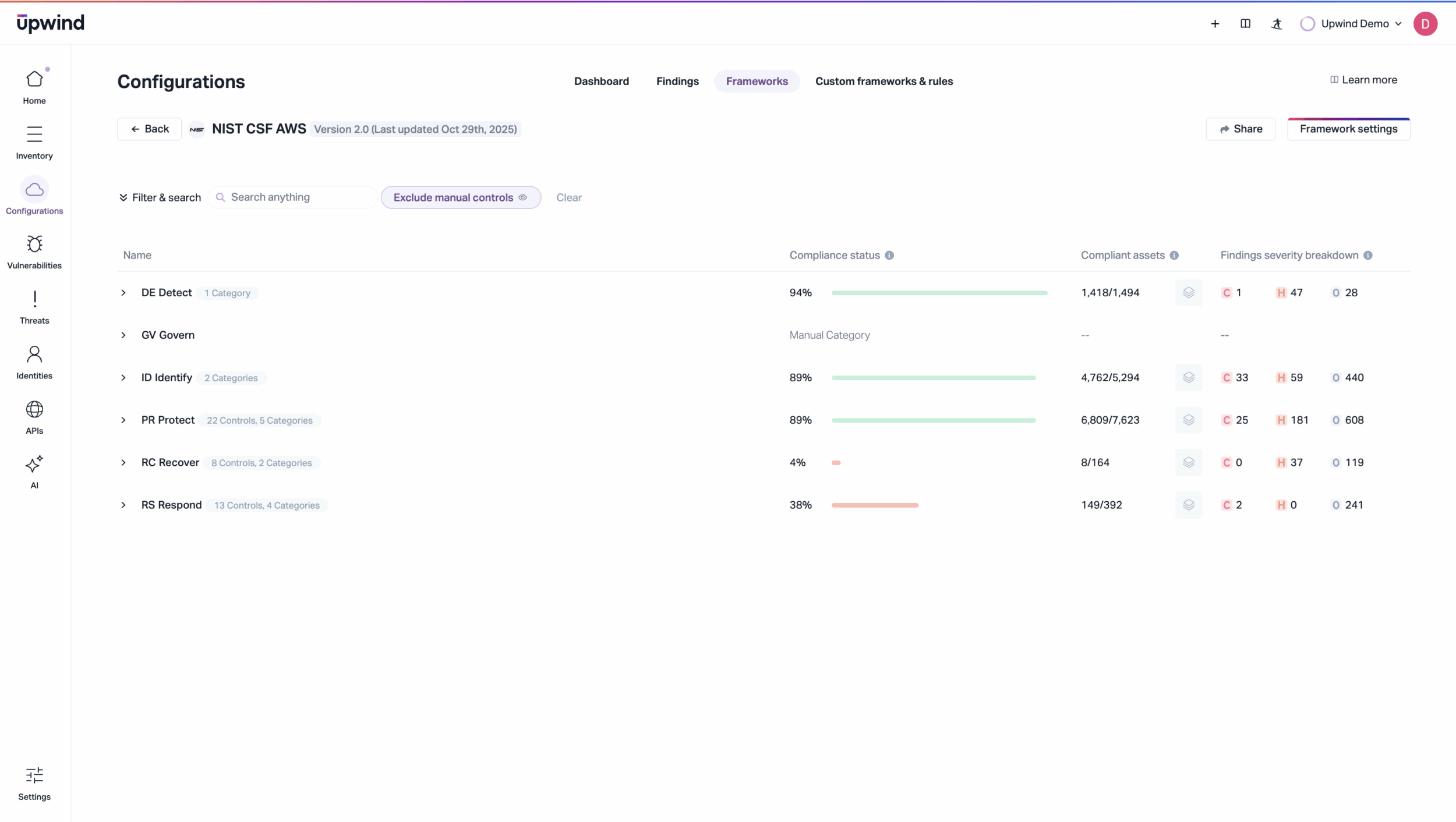
- See exactly how their posture aligns with each NIST function
- Receive prioritized recommendations for improvement
Faster, Actionable Compliance Through Automation
Upwind’s NIST support enables organizations to move from reactive, manual compliance work to proactive, continuous assurance. Once connected, the platform automatically discovers assets, permissions, and configurations, mapping them to NIST’s categories and subcategories without requiring custom setup or external integrations.
”We don’t just want to tick compliance boxes. We want to build real security for the specific risks our business faces. Upwind makes that possible.”
-Wojciech Syrkiewicz-Trepiak, VP Security, Spacelift
Security and compliance teams can view their current alignment in real time, understanding which controls they are compliant with, which need attention, and how posture has changed over time. This instant visibility not only accelerates audit readiness but also helps teams focus resources on the areas of greatest impact.
Because Upwind combines configuration checks with contextual insights, findings are presented with business relevance and remediation guidance, turning compliance data into clear, prioritized action.
Example Checks in Action
Upwind’s NIST support includes a growing library of automated checks that translate framework requirements into practical detections. These checks identify real risks across workloads, configurations, and identities while mapping each issue to its corresponding NIST control, such as:
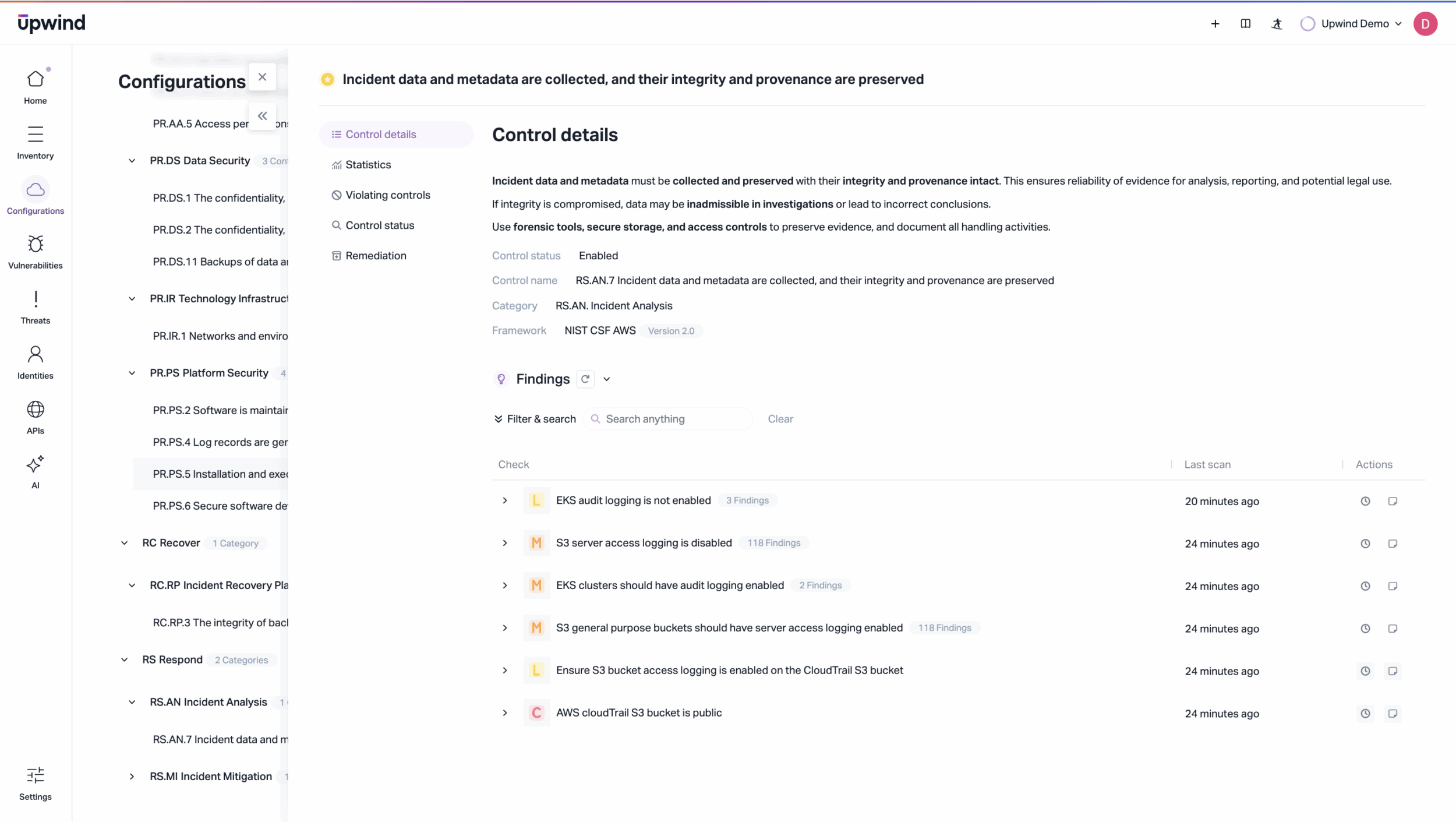
- Ensuring audit logs are enabled in order to preserve the integrity of incident data and metadata.
- Without comprehensive audit logs, incident response becomes guesswork. Enabling audit logs ensures every action is traceable and verifiable, allowing security teams to detect anomalies, prove compliance, and maintain trust in the integrity of their systems.
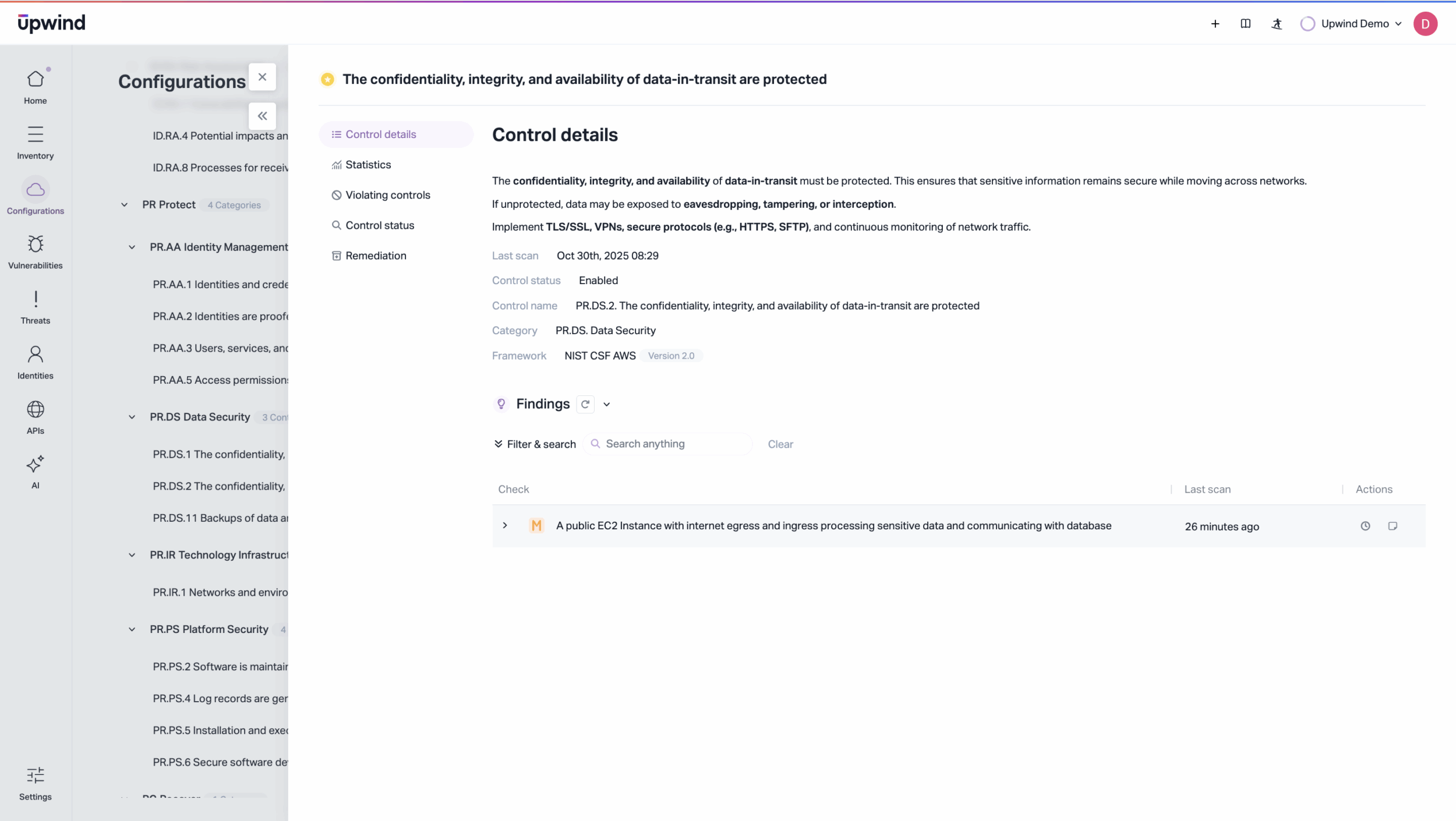
- Ensuring the confidentiality of data in transit is protected.
- Without proper encryption and network controls, sensitive data moving between systems is exposed to interception and tampering. By identifying unsecured public instances and unencrypted connections, organizations can prevent data leakage, maintain compliance, and ensure that critical information remains private and trustworthy as it travels across networks.
- Ensuring computing environments are continuously monitored for potentially adverse events.
- When a public EC2 instance stores sensitive data locally, it creates an open door for attackers to access credentials, personal information, and internal secrets. Proactive monitoring and secure configuration reduce this risk — helping teams detect misconfigurations early, isolate sensitive assets, and maintain the integrity of their environment before an incident occurs.
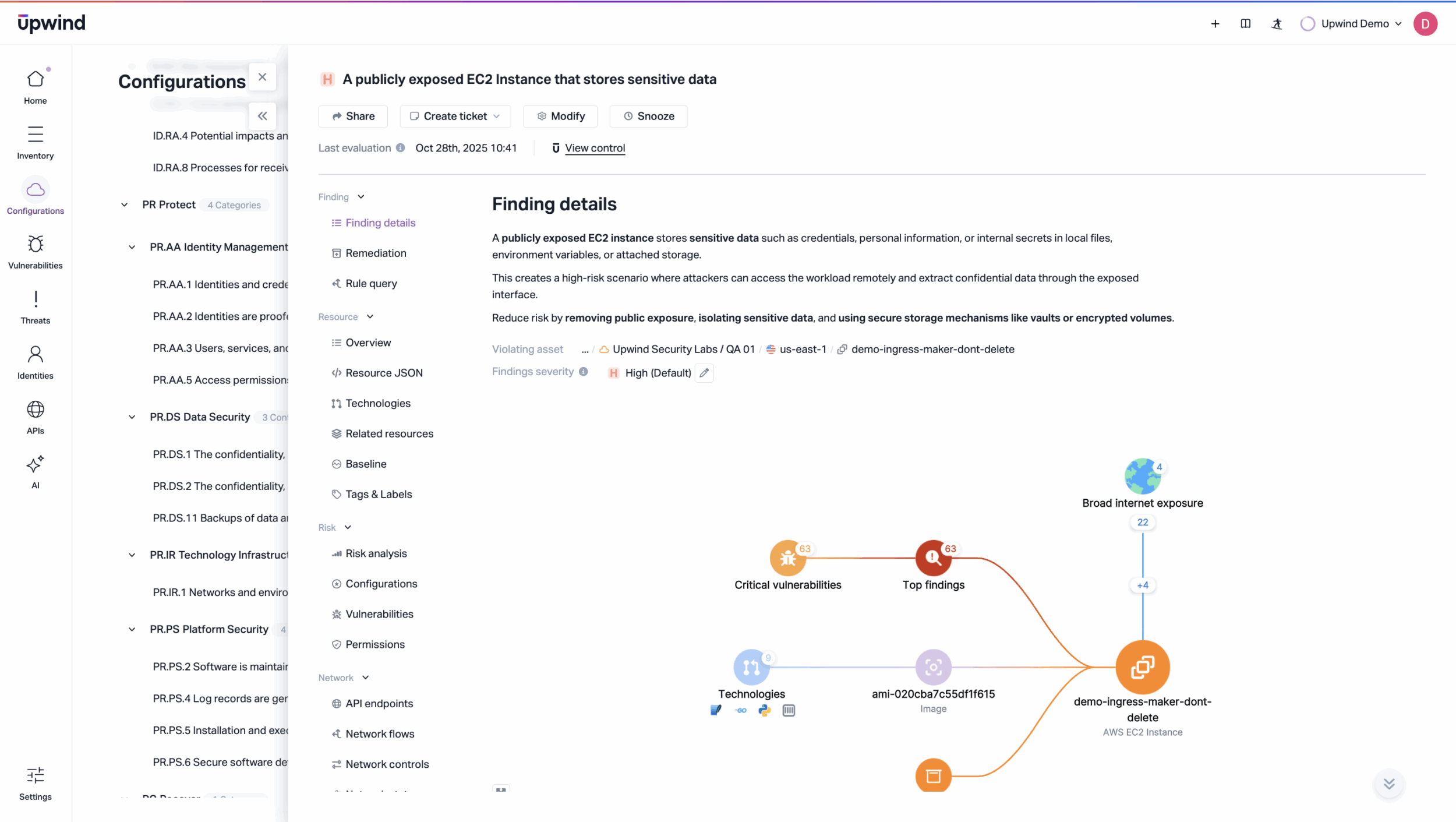
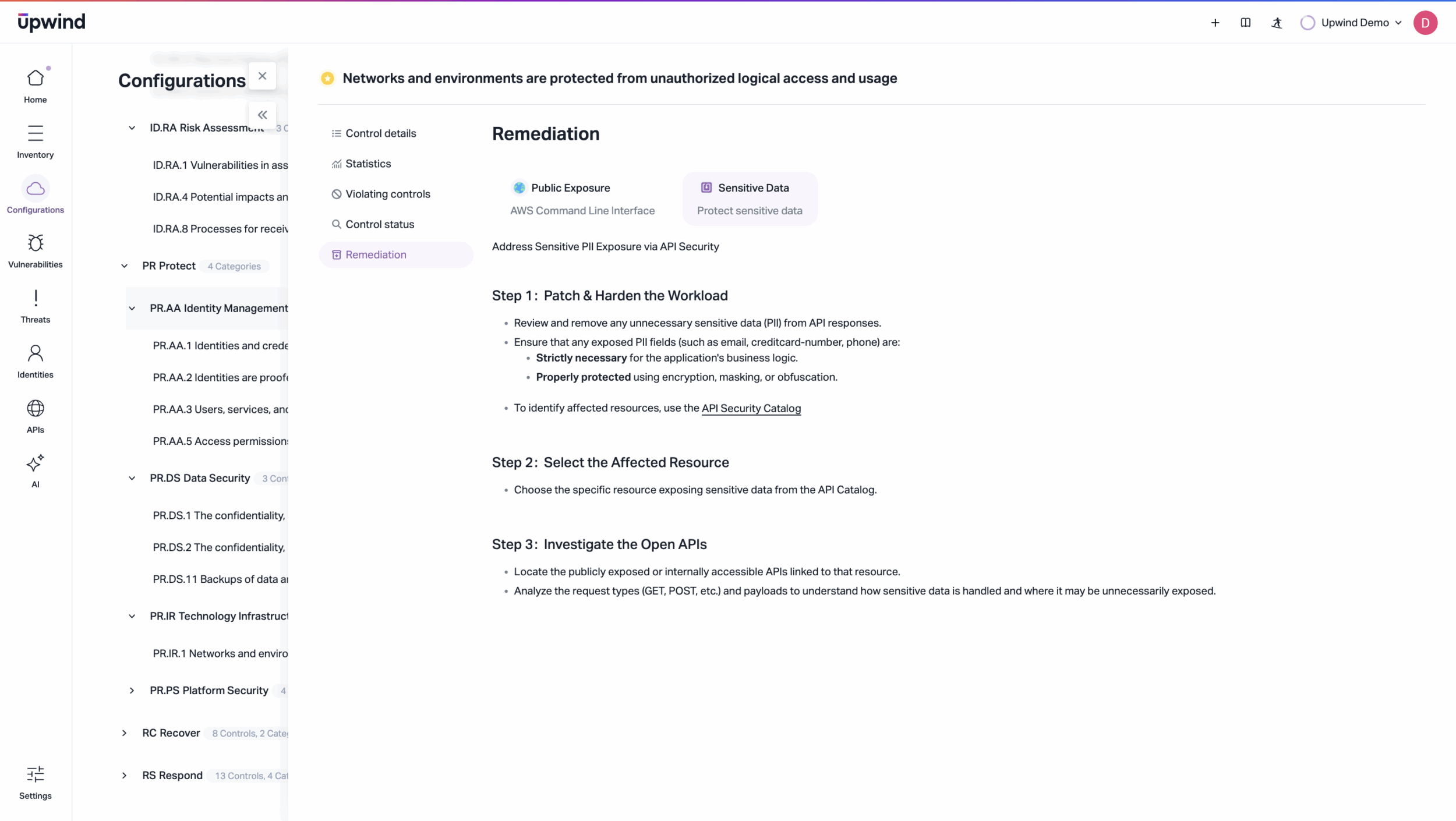
Each detection includes its NIST control mapping, relevant configuration details, and recommended remediation steps, allowing teams to close gaps quickly and demonstrate compliance with evidence-backed accuracy.
Continuous Alignment and Unified Visibility
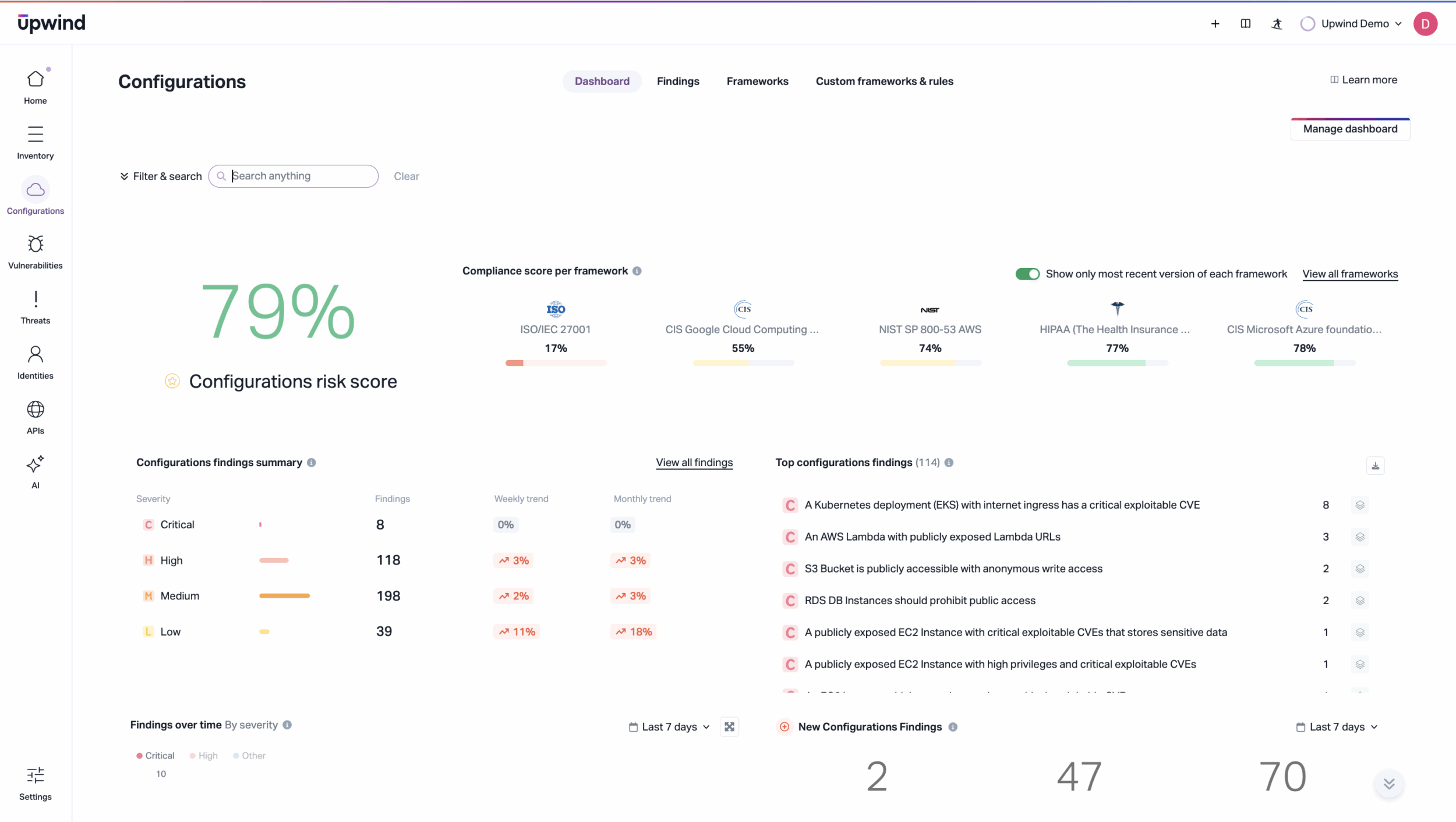
Once the initial mapping is complete, Upwind continuously evaluates each environment for changes that could affect compliance. New assets, policy updates, or configuration drift are automatically detected and assessed against NIST controls, giving teams an always-current view of their posture.
NIST alignment is displayed alongside other frameworks such as CIS, SOC 2, and ISO/IEC 27001, helping organizations manage all compliance requirements from a single platform. Whether preparing for an audit or improving overall security maturity, teams can rely on Upwind’s unified dashboard to provide clarity and consistency.
Each detection includes its NIST control mapping, relevant configuration details, and recommended remediation steps, allowing teams to close gaps quickly and demonstrate compliance with evidence-backed accuracy.
Final Thoughts
The NIST Cybersecurity Framework remains a leading standard for structuring security programs and demonstrating resilience. With integrated NIST support, Upwind helps organizations achieve measurable results faster by mapping full environments in hours, maintaining continuous alignment, and reducing the manual effort traditionally required to meet compliance goals.
By uniting automation, visibility, and contextual intelligence, Upwind transforms NIST compliance from a static obligation into an active, ongoing process that scales with modern infrastructure.
Upwind helps organizations map their environments to NIST controls in a single day, with continuous validation, contextual risk insights, and clear evidence for every control. Book a customized demo to see how Upwind can accelerate your path to NIST.