
Today, we’re excited to announce expanded configuration override settings, a new set of capabilities that give teams greater control over how configuration risk is prioritized. With support for rule-level severity overrides and in-platform commenting, teams can now apply context and collaborate directly where risk decisions are made.
Earlier this year, we introduced Upwind’s Open Source Security model, along with the initial ability for teams to modify configuration severity at the resource level. That release marked an important shift away from fixed, centrally enforced severity toward shared ownership of cloud risk.
Expanded configuration serverity override settings build on that foundation. By extending severity overrides to the rule level and enabling collaboration directly within the Upwind Platform, teams can apply context at the right scope—aligning prioritization with how their environments actually operate and turning contextual judgment into a repeatable, everyday practice.
Configuration Risk, Informed by How Your Cloud Actually Runs
Configuration findings identify deviations from security best practices, compliance frameworks, and organizational policies across cloud environments. They surface misconfigurations such as overly permissive access, missing encryption, or insecure network settings—conditions that can increase exposure to risk if left unaddressed.
Their value is preventative. Configuration findings help teams identify and remediate weaknesses early, providing continuous visibility into cloud posture and establishing a strong security baseline. What differentiates Upwind is context: configuration findings are informed by runtime behavior—how resources are used, what is exposed, and what is reachable in practice – transforming static checks into security signals grounded in real-world risk.
However, not all configuration findings carry the same weight in every environment. A critical finding in production may be far less impactful in a tightly isolated development account. Without contextual prioritization, static severity assignments can lead to alert fatigue, misaligned priorities, and wasted effort.
Upwind’s expanded configuration severity override settings address this directly. By allowing teams to adjust severity based on real-world usage, organizations can improve signal quality and focus attention where risk is truly highest.
Configuration Severity Override Within the Upwind Platform
Upwind’s expanded configuration override settings are seamlessly integrated into the Upwind Platform, giving teams flexible, practical control over how configuration risk is prioritized.
Teams can modify severity at multiple levels, depending on how broadly they want to apply context:
- Rule-level (check-level) severity overrides allow users to update severity for all findings associated with a configuration rule in a single action. This is ideal when a rule’s default severity doesn’t accurately reflect risk in a given environment.
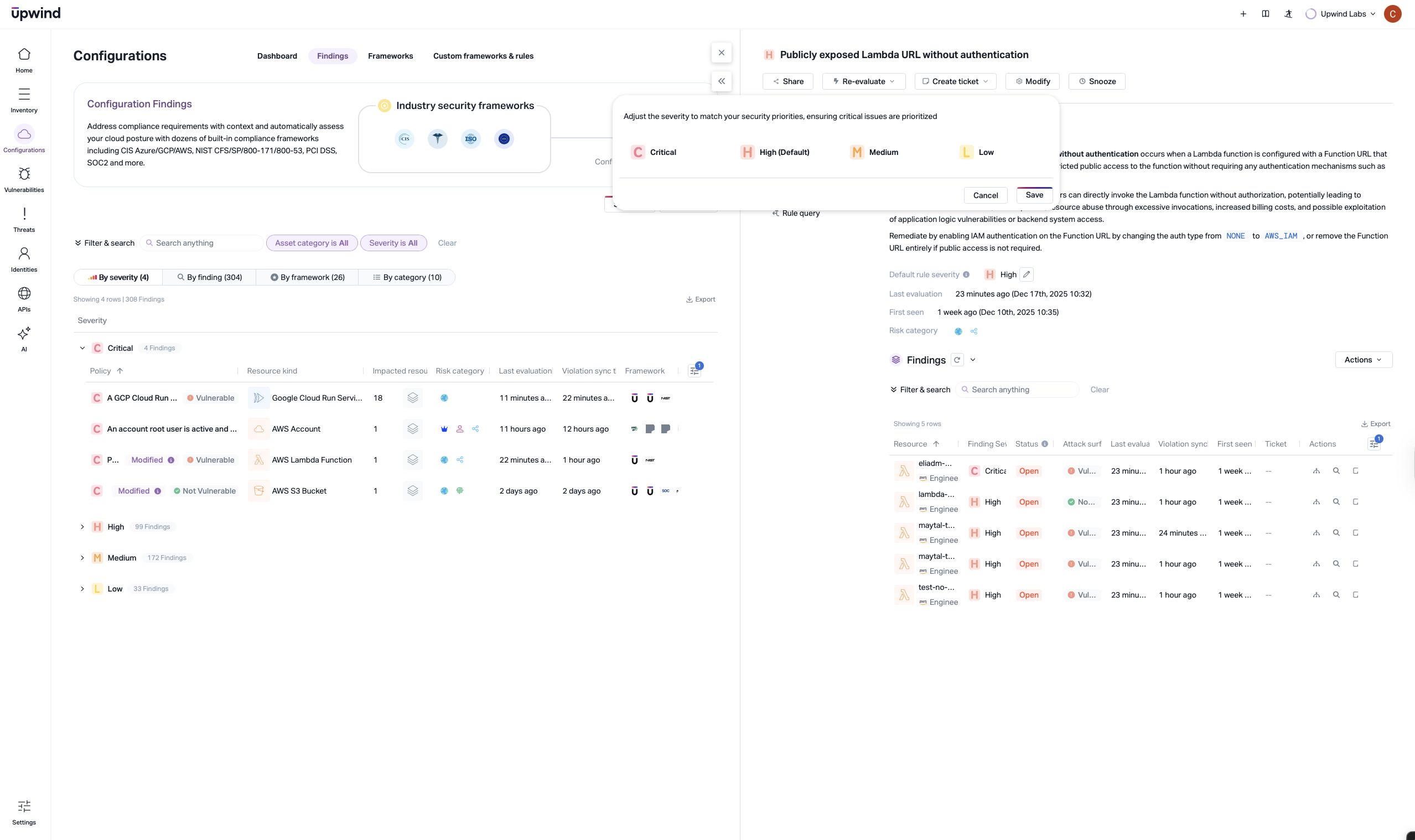
- Resource-level severity overrides remain fully supported, enabling granular adjustments when risk varies between individual resources.
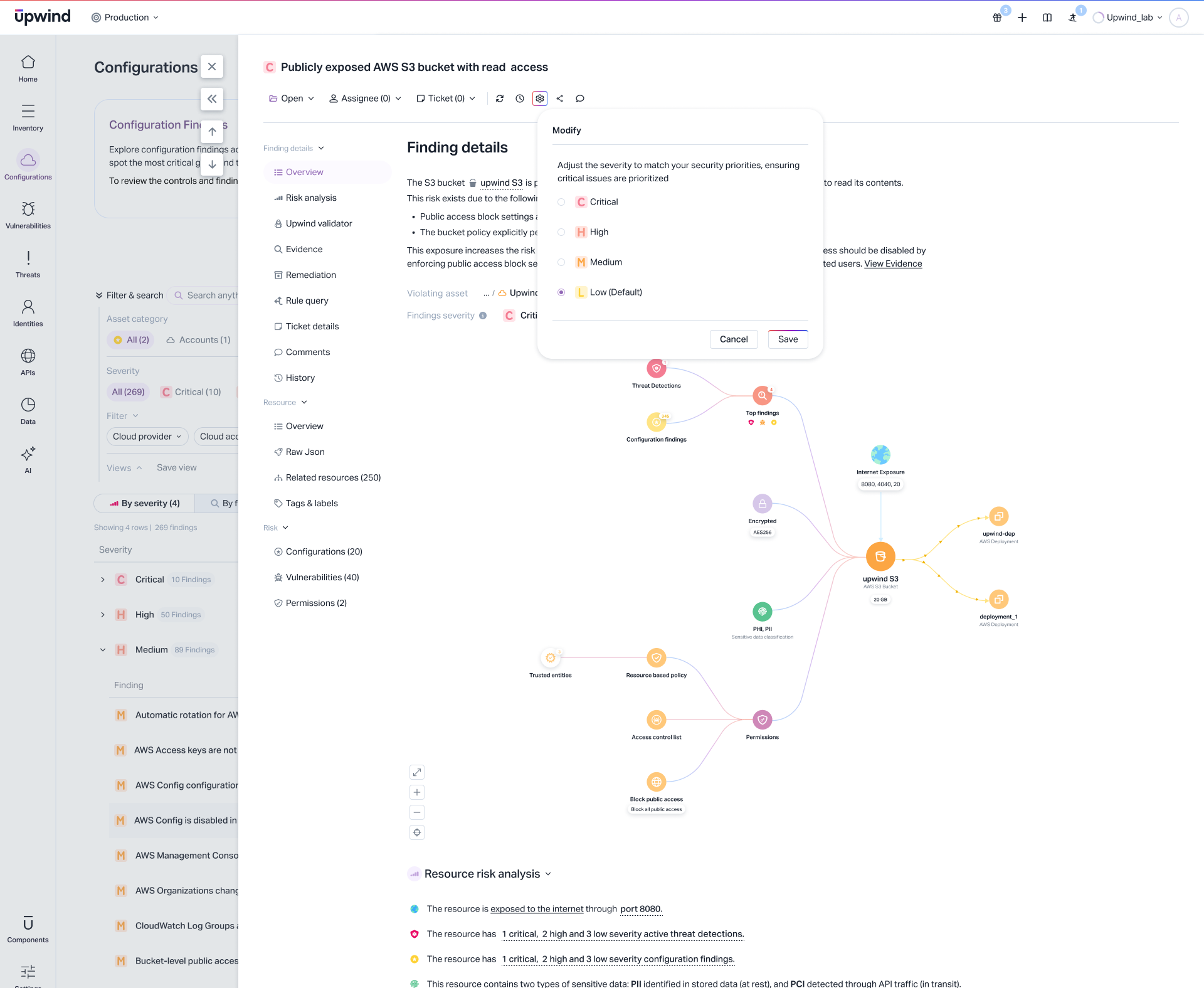
This combination gives teams both scale and precision – the ability to apply context broadly where appropriate, while retaining fine-grained control where nuance matters.
Alongside severity modification, resource-level commenting enables teams to collaborate directly within findings. For example, Engineers can explain why severity was adjusted, security teams can provide guidance, or platform owners can document environment-specific considerations. These comments preserve decision context over time, reduce back-and-forth, and help teams stay aligned as environments and ownership evolve.
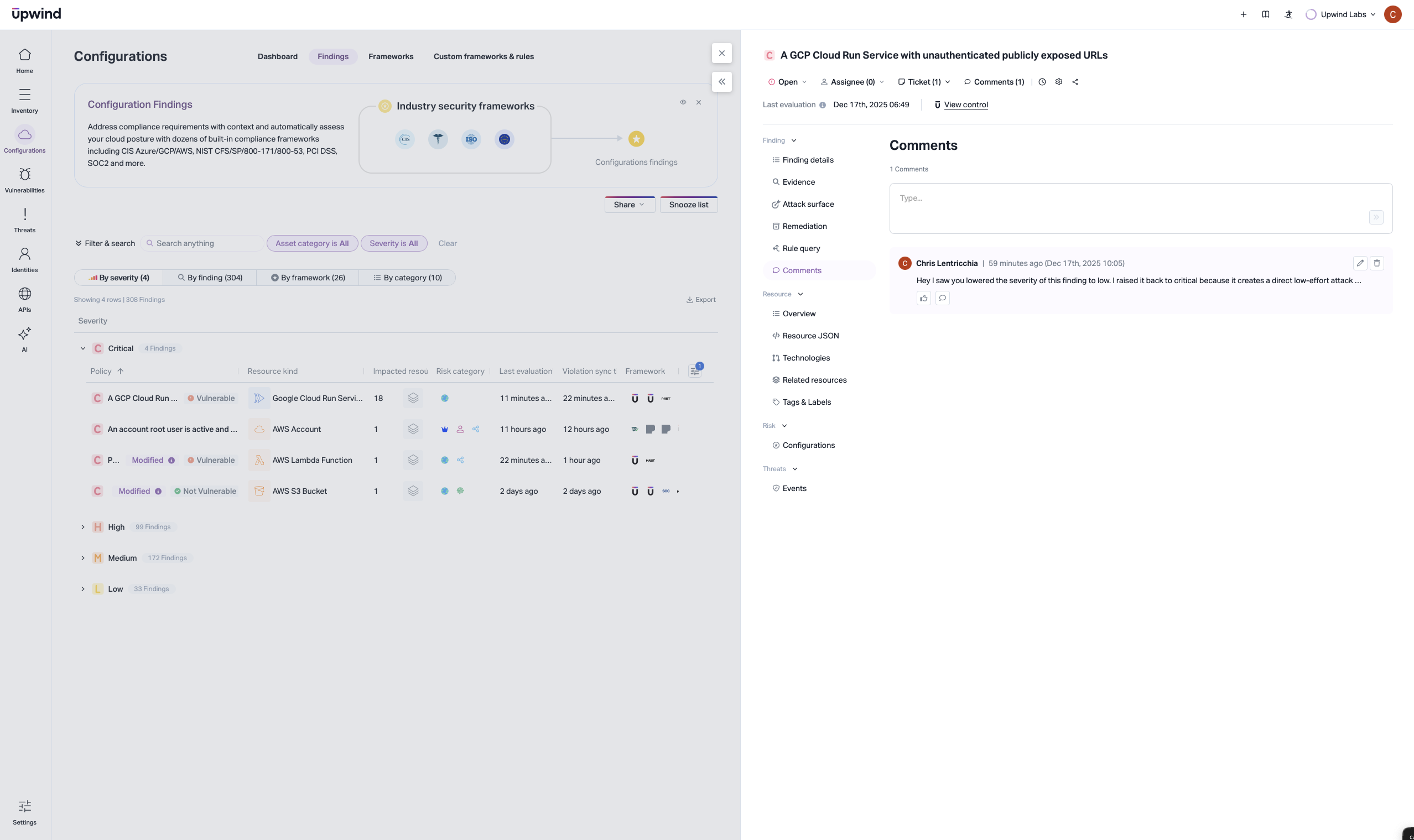
By keeping severity decisions and commentary in the same place, Configuration Modify helps teams move faster and make clearer, more confident prioritization decisions.
Decentralizing Security with Expanded Configuration Severity Override Settings
Upwind’s expanded configuration override settings enable a more distributed approach to cloud security, one that aligns decision-making with the teams closest to the infrastructure.
Rather than relying on globally defined severity ratings, teams can tailor how configuration risk is prioritized based on real-world context. These decisions are made directly in the platform, where they can be shared, understood, and revisited as environments change.
This capability reflects the principles of Upwind’s Open Source Security model:
- Extreme ownership. Teams apply domain knowledge directly to risk decisions
- Decentralized control. Security teams are no longer bottlenecks for prioritization
- Transparency through collaboration. Severity decisions and context live where work happens
By shifting configuration security from static enforcement to shared ownership, Upwind reduces friction between security and engineering while improving trust in security signals. The result is a more accurate, scalable, and human-centered approach to managing cloud risk.
See it in Action
Expanded configuration severity override settings represent the next step toward a security model built for how modern cloud organizations operate—dynamic, distributed, and deeply contextual. By enabling teams to align severity with real-world risk and collaborate directly on decisions, Upwind helps organizations focus on what matters most and move faster with confidence.
To see these capabilities in action and understand how they fit into the broader Upwind Platform and Open Source Security model, schedule a customized demo and learn how Upwind enables true ownership of cloud risk – without sacrificing visibility, governance, or trust.