
We’re excited to announce that the new “By Finding” view is now live in the Upwind Vulnerability Management module, enabling security teams to triage vulnerabilities faster and more flexibly across their entire cloud environment.
As cloud-native infrastructure continues to scale across clusters, container images, packages, and services, security teams need vulnerability management workflows that are efficient, adaptable, and easy to integrate with the rest of their security stack. The “By Finding” view was designed to help teams move from visibility to action with greater speed, clarity, and control
Partnering with Customers to Build the Way Security Teams Actually Work
At Upwind, we build in close partnership with our customers, focusing on how security teams operate day to day and how our platform can support their workflows as they scale.
Recently, one of our customers shared feedback about challenges they were facing when reconciling Upwind vulnerability data with their SIEM and SOAR platforms. That input highlighted an opportunity to further align the Upwind experience with how teams triage, investigate, and operationalize vulnerability data across tools.
Rather than prescribing a single way to view or organize findings, we focused on expanding flexibility and precision. The result is an experience that adapts to different operating models, whether teams are working directly in the Upwind platform, integrating with automation tools, or collaborating across security and engineering functions.
The new “By Finding” view reflects how we approach product development: listening carefully, identifying where incremental improvements can unlock meaningful efficiency, and delivering enhancements that fit naturally into existing workflows.
“Upwind is actually listening and trying to fix problems — it’s clear they want us to succeed.
– Moshe Bareket, IT and Security Manager, EX.CO
One Unified View for Every Vulnerability Finding
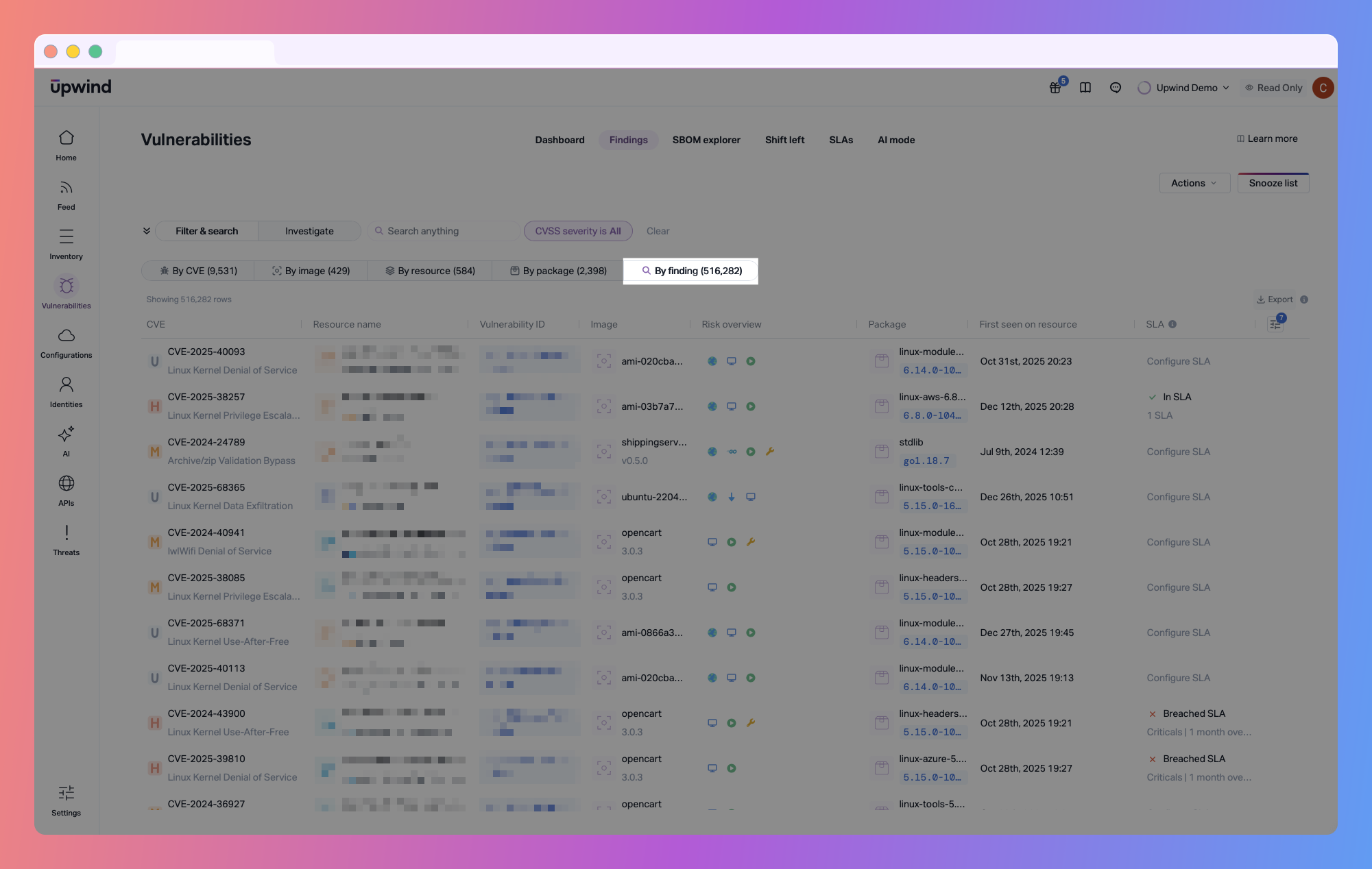
The “By Finding” view introduces a flat, comprehensive table that displays every individual vulnerability occurrence across your environment.
This unified view provides a consistent way to examine vulnerabilities across clusters, container images, packages, and other asset types, without navigating nested groupings or switching between resource-specific views. All findings are presented in a standardized format, allowing teams to filter, sort, and analyze vulnerabilities based on the attributes most relevant to their organization.
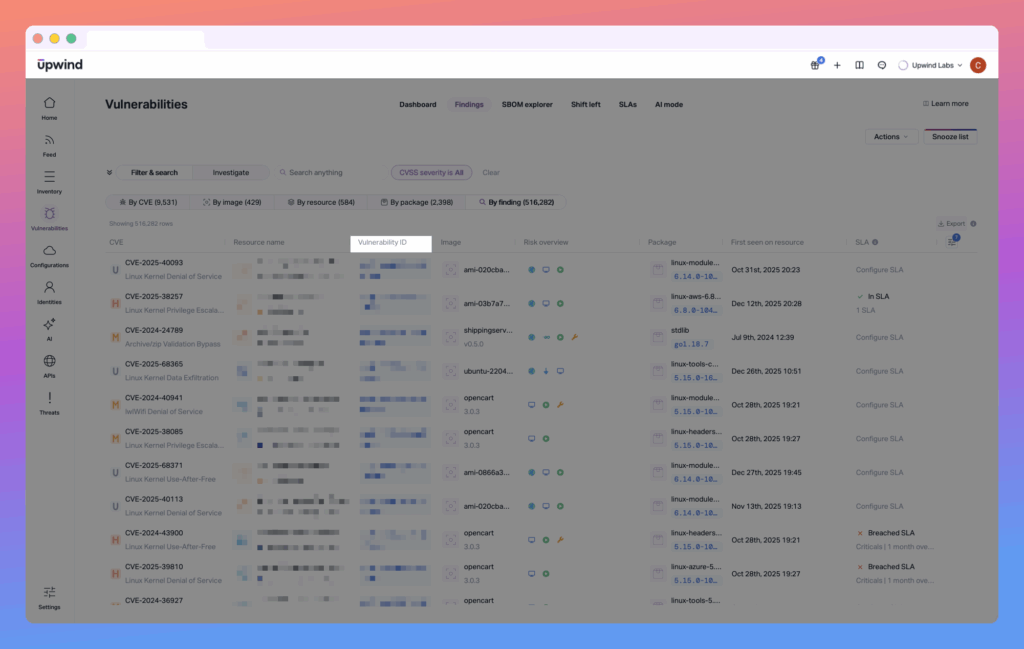
To support precision and traceability, we’ve also surfaced the Vulnerability ID directly in the Upwind console. The Vulnerability ID is now accessible as:
- A dedicated filter for locating specific vulnerabilities
- A hidden column in the findings table that can be enabled when needed
- A copy-to-clipboard field for easy reference and sharing
Looking ahead, we’re continuing to build on this foundation. While the Vulnerability ID filter already supports targeted searches, we’re working to make Vulnerability IDs fully searchable through Upwind’s “Search Anything” experience, making it even easier to find and act on specific findings across the platform.
Together, these capabilities give security teams a clear, detailed, and flexible view of their vulnerability landscape, without adding complexity or clutter.
Turning Vulnerability Data Into Action Across Tools and Teams
With a complete, finding-level view in place, security teams can move faster and operate more efficiently across their workflows. The flat, finding-centric format allows analysts to triage vulnerabilities more quickly and apply consistent prioritization across all resource types. Rather than adapting workflows to Upwind’s UI, teams can assess and remediate vulnerabilities the way they naturally think about risk – one finding at a time.
Making the Vulnerability ID visible in the Upwind console also strengthens integration with SIEM, SOAR, and ticketing platforms. Teams can easily correlate Upwind findings with alerts, incidents, and automated playbooks, improving accuracy and enabling more reliable automation across the security lifecycle.
Beyond individual workflows, this update improves cross-team collaboration. Clear, shareable identifiers help security, DevOps, and engineering teams stay aligned on the same vulnerabilities, reducing handoff friction and accelerating remediation timelines.
Final Thoughts: Small Enhancements, Meaningful Impact
At Upwind, we believe the most meaningful product improvements often come from listening closely to how our customers work in practice. The “By Finding” view is a strong example of how targeted enhancements, guided by real customer input, can significantly improve day-to-day efficiency without requiring teams to change their workflows.
By refining how vulnerability data is presented and making key identifiers more accessible, we’re helping security teams move faster, integrate more easily with the tools they already rely on, and collaborate more effectively across organizations. While the change itself is intentionally focused, its impact extends across triage, automation, and remediation.
We remain committed to building alongside our customers and continuously improving the Upwind platform in ways that deliver immediate, practical value. As environments and workflows evolve, we’ll continue to listen, iterate, and invest in enhancements that make a real difference.
The product evolves quickly. We’ve seen requested improvements turn into live features in days, not quarters.
– Aman Sirohi, People.ai
See it in Action
The “By Finding” view is available now in the Upwind Vulnerability Management module, and it’s designed to help teams work faster, integrate more seamlessly, and reduce friction across their security operations.
If you’d like to see how this feature fits into your environment – or to explore how Upwind can help you prioritize and remediate risk more effectively – schedule a customized demo us. We’ll walk through your use cases, integrations, and security goals to show how Upwind delivers actionable cloud security at scale.