


We’re excited to announce Upwind Attack Surface Management (ASM), a new way for security teams to discover unknown attack surfaces, understand risk exposure, and prioritize the issues that matter most.
Security teams have spent years improving visibility across their environments. They use scanners, asset inventories, vulnerability management platforms, CSPM tools, and attack surface management solutions to identify what is exposed.
But more visibility often creates more findings: more assets, more vulnerabilities, and more alerts for teams to sort through.
Yet one critical question often remains unanswered:
Which of these exposures can attackers actually use?
As cloud environments become more dynamic, discovery remains critical, but visibility alone is not enough. An exposed resource is not automatically a critical risk. Some assets are unreachable. Others are inactive. Many are disconnected from sensitive systems or create little meaningful blast radius if compromised.
Upwind ASM moves security teams from a long list of exposed assets to a prioritized view of the risks that matter. It combines attacker-perspective discovery with realtime intelligence to identify reachable and exploitable exposures, so teams can focus response efforts where they make the greatest impact.
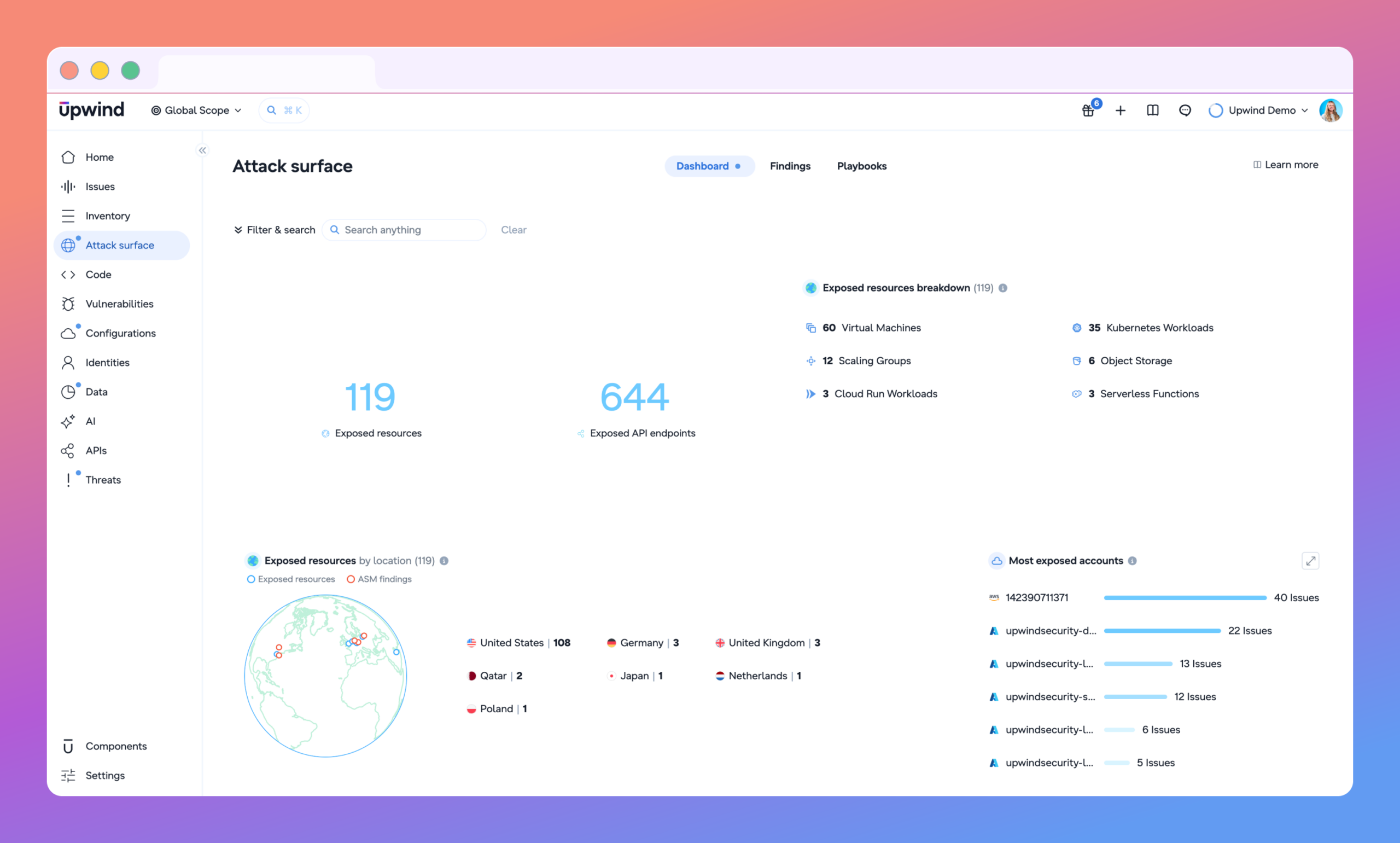
From Discovery to Validated Risk
Traditional ASM solutions answer an important question:
What is exposed?
But they often stop there.
Security teams still need to determine:
- Is the asset actually reachable?
- Is the exposure exploitable?
- Is sensitive data involved?
- What business systems are connected?
- How would an attacker move from this exposure to something valuable?
Without this context, every finding competes for attention.
The result is alert fatigue, delayed remediation, and security teams spending more time investigating than reducing risk.
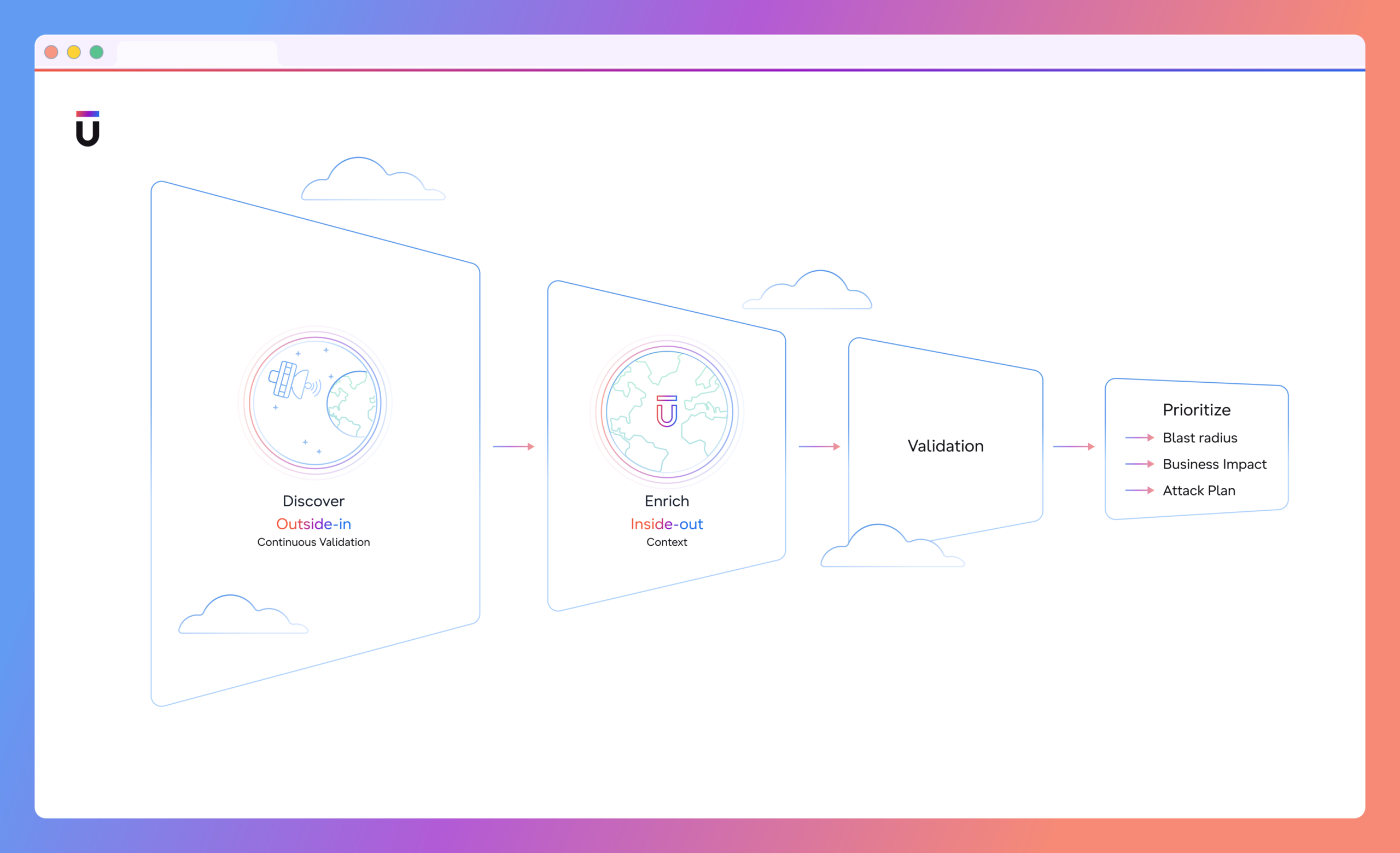
Introducing Agentic Attack Surface Management
Upwind ASM combines external exposure discovery, runtime intelligence, cloud context, identity relationships, and AI-powered validation to help security teams understand risk from an attacker’s perspective.
Instead of simply identifying exposed resources, Upwind validates exposures and connects them to the surrounding cloud environment to determine their real security impact.
This allows teams to prioritize based on exploitability, reachability, and business impact rather than static severity scores alone.
At the center of this approach is Red, Upwind’s AI validation agent.
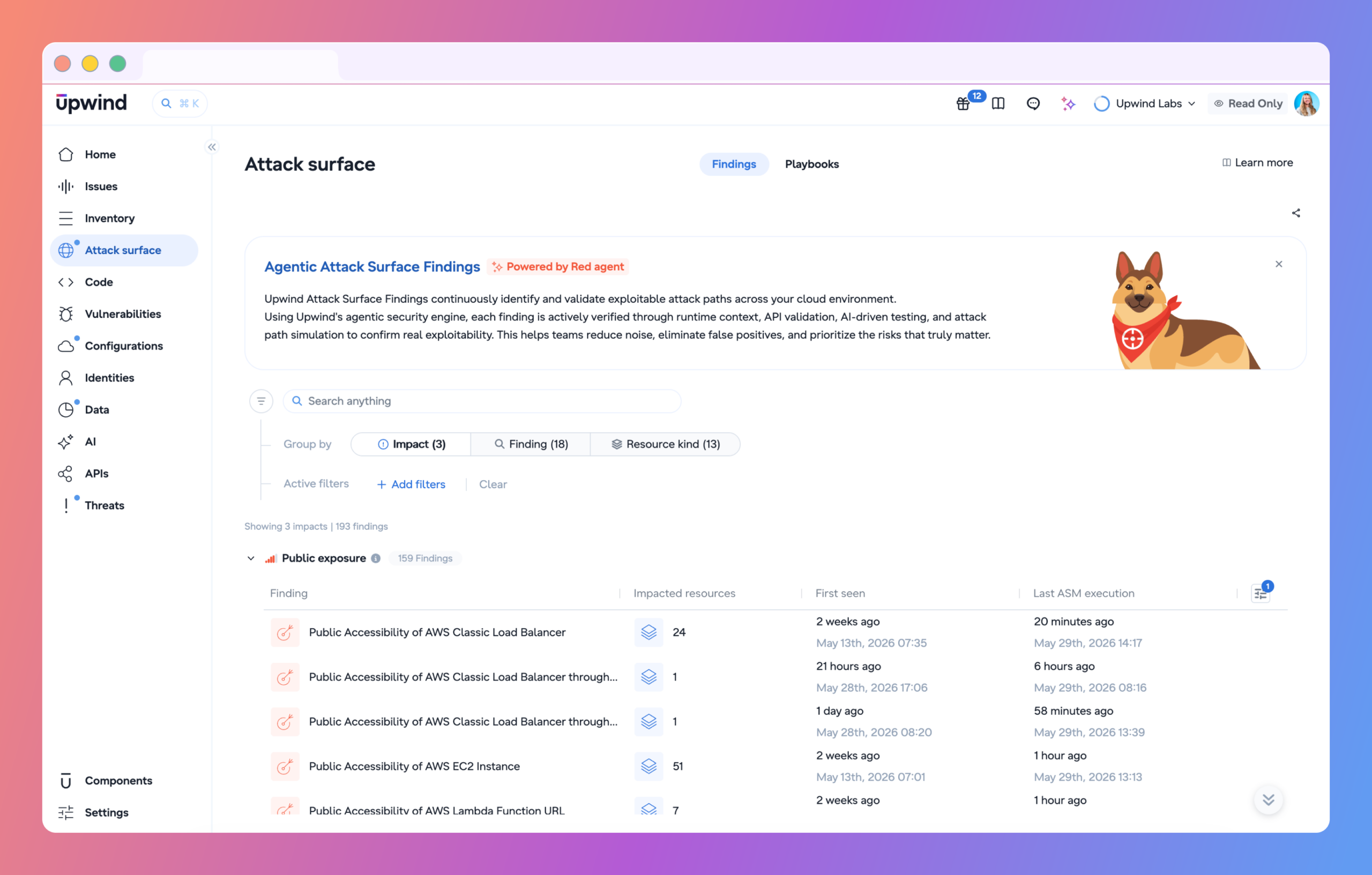
Validate Exposure Risk with Upwind’s Red Agent
The hardest part of Attack Surface Management isn’t finding exposed assets- it’s determining which ones attackers can actually use.
Red helps automate that process.
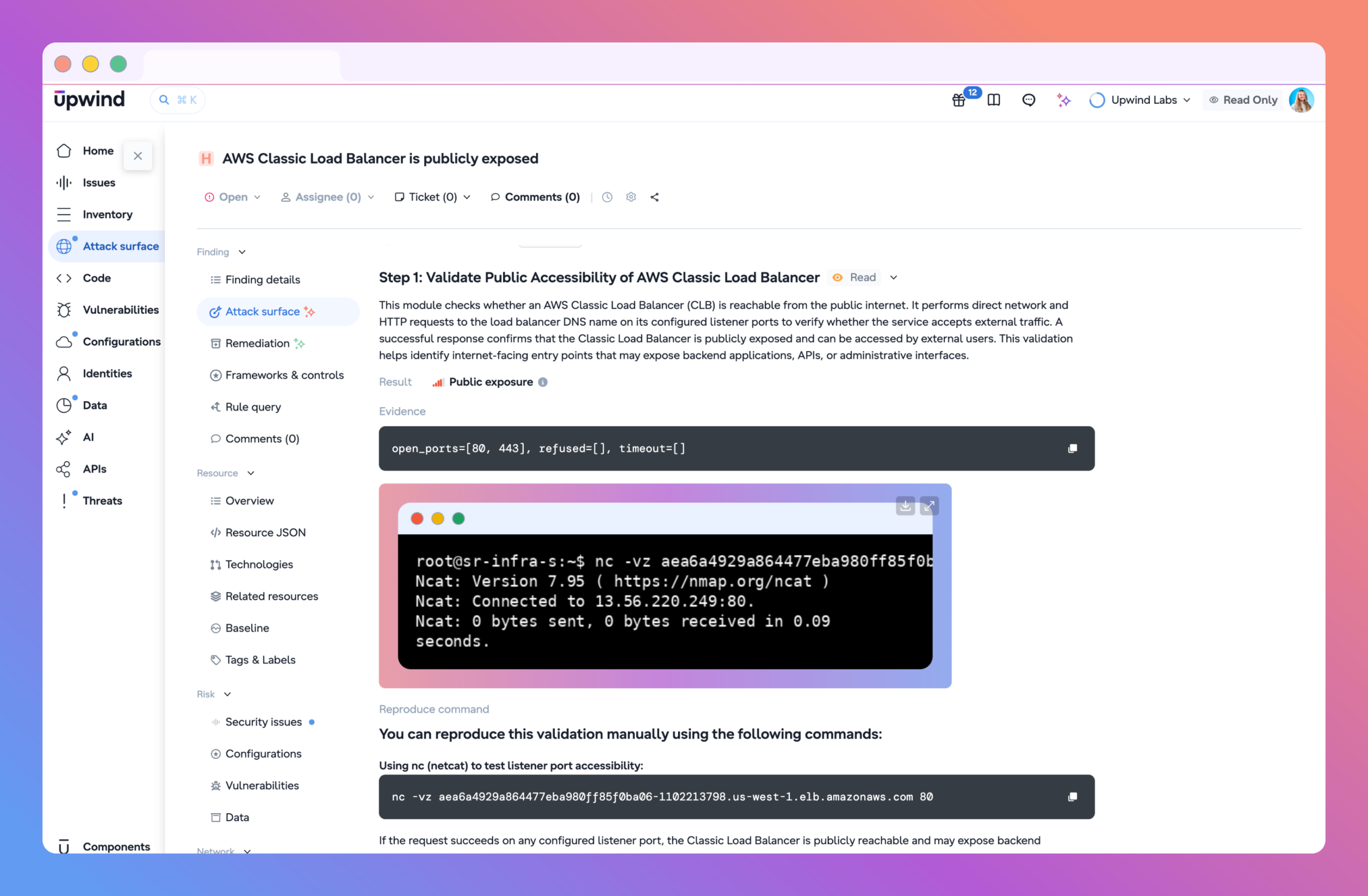
When Upwind identifies an exposure-related finding, the red agent evaluates the resource from an attacker perspective, validating whether the risk is reachable, relevant, and potentially exploitable.
Rather than relying solely on static configuration analysis, it incorporates runtime intelligence, cloud relationships, identity context, and operational signals to understand how the exposure behaves in the real environment.
The result is evidence-backed prioritization.
Teams can quickly distinguish between findings that are merely visible and findings that create meaningful risk.
Instead of asking:
“Is this exposed?”
Security teams can ask:
“Can this actually be exploited?”
And receive a data-driven answer.
Find the Golden Attack Path
Attackers do not think in isolated findings.
They think in paths.
A publicly exposed asset becomes interesting only when it provides access to identities, permissions, sensitive resources, or opportunities for lateral movement.
This is why Upwind ASM introduces Attack Path Visualization.
Attack Path Visualization helps teams understand how exposed resources connect to the broader cloud environment, revealing realistic paths an attacker could follow after initial access.
By connecting exposures with identities, permissions, workloads, applications, and sensitive resources, Upwind helps security teams understand:
- Where an attacker can move next
- Which permissions can be abused
- What resources become accessible
- What business impact could result
Instead of prioritizing based on severity alone, teams can prioritize based on potential attacker outcomes.
From Findings to Action
Upwind ASM provides a centralized experience for managing validated exposure findings across the organization.
Security teams can investigate findings using:
- Validation outcomes
- Business context
- Asset ownership
- Runtime intelligence
- Attack path insights
- Operational impact
Every finding is connected to the evidence required to support remediation decisions.
Playbooks further operationalize this process by providing repeatable validation workflows that document investigation steps, collected evidence, and remediation context.
The result is a consistent path from exposure discovery to remediation without requiring teams to manually piece together information across multiple platforms.
What’s next
This launch represents the first step in Upwind’s broader vision for Attack Surface Management.
Future enhancements will expand validation capabilities across APIs, AI services, identities, and additional cloud resources while continuing to strengthen attack path analysis and contextual risk correlation.
As cloud environments become increasingly dynamic, security teams need more than visibility.
They need to understand which exposures attackers can realistically exploit and where those exposures can lead.
Upwind ASM was built to answer exactly that question.
Move Beyond Exposure Discovery
Security teams don’t need another list of exposed assets.
They need to know which exposures create real risk.
Upwind ASM combines exposure discovery, AI-powered validation, runtime intelligence, and attack path analysis to help organizations focus on what matters most.
Because the goal of Attack Surface Management isn’t to find everything.
It’s to understand what attackers can actually use.
Learn how the Upwind Agentic Pack helps security teams use AI and realtime intelligence to focus investigation, validation, and remediation on what matters most.