

If you asked most security leaders where all of their data is flowing, which workloads and AI services are accessing it, and whether it’s exposed, only a few could answer with confidence, and almost none would have the answer in real time.
Not because that data is not available, but because it’s scattered across multiple cloud providers, accounts, solutions, and services, each with its own security tooling and limited view without a unified and connected context or intelligence layer.
Upwind Data Security provides a single, runtime-powered view of data across your entire cloud estate. Instead of showing only where data is stored, it reveals where it’s exposed, how it’s being accessed, how it moves between resources, and whether it’s leaving your environment, giving security teams the context to prioritize the risks that matter most, in real time.
Data Doesn’t Respect Cloud Boundaries
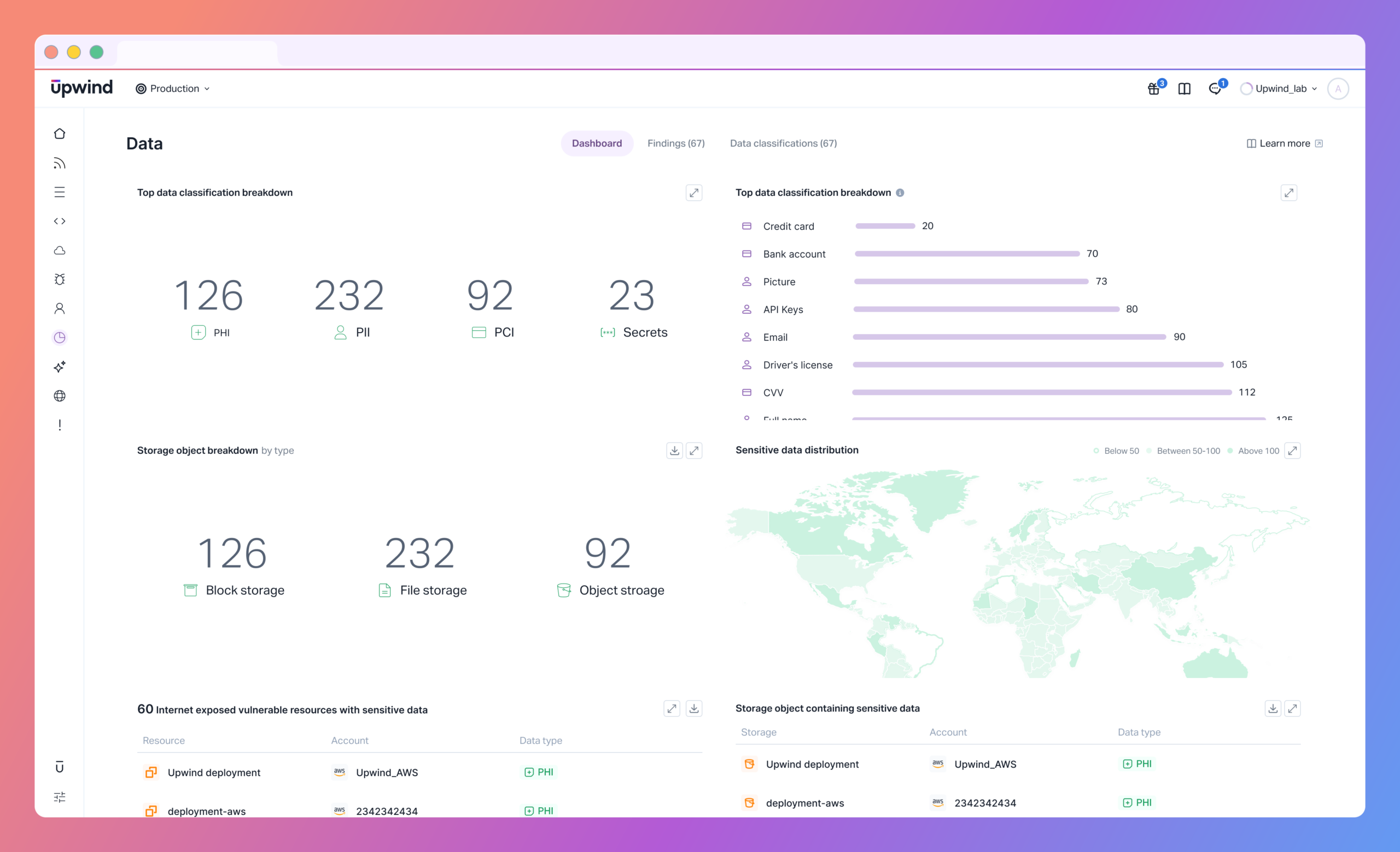
Security teams operating across multiple clouds have to run separate discovery tools, reconcile separate findings, and build a unified picture by hand. By the time that picture is complete, the environment has already changed.
Upwind replaces that fragmented approach with a single data inventory spanning AWS, Azure, and GCP, covering PII, PHI, PCI data, secrets, and credentials across storage, workloads, and APIs. But a list of every resource touching sensitive data isn’t a security program. What turns a finding into a priority is context.
Data Classification Meets Runtime Exposure
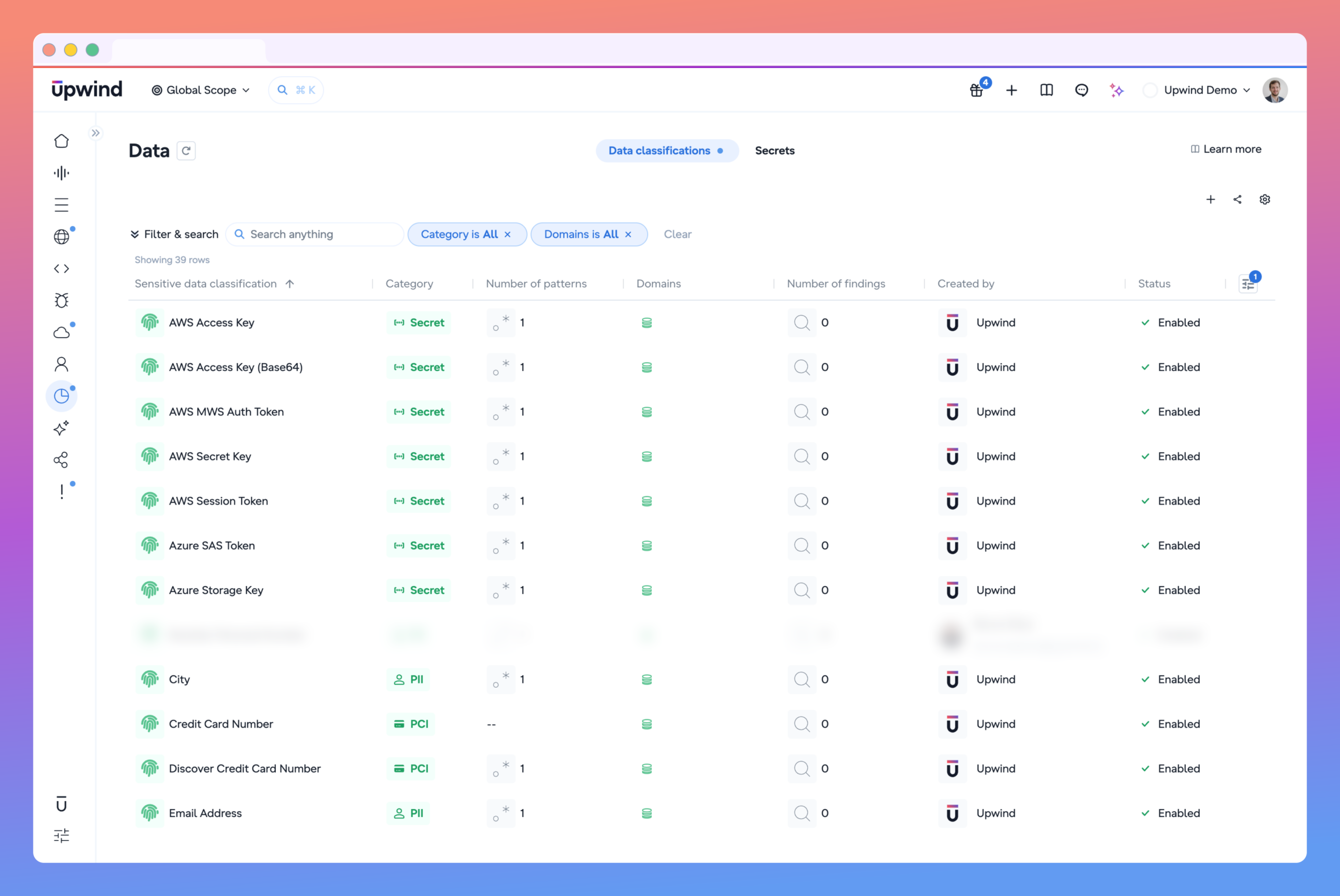
A workload carrying PII is a finding. A workload carrying PII that is internet-exposed, over-privileged, and running an unpatched critical vulnerability is an incident waiting to happen.
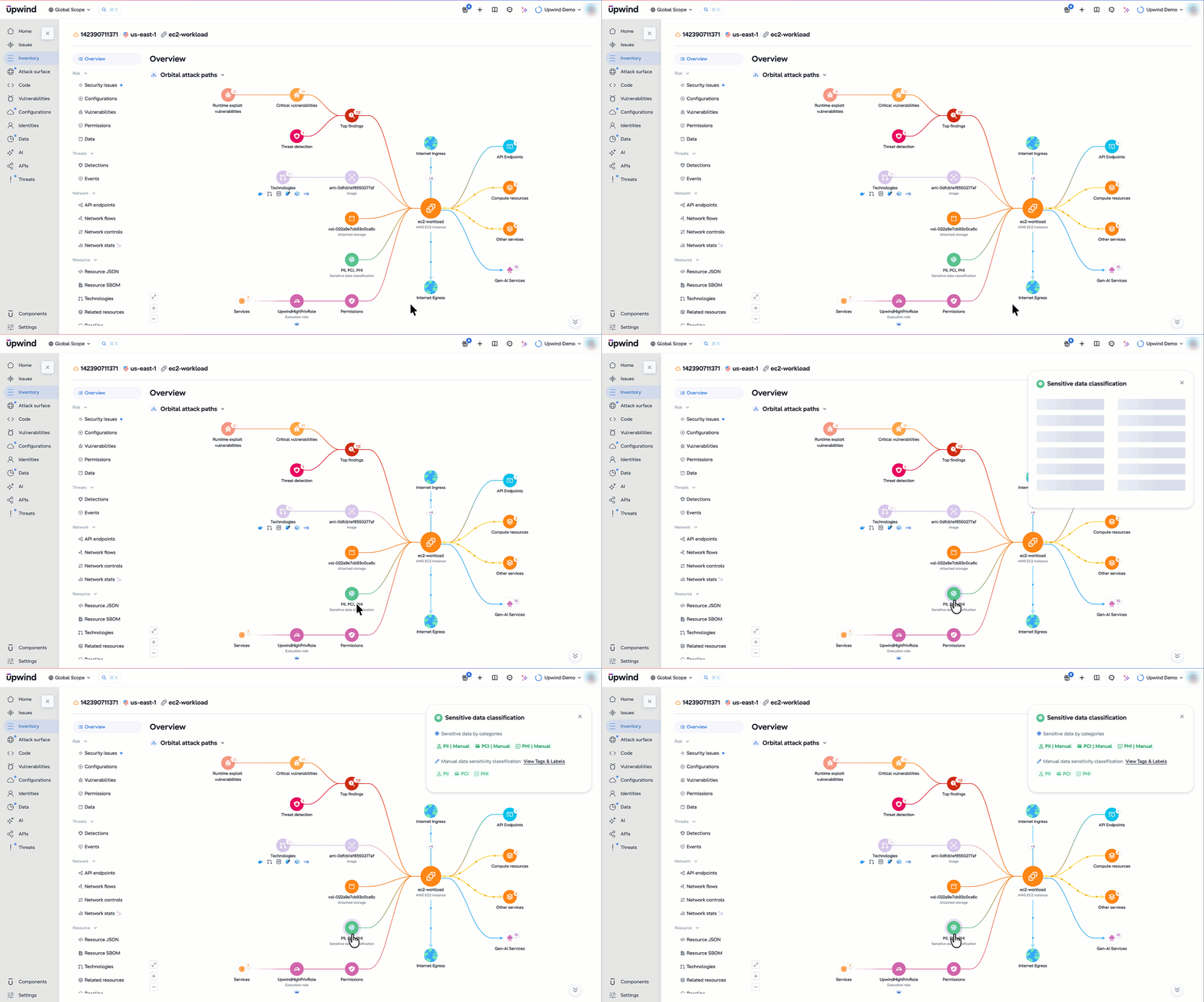
Upwind fuses sensitive data classification with exposure context into a single correlated finding, highlighting the present data, how the resource is exposed, what vulnerabilities exist, and who can reach it.
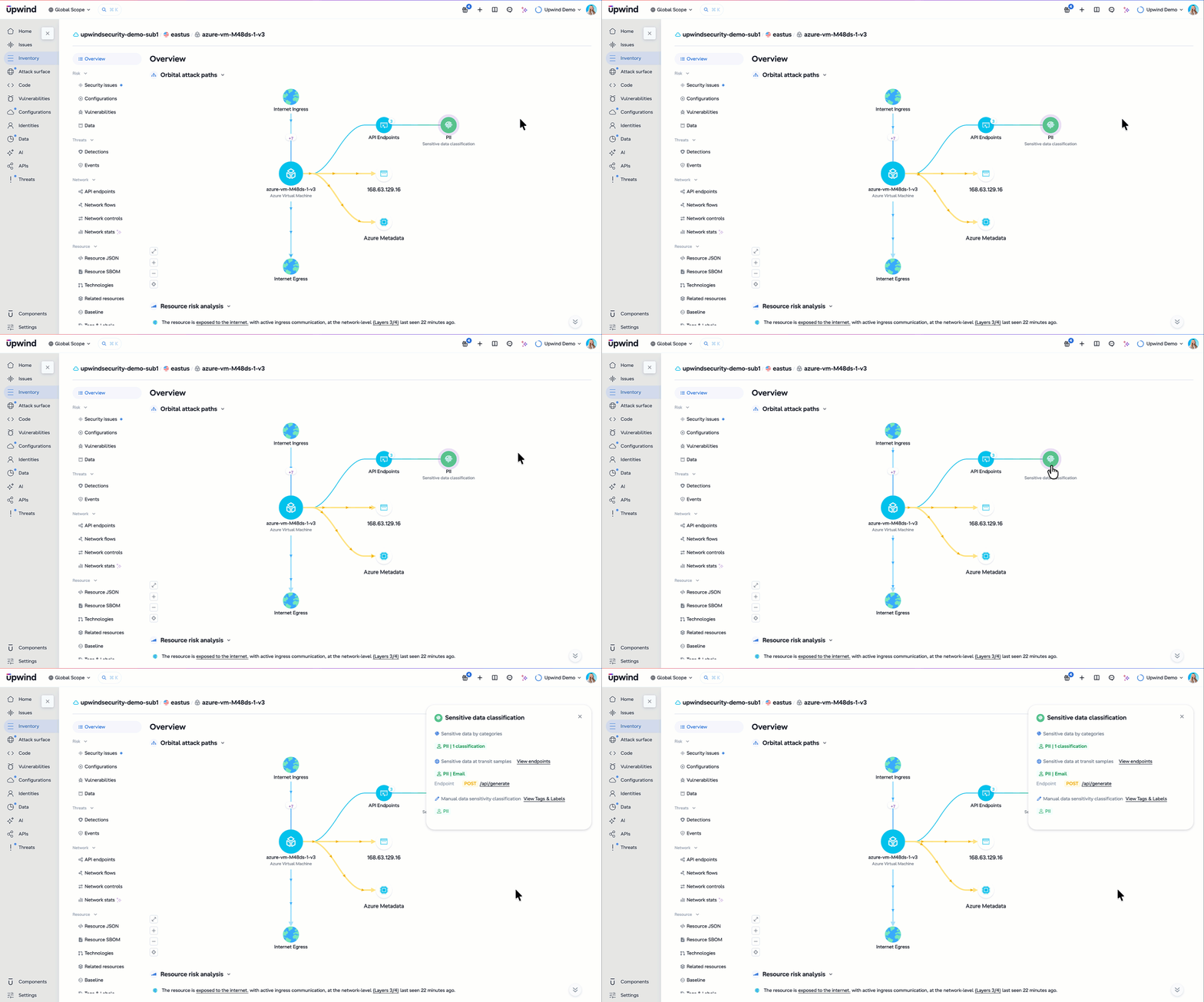
Take an Azure host on a public IP, processing PII. It’s allowing unrestricted inbound SSH. That combination, sensitive data classification plus unrestricted exposure, is exactly the risk a security team would spend hours stitching together by hand.
That’s a serious finding. But it’s not the worst one.
When a single AWS host carries every regulated class, PCI, PHI, and PII simultaneously, and is open to the internet, over-privileged, running critical vulnerabilities, and has a live critical detection on it, the compliance risk and the security risk are the same problem.
For a regulator, it’s a violation. For an attacker, it’s an open door.
Upwind surfaces that convergence before it becomes either.
Visibility Into Data as It Moves
Most native cloud tools don’t see what’s moving through APIs, crossing cloud boundaries, or flowing to external services right now.
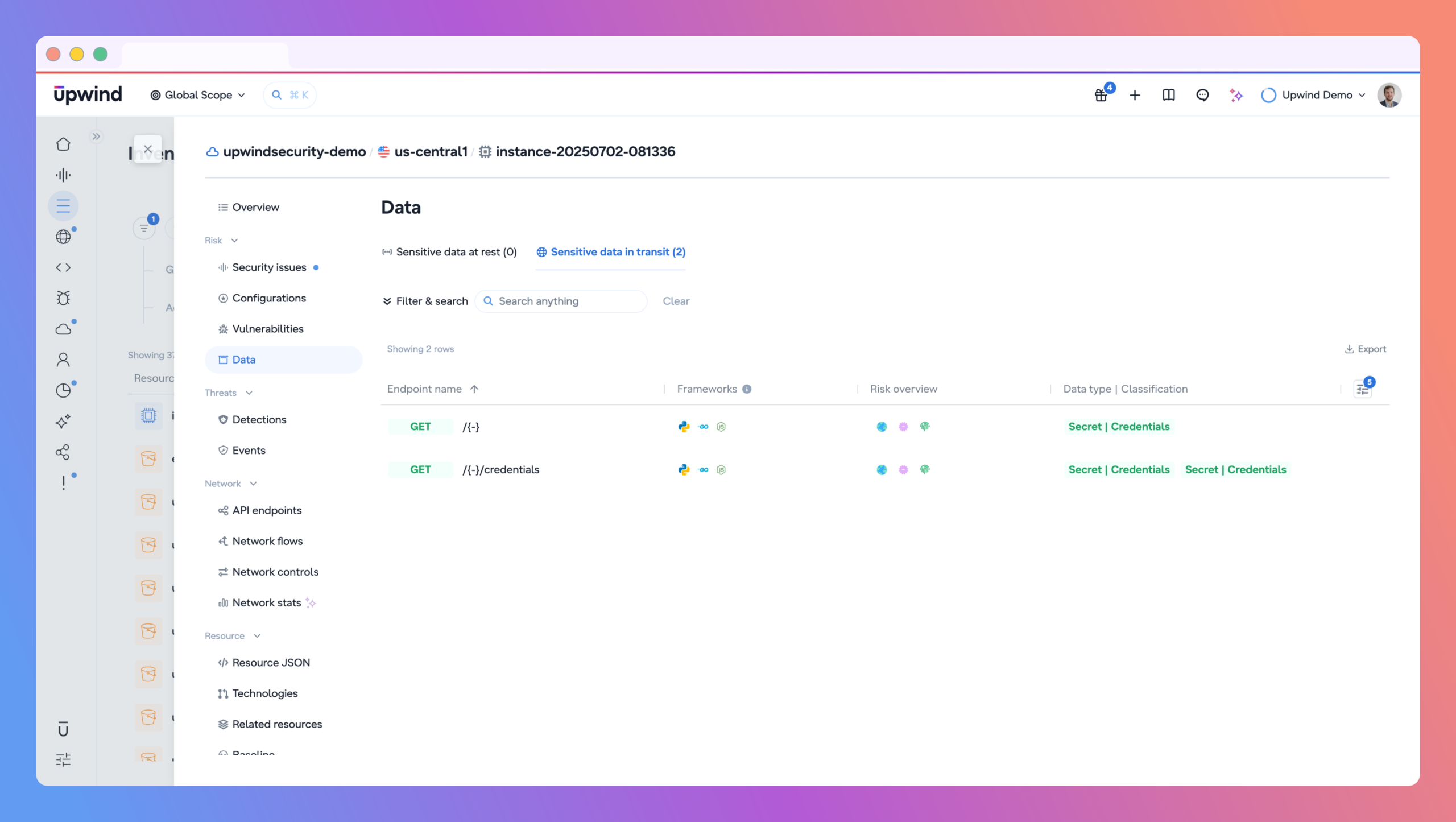
Upwind’s Sensitive Data in Transit observes sensitive information moving through production API traffic in real time. When PII and PCI data are flowing through an internet-facing frontend that’s live evidence of exposure, a static scan can’t produce.
The GenAI Egress Filter extends this to AI traffic, identifying outbound communication with services like OpenAI, Anthropic, and AWS Bedrock before sensitive data reaches an external AI provider and becomes a compliance or security incident.
For data that doesn’t fit standard regulatory categories, Custom Data Classifications let teams define sensitive data on their own terms scoped to specific accounts, resources, or environments, with built-in classifications narrowed or disabled as needed.
Detecting Data in Motion Across Cloud Environments
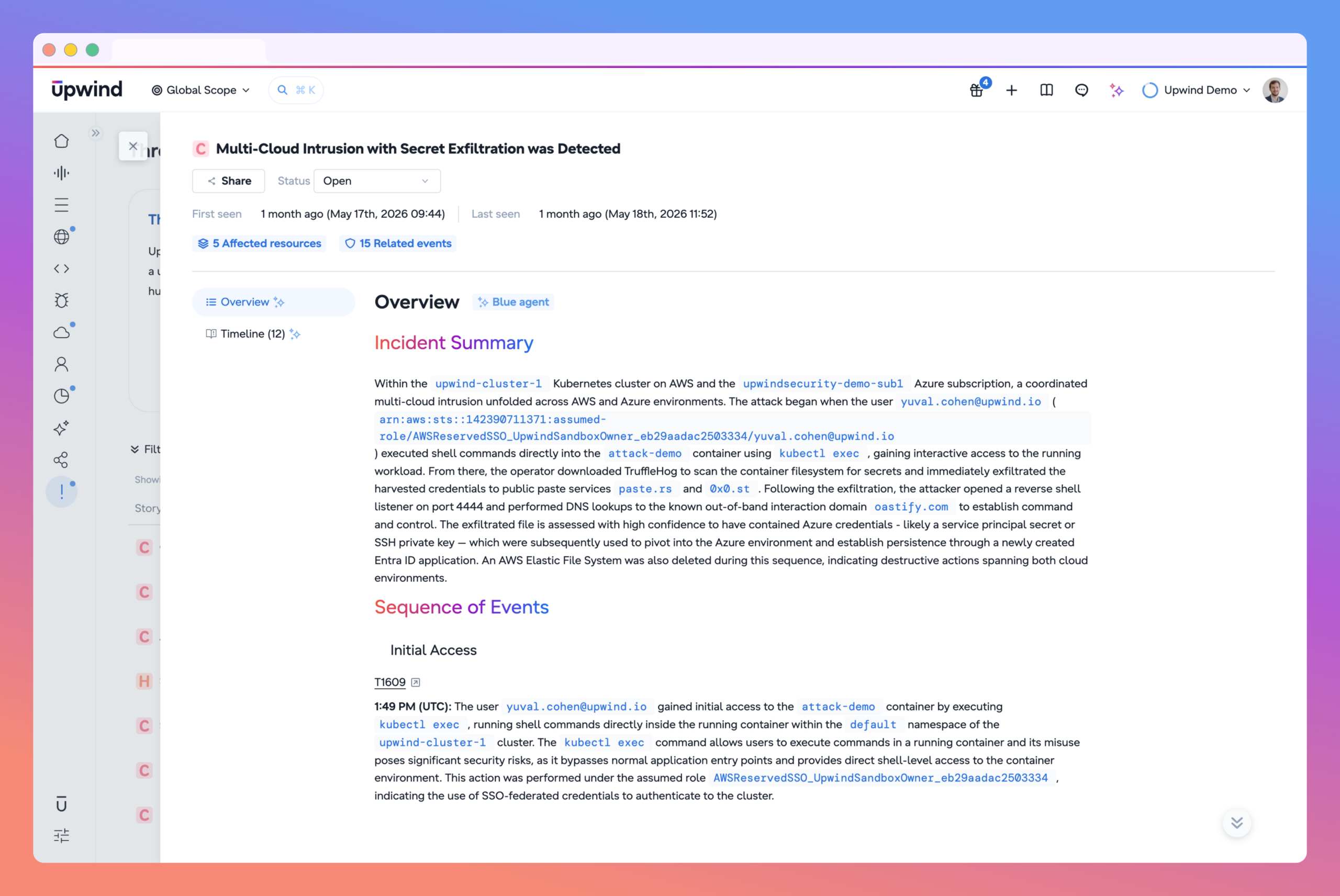
When an attacker moves across cloud boundaries, executing commands inside a running container, harvesting credentials, and establishing command-and-control, the sequence shows up as dozens of disconnected detections across two clouds, spanning hours.
Upwind correlates those detections at runtime into a single investigation showcasing initial access, credential harvesting, lateral movement, and exfiltration. One attack path, not a list of unrelated events.
For Security Teams and Leaders, This Means
One inventory across every cloud: A single prioritized view of sensitive data across AWS, Azure, and GCP.
Findings that tell the full story: Data classification, exposure context, vulnerability data, and identity access fused into one correlated finding.
Visibility that static tools can’t provide: Sensitive Data in Transit shows what’s moving on the wire, not what was labeled in last night’s scan.
Faster triage, less noise: Findings ranked by reachability so teams focus on what requires immediate action.
Exfiltration detection across cloud boundaries: Dozens of separate events correlated into a single investigation
Compliance posture that traces back to findings: Regulatory scores for GDPR, PCI, HIPAA, and HITRUST connect directly to the asset-level findings driving them, so security leaders can defend the number line by line.
“Upwind’s Data Security Framework gives us a real-time view of how sensitive data is exposed in production, not just at rest. It correlates runtime behavior, access patterns, and cloud misconfigurations to show us real attack paths, not hypothetical ones. That helps our team focus on issues that are exploitable right now, not just theoretically risky.”
— Josiah Nosek, Security Architect, Audacy
Schedule a demo to see how your team can move from sensitive data discovery to data risk prioritization across every cloud.