
Today, we’re excited to announce the general availability of Upwind’s new End of Life (EOL) and End of Support (EOS) Visibility, now accessible to all customers and POCs. This feature brings clarity to lifecycle risk across cloud environments and represents a meaningful advancement in strengthening operational resilience. Importantly, this capability was shaped directly by customer feedback, and with this release, EOL/EOS visibility is now seamlessly integrated with the Upwind Platform.
Understanding Software End of Life and End of Support, and Why it Matters
Every technology moves through a lifecycle, beginning with active development and eventually reaching various stages of deprecation. Two of the most critical lifecycle milestones are End of Life (EOL) and End of Support (EOS):
- End of Life (EOL) means a piece of software is no longer being sold or actively developed by the vendor.
- End of Support (EOS) is the final stage in the lifecycle, when the vendor stops providing all updates, patches, and technical assistance.
While EOL signals that a technology is aging and no longer evolving, EOS represents a much more significant risk. Without security patches or vendor support, organizations are left exposed to vulnerabilities, compatibility issues, and operational instability. And because these lifecycle milestones often differ by technology and version, keeping track of them, especially in a large, dynamic cloud environment, can be extremely difficult.
This lack of visibility turns EOL/EOS into a hidden operational and security liability. Outdated components may quietly persist within workloads long after teams believe they’ve been retired. Without a reliable, automated source of truth, lifecycle drift becomes inevitable, and risk accumulates.
Lifecycle Insight, Embedded Across the Upwind Platform
EOL/EOS visibility from Upwind automatically identifies lifecycle status for all technologies and operating systems discovered in your environment. These insights are embedded throughout the Upwind Platform in the places teams naturally work, making lifecycle awareness an integral part of operational and security decision-making rather than a separate task. EOL/EOS visibility now appears in:
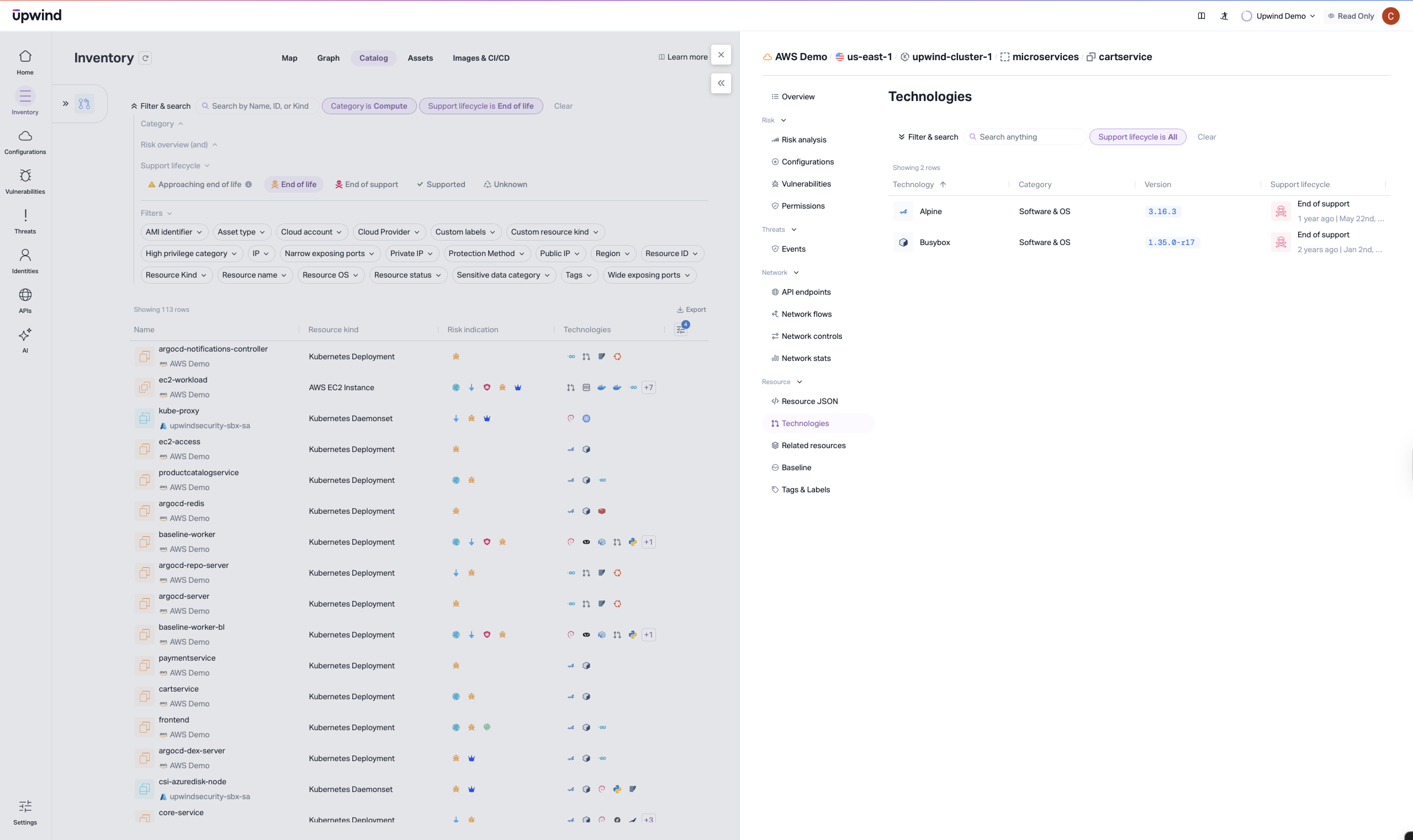
Catalog: Technologies nearing end-of-life or already past support are highlighted directly within the Catalog tab of the Inventory module. Teams can instantly see which resources are running outdated components or approaching lifecycle deadlines, without additional navigation or manual checks.

Resource Details: Each asset includes a dedicated Technologies tab that shows its EOL/EOS classification, support timeline, and relevant lifecycle insights. This helps users assess whether a service is relying on an outdated version and how urgently it needs attention.
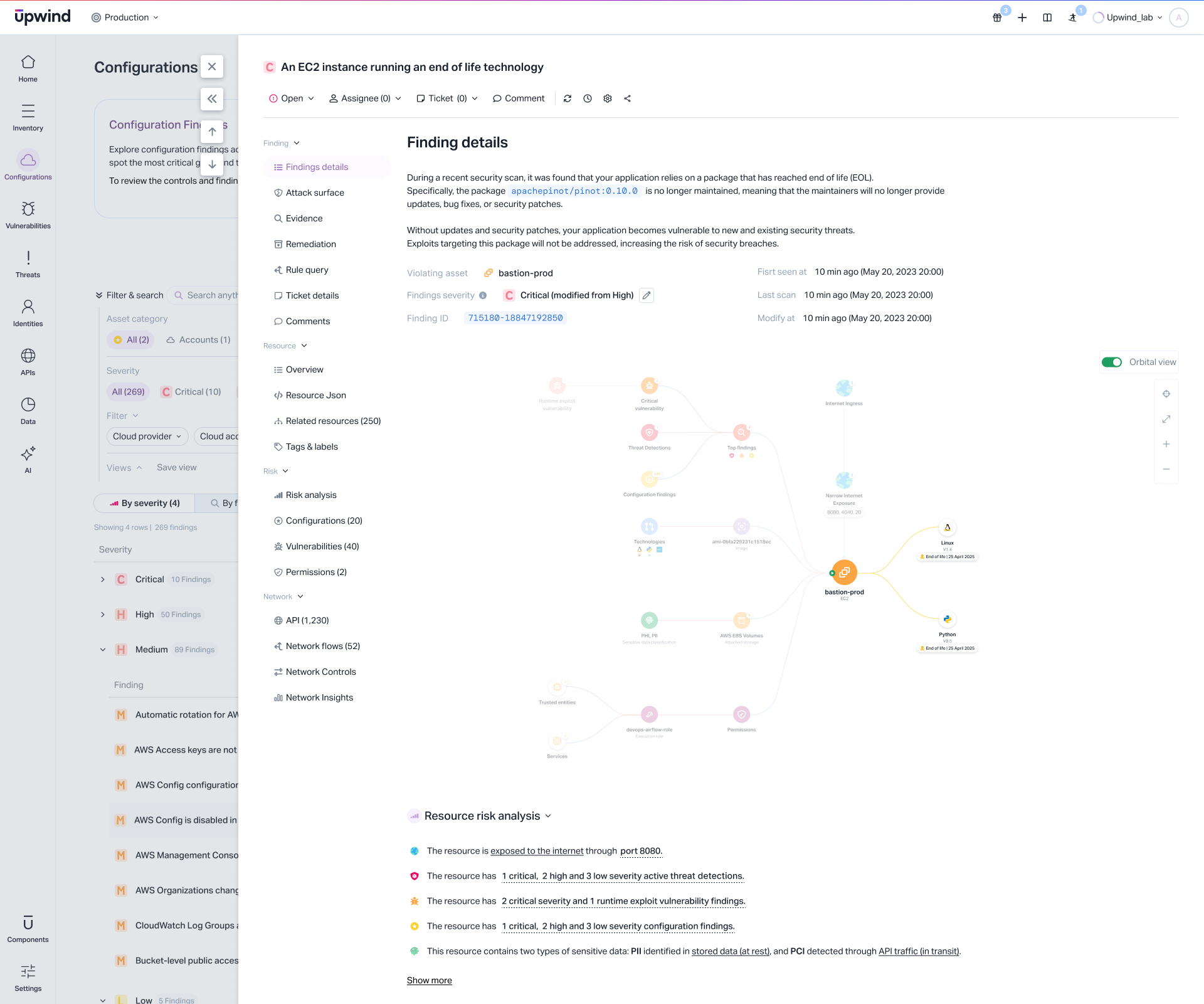
Orbital View: Upwind surfaces EOL/EOS status at a glance while exploring the orbital view, allowing users to quickly understand lifecycle status at a glance while navigating their environment.
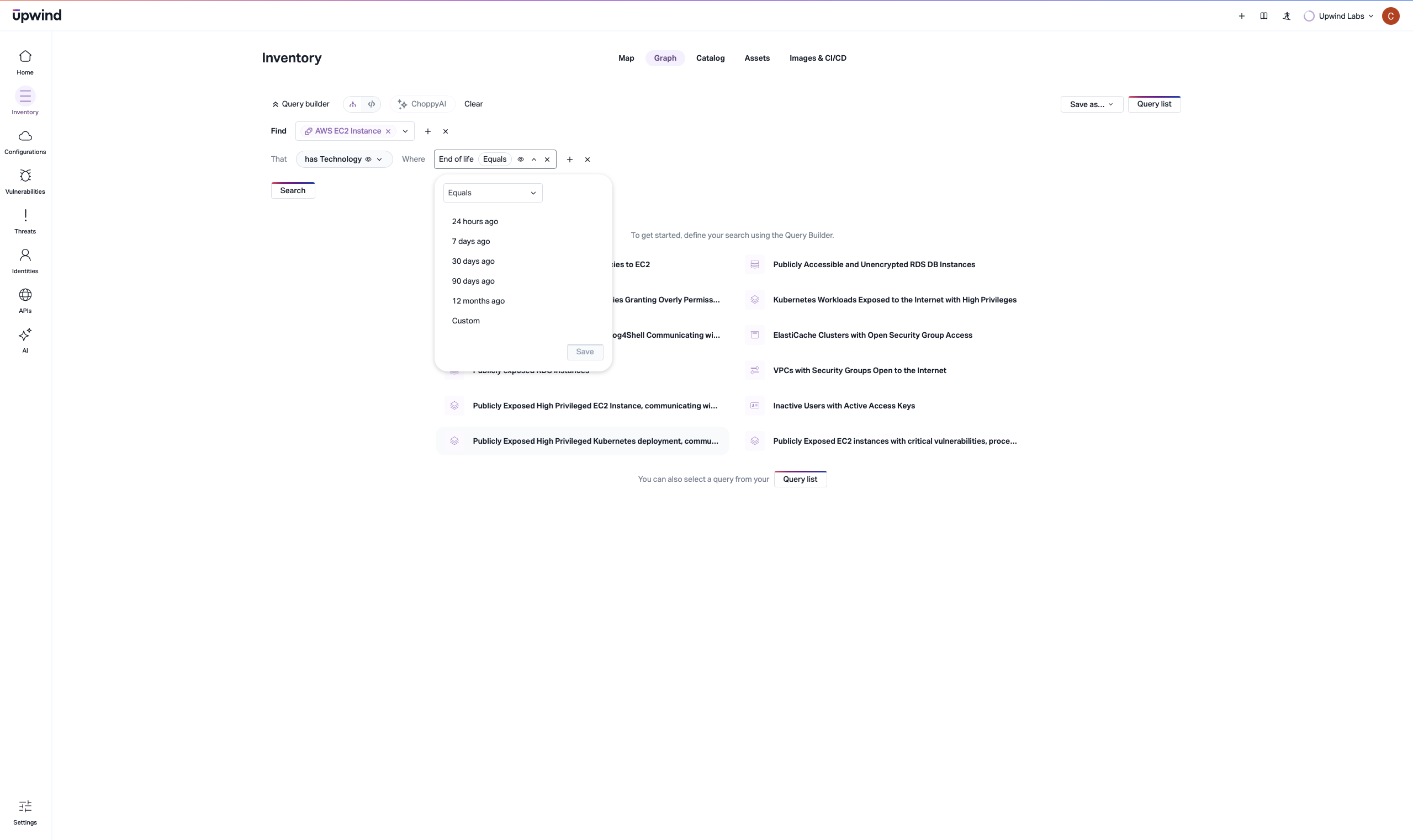
Graph Queries: EOL/EOS attributes can now be queried across your environment, enabling lifecycle investigations at scale. Teams can explore where outdated software is clustering, how unsupported components map across services, and how lifecycle risk intersects with active exposures.
A Real-Time Approach That Sets Upwind Apart
Traditional lifecycle-tracking methods rely on static inventories, periodic scans, or manual documentation – processes that quickly fall out of sync with fast-moving cloud environments. Technologies can be deployed, scaled, or retired in minutes, and tools that depend on infrequent updates simply can’t keep up.
Upwind approaches lifecycle visibility from a completely different angle. Because Upwind continuously observes your live cloud workloads, it always knows which technologies are present and can immediately show you which of them are approaching or past their supported lifespan.
This combination of live environment awareness and lifecycle intelligence gives teams a level of accuracy and timeliness that static tools can’t match. Organizations gain a clear view into where unsupported components exist today and how they intersect with vulnerabilities, misconfigurations, and critical dependencies across the environment.
What’s Coming Next
The introduction of End of Life and End of Support Visibility is just the beginning. In upcoming releases, Upwind will extend lifecycle intelligence even further through:
- Misconfiguration rules that automatically flag outdated or unsupported technologies
- Recommended remediations to guide teams toward timely updates
- Lifecycle-based filtering within the Vulnerabilities module to correlate outdated components with active exposures
These enhancements will allow organizations not just to detect lifecycle risk, but to operationalize and remediate it more efficiently.
See It In Action
End-of-Life and End-of-Support challenges have long been some of the most hidden but impactful risks in cloud environments. With Upwind’s EOL/EOS visibility embedded across Catalog, Resource Details, Orbital View, and graph queries, teams finally gain the real-time clarity needed to understand where outdated technologies live and how they affect the environment.
To see how EOL/EOS visibility can elevate your operational and security strategy, book a customized demo with us and explore the capability live within your environment.