
Key Takeaways
- Trust doesn’t transmit through information. It transmits through presence, the live, two-way exchange where both people are reading each other in real time.
- The most advanced AI researchers alive are now spending enormous effort to rebuild exactly that. They’ve named the thing they were missing: turn-based interaction is a bottleneck.
- Cybersecurity has spent a decade flattening presence into turns, with sequences, nurture tracks, and “personalized” outreach. That flattening is where the trust leaks out.
- AI is very good at the parts of a relationship that were never the relationship. It is bad at the part that was.
- The fix isn’t to reject the technology. It’s to stop pointing it at the one thing it can’t do, and to protect the presence it can’t replace.
A few weeks ago, Mira Murati’s lab, Thinking Machines, put out a research preview of something they’re calling interaction models. If you haven’t seen it, it’s worth your time. This is a serious effort from serious people, the kind of lab that trains a 276-billion-parameter model from scratch and stands up a whole research grant program around a single idea. This is more than a new AI feature bolted onto some other AI product. They’re making an argument about how humans and machines should work together, and they’ve put real money and real engineering behind it.
The argument, as plainly as I can put it, is this: every AI model you’ve ever used works in turns. You talk, it waits. It answers, you wait. Until you finish typing or speaking, the model has no idea what you’re doing or how you’re doing it. Until it finishes generating, its perception freezes, taking in nothing new. Thinking Machines calls this a collaboration bottleneck, and their fix is to make the model perceive and respond at the same time, in a continuous loop across audio, video, and text. The technical term for it is full-duplex. Both directions at once, like a phone call instead of a stack of voicemails.
I read the whole thing twice. And the second time through, I realized they were describing my job.
What an AI lab just spent a fortune proving
I’m not going to pretend to evaluate their benchmarks. That’s not my lane. What grabbed me is the shape of the insight, because I’ve spent twenty years living inside it from the other direction.
The Thinking Machines thesis is that you lose enormous bandwidth when a system can only take the world in through frozen, alternating turns. That a real exchange, the kind where understanding actually happens, requires being present and responsive in the same moment, reading silence and hesitation and interruption as part of the signal. They believe this so strongly that they built an entirely new architecture to get back to it. Some of the smartest people in technology looked at the way we currently interact with machines, decided it was too narrow a channel for real collaboration, and went to work rebuilding presence from scratch.
Now read that again, but with a CISO’s ear. They spent a fortune engineering their way back to the thing a good field CISO already knows in their body: you cannot build a real relationship in turns.
I want to be careful here, because this is not an anti-AI piece, and I’d be the wrong person to write one. The technology is genuinely exciting and the advancement matters. What Thinking Machines is doing will make a hundred things better, and I hope they ship. But the reason their work landed on me the way it did is that they’ve named, in clean technical language, the exact failure I watch cybersecurity commit every single day. We took human relationships, which are full-duplex by nature, and we flattened them into turns. Then we wondered why they stopped working.
Presence is the channel
In an earlier piece I argued that field CISO work is closer to courtship than sales, that by the time a CISO has an urgent project the field of trusted vendors has already been chosen, so the year before the buying moment is the entire game. I still believe every word of it, but that piece left a question open, and it’s the one worth answering now. How does trust actually move between two people? What’s the medium?
It isn’t information. This might shock some, but it’s the part many get wrong. We act as though trust is built by transmitting the right facts in the right order, the right case study, the right proof point, the right “personalized” opener that proves you read someone’s LinkedIn. If that were true, trust would be a delivery problem, and you could solve it with a good enough sequence.
But you can’t, and you know you can’t, because you’ve been on the receiving end. Trust moves through presence. The live, two-way thing where both people are reading each other in real time. Watching how the other person handles being wrong, or being interrupted, or a tangent about their kid’s soccer game. None of that is in a deck. None of it survives being chopped into turns.
I host an event called Cyberkicks, where security leaders and founders sit down together and customize sneakers with paint and markers and whatever else is on the table.
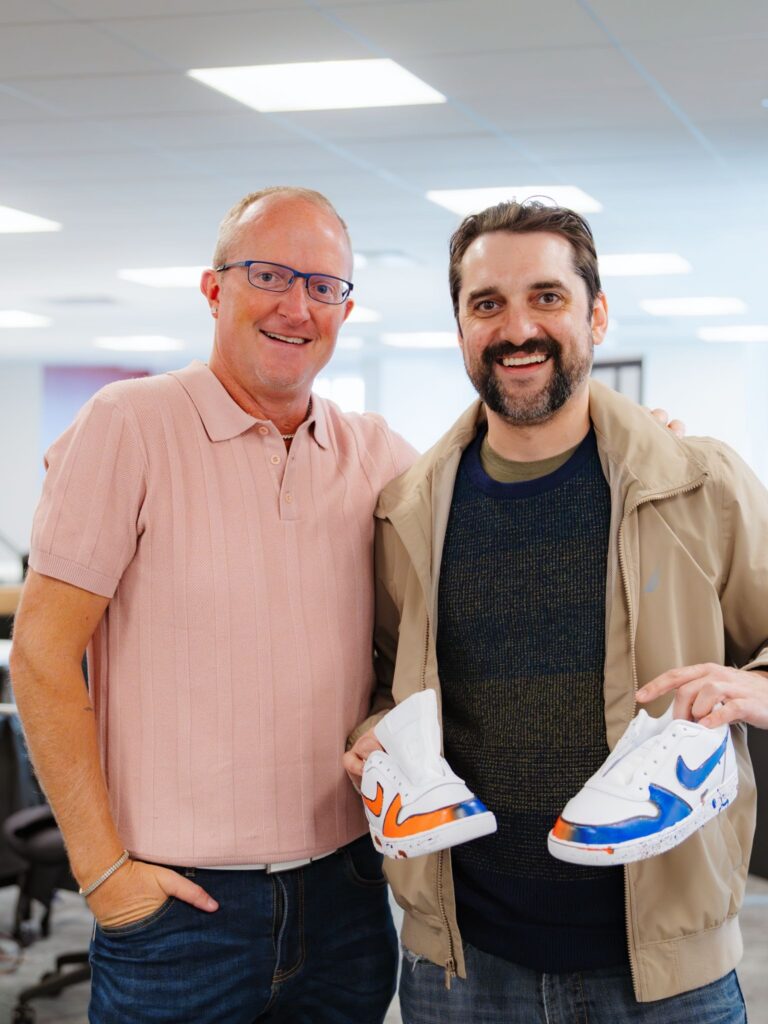
I’ve written before about why it works, but I understand it better now that I have the vocabulary for it. Two people who are theoretically on opposite sides of a transaction argue about the right shade of red for a swoosh, laugh about how bad they are at it, and somewhere in there stop pitching and start trusting. What’s happening at that table is full-duplex. Both people are perceiving and responding in the same continuous moment, reading a hundred tiny signals that no one could write down. The sneaker is just the artifact, the presence is what really matters.
You can’t do that in turns. You can’t backchannel in a cold email. You can’t read someone’s hesitation in a scheduled follow-up. The medium that carries trust is precisely the medium that a sequence strips out.
The thing we automated was never the relationship
Now here’s the part where I’m supposed to sound like the old guy yelling at the cloud, but you won’t catch me doing that. The people building AI outreach tools are not wrong about everything. They’re right about a lot.
The honest version of the AI sales pitch goes like this: a modern agent can identify thousands of prospects a day from intent signals, enrich every one of them with public context, and generate a tailored first-touch email in a couple of seconds, work that used to take a specialist hours. That’s real and I’ve seen it. The mechanical layer of outreach, the research, the list-building, the first draft, genuinely can be done at a scale and speed no human can match, and pretending otherwise just makes you look like you haven’t been paying attention.
But notice what that pitch quietly concedes, because the better vendors say it out loud. Even the most aggressive “infinite scale” outreach tools admit, in the fine print, that AI can’t navigate a multi-stakeholder buying committee, can’t manage a strategic relationship that has to be built over months, and can’t read the room when the context shifts mid-conversation. The most heavily funded company in the category, 11x, raised tens of millions from two of the best investors in the business, and then TechCrunch reported that most of its early customers used contract break clauses to walk away, citing a product that didn’t work as promised.The mechanical parts scaled beautifully. The judgment parts didn’t scale at all.
So the technology is good at the parts of a relationship that were never really the relationship, and bad at the part that actually is. And we keep aiming it at the wrong target, then acting surprised when reply rates collapse and the pipeline number goes up while the conversion rate goes down.
When anyone can send ten thousand emails for pennies, human connection becomes the premium currency. The flood of automated, frictionless, hyper-personalized contact doesn’t make the personal touch less valuable. It makes it the only thing left with any value at all. Scarcity does that.
“I am not anti-technology, I am pro-conversation”
That line isn’t mine. It belongs to Sherry Turkle, the MIT psychologist who has spent close to four decades studying how people relate to machines, and it sums up the position I’m trying to hold. Turkle’s whole body of work draws a line between connection, the surface-level pinging back and forth that technology is very good at multiplying, and conversation, the live, present, empathetic exchange that only happens when two people are actually there with each other. Her warning is that we’ve gotten so good at connection that we’ve started mistaking it for conversation, and quietly lost the conversation that mattered more.
She is not a critic of technology. She arrived at MIT fascinated by what computers could do for us, and she still is. Her point, and mine, is that some things have to stay human, not because the machine is bad but because those things were never the machine’s to do.
In the courtship piece I leaned on two ideas worth bringing back here. The sociologist Mark Granovetter showed that weak ties, the acquaintances and friends-of-friends, are what carry new information through a network. The trust researcher Rachel Botsman defines trust as a confident relationship with the unknown. Put all of it next to the Thinking Machines work and a single picture comes into focus. New information moves through weak ties. Trust is a willingness to engage with someone whose response you can’t predict. And both of those things, the surprise and the connection, live in presence, in the full-duplex moment where you can’t script the other person and you wouldn’t want to. The instant you flatten that exchange into turns, you’ve thrown away the unpredictability that trust is supposed to navigate in the first place.
What this means for the next decade
The world we sell into has changed, and not in our favor. Buying committees are bigger, project windows are shorter, the volume of information aimed at every CISO is overwhelming, and the trust required to close anything is higher than it’s ever been. In a market like that, the temptation is to reach for the tool that promises scale, point it at the relationship, and let it run.
That’s a mistake. Real-time security demands real-time relationships, and a real-time relationship is full-duplex by definition. You build it on the timeline of a friendship, over months and years, before there’s anything to sell, with people you’d still want to talk to if no one ever bought a thing. That part doesn’t compress, and it doesn’t automate, and the harder the tools push to automate it, the more valuable the people who refuse to use it will become.
So use the technology. Let it do the research, draft the first pass, clear the mechanical work off your plate so you have more hours for the part that matters. I mean that. The advancement is real and the leverage is real. Just stop pointing it at the one thing it can’t do. The smartest AI lab in the world just spent enormous effort proving that presence is a thing worth rebuilding from scratch. The least we can do, on the human side of the table, is stop throwing ours away.
The next decade will reward the companies that understand this and slowly leave behind the ones that don’t. Not because those companies will do anything obviously wrong. They’ll do exactly what the tools told them to do. They’ll run a perfectly optimized, infinitely scalable transaction, in an industry that has quietly turned into a relationship business.
Jake Martens is the Field CISO at Upwind. He hosts Cyberkicks events for security leaders and founders in cities around the world. Follow him on LinkedIn for the next one. More of his writing on cloud security, runtime intelligence, and the field CISO role lives at upwind.io/blog.