Get a Demo
Under Attack?
A pattern of red traffic cones arranged in rows on a gradient background transitioning from sandy beige to deep blue, resembling a shoreline with foamy waves.

Detect Suspicious Spambot Port 25 Communication

<br />
<b>Warning</b>:  Undefined variable $photo in <b>/nas/content/live/landing173/wp-content/themes/bricks/includes/elements/code.php(236) : eval()'d code</b> on line <b>24</b><br />
<br />
<b>Warning</b>:  Trying to access array offset on value of type null in <b>/nas/content/live/landing173/wp-content/themes/bricks/includes/elements/code.php(236) : eval()'d code</b> on line <b>24</b><br />
Denise Ashur April 10, 2024

Detect Suspicious Spambot Port 25 Communication

We are excited to announce the release of a new threat detection type – Spambot detection that targets suspicious activity on Port 25.

A Spambot detection alerts you that a resource in your environment is abnormally communicating with a remote host most commonly via port 25.

What is SMTP?

Simple Mail Transfer Protocol (SMTP) is an email protocol and one of multiple internet protocols that use plaintext, meaning that the communication is easy to see and read. When sending plaintext, SMTP uses port 25. Many firewalls and end-user networks block port 25, since spammers try to abuse it and send large amounts of spam.

Indicators of Compromise

There are several ways that SMTP can be used for malicious purposes, including phishing and spam emails, as well as being used by an attacker in reconnaissance when preparing for an attack.
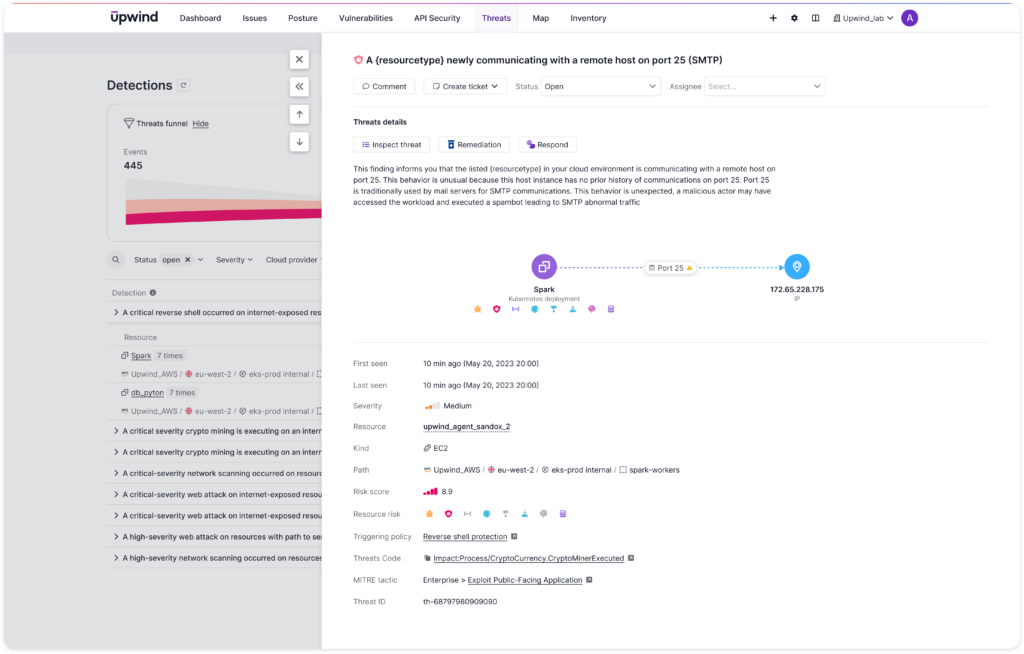
spambot-detection-1024x654

Upwind’s Spambot detection informs you that a resource within your environment is abnormally communicating with a remote host on port 25, with no prior history of communications on port 25 between this resource and host. This behavior could indicate that a malicious actor has accessed a workload and executed a spambot leading to abnormal SMTP traffic.

There are several kinds of common Spambot attacks, including:

  1. Spam and phishing emails: an attacker compromises an organization’s mail server and sends phishing emails from a compromised account. 
  2. Emailing malwares: while less common in recent years, mass-mailer malware worms have historically been sent to distribute malware through email when opened by the recipient.
  3. Credential stealing: an attacker discovers email addresses and sends spam to try to gain their credentials to online services. Attackers can also use SMTP with a VRFY command to validate email addresses.

Spambot attacks are common, and they can pose a significant danger to organizations if an attacker is able to gain access to a workload and execute a spambot, potentially leading to attacks such as those listed above, or to carrying out reconnaissance ahead of a larger planned attack on your infrastructure or network.

Upwind leverages runtime data to rapidly identify unusual port 25 communication and immediately alert you to suspicious activity. Read more about Spambot detections in the Upwind Documentation Center.

Contents

Further Reading

OpenAI Breach

Everyone Read the OpenAI Breach as a Model Story, But It Was a Runtime Story

Key Takeaways Autonomous AI agents can now break out of a sandbox, cross an internal network, and breach a production system with no human at the keyboard. OpenAI's evaluation that hacked Hugging Face this month is the clearest proof on record. Most of the coverage read it as a story about a model turning dangerous.…
upwind-identities

Introducing the Upwind Identity Graph: End-to-End Identity Security

Identity used to be treated as a directory problem: find the user, inspect the groups, review the assigned roles, and decide whether the account has too much access. That model no longer matches the cloud. A single person may authenticate through Okta, inherit permissions from multiple groups, receive role assignments in more than one cloud,…
AI-Graph

Introducing the Upwind AI Graph: Extending AI Inventory Beyond Cloud Infrastructure

As enterprise adoption of artificial intelligence accelerates, modern AI infrastructure has expanded far beyond traditional cloud perimeters. Securing enterprise AI today requires complete visibility across four distinct operational layers: Traditional cloud security tools stop at the cloud provider boundary. When enterprise teams connect directly to external AI Providers, security teams lose sight of access paths,…
Add the Upwind RSS Feed to Slack
Connect the Upwind RSS Feed to your Slack.
Follow the how-to here.
Threat RSS
Add the Upwind RSS Feed to Slack
Connect the Upwind RSS Feed to your Slack.
Follow the how-to here.
Main RSS