Get a Demo
Under Attack?
Diagram showing blue arrows moving left to right, indicating data flow. A dashed red line cuts through, suggesting a breach. A lock icon is present, implying security. The word upwind is in the top left corner.

Detect Unusual DoT Communications

<br />
<b>Warning</b>:  Undefined variable $photo in <b>/nas/content/live/landing173/wp-content/themes/bricks/includes/elements/code.php(236) : eval()'d code</b> on line <b>33</b><br />
<br />
<b>Warning</b>:  Trying to access array offset on value of type null in <b>/nas/content/live/landing173/wp-content/themes/bricks/includes/elements/code.php(236) : eval()'d code</b> on line <b>33</b><br />
Joshua Burgin May 02, 2024

Detect Unusual DoT Communications

We are excited to announce a new detection type, identifying unusual DoT activity.

This detection notifies you of unusual DNS over TLS (Transport Layer Security) communication, often referred to as DoT, which could indicate attempts to blend malicious communications with regular encrypted web traffic to evade detection.

DNS over TLS (DoT) 

DNS is a crucial part of infrastructure that maps out IP addresses for hosts connected to the internet through a process called DNS resolution, allowing users to access websites with user-friendly names rather than remembering specific IP addresses for sites.

DNS is a fundamentally “insecure” network whose communication can easily be intercepted. To avoid security risks, DNS needs TLS or HTTPS (Hypertext Transfer Protocol Secure) encryption protocols to improve network security.

TLS is a widely-used protocol that is designed to keep data secure in Internet communications. By using DNS over TLS, users can protect data that is being transferred, keeping it private even if it is intercepted. By using DNS over TLS (DoT), you send DNS requests over an encrypted TLS tunnel and can ensure the data is not readable by unauthorized parties – acting as a needed safeguard against data breaches. 

This is why DoT has become a popular method of safeguarding DNS communications.

Indicators of Compromise 
Screenshot-2024-04-30-at-10.56.50%E2%80%AFAM-1024x561

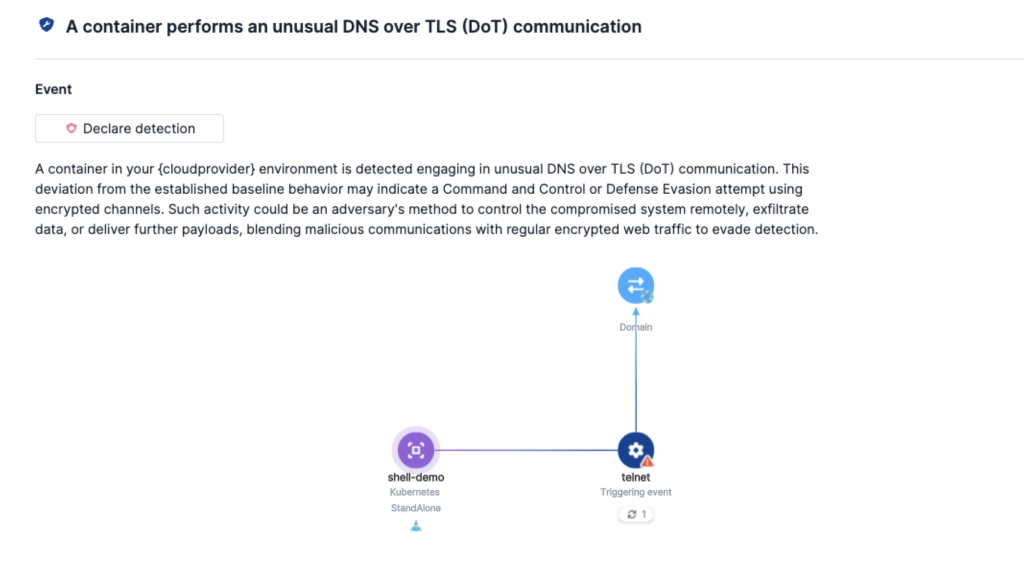
While DoT helps safeguard data, it can still be compromised by attackers. Upwind detects when a host or container in your cloud environment engages in DoT communication that deviates from established baseline behavior, which may indicate a “Command and Control” or “Defense Evasion” attempt using encrypted channels. This unusual communication could indicate an attacker’s method to compromise your system remotely, exfiltrate data, or deliver further payloads, blending malicious communications with regular encrypted web traffic to evade detection.

Upwind leverages runtime data to rapidly identify unusual DNS over TLS (DoT) communication and immediately alert you to suspicious activity. Read more about DNS over TLS (DoT) detections in the Upwind Documentation Center.

Contents

Further Reading

KSPM-Agentless-Scanning

Complete KSPM: From Pull Request to Production Runtime

Kubernetes environments move fast. Workloads appear and disappear, container images change continuously, services are exposed, permissions evolve, and development teams deploy updates throughout the day. But most cloud security platforms force practitioners to investigate Kubernetes risk through interfaces designed for the broader cloud, leaving teams to manually filter the noise before they can begin investigating…
Upwind MCP Server

Revolutionizing Security Investigations with the Upwind MCP Server

Frontier AI models combined with a rampant rate of new critical vulnerabilities mean speed and context are everything. When a critical production service starts behaving suspiciously, every second spent jumping between different tools and dashboards is a second lost to a potential attacker. At Upwind, we are excited to introduce a game-changer for security teams:…
Security Feed - Threat

No npm Token Required: Inside the AsyncAPI Supply Chain Attack

Executive Summary Upwind identified a critical supply chain compromise across five npm packages in the @asyncapi scope, published on July 14, 2026 via two separate branch compromises in two GitHub repositories. The attacker never touched an npm token. They abused each project's own CI pipeline through GitHub Actions OIDC to publish the malicious packages. The…