Get a Demo
Under Attack?
A promotional graphic for Upwind featuring the text Evaluate Your Vulnerability Resolution Over Time. It shows colorful umbrellas and abstract shapes against a gradient blue to sand-colored background.

Evaluate Your Vulnerability Resolution Over Time

<br />
<b>Warning</b>:  Undefined variable $photo in <b>/nas/content/live/landing173/wp-content/themes/bricks/includes/elements/code.php(236) : eval()'d code</b> on line <b>24</b><br />
<br />
<b>Warning</b>:  Trying to access array offset on value of type null in <b>/nas/content/live/landing173/wp-content/themes/bricks/includes/elements/code.php(236) : eval()'d code</b> on line <b>24</b><br />
Denise Ashur February 19, 2024

Evaluate Your Vulnerability Resolution Over Time

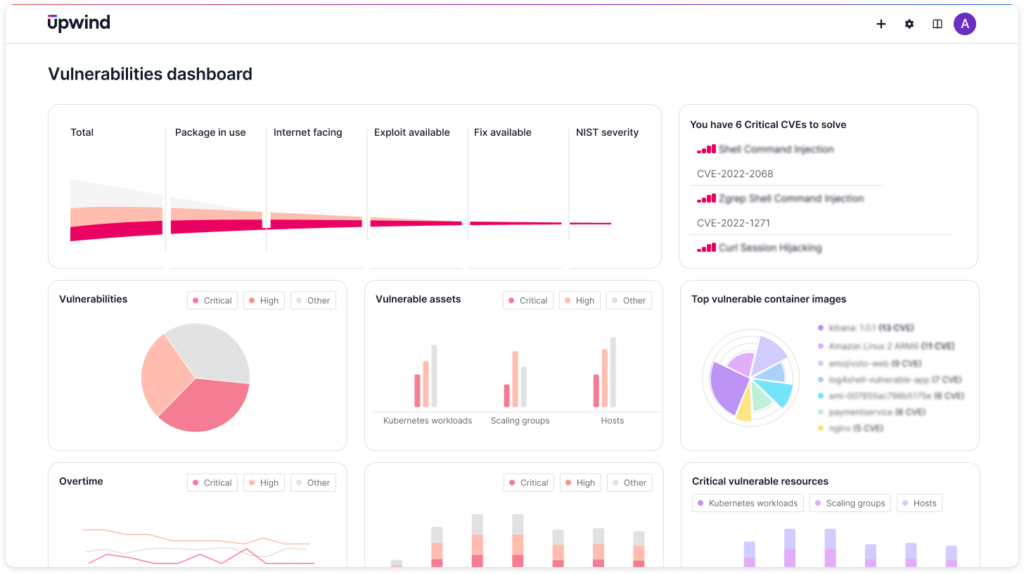
We are excited to announce a new section in the Upwind Platform – the Vulnerability Dashboard. 

The Vulnerability Dashboard will give you the ability to see both an overview of your current critical vulnerabilities and the state of your vulnerabilities over time. 

Get an instant overview of your current vulnerabilities, including:

  • the most critical vulnerabilities that should be prioritized for remediation 
  • the amount of vulnerabilities by severity
  • the number of CVEs and severities for Kubernetes workloads, scaling groups, and hosts. 
  • top container images with the highest number of critical CVEs.
Vulnerabilities-dashboard-mock-A-1024x574

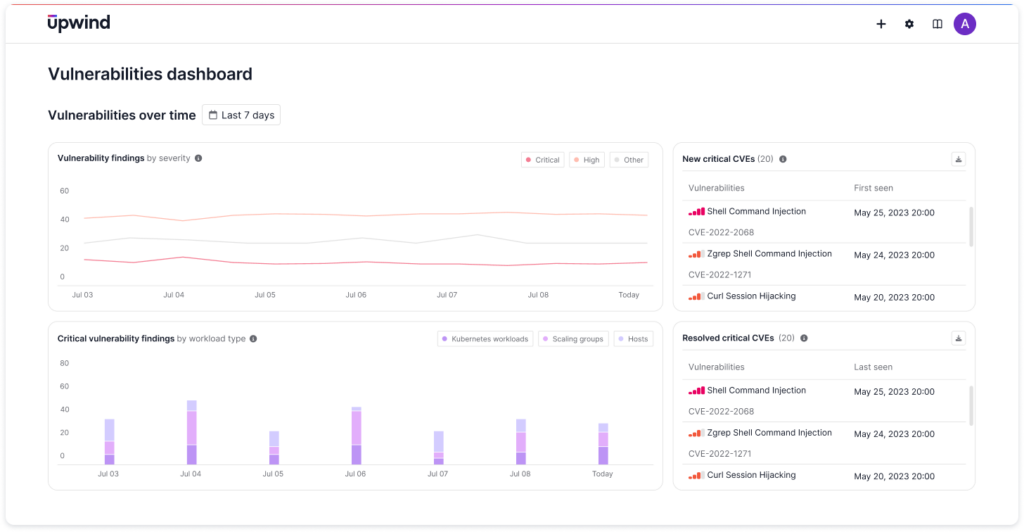
The Vulnerability Dashboard will also give you high-level insights into your vulnerability management over time, including: 

  • how your environment was exposed over a period of time 
  • how many new vulnerabilities were introduced versus how many were resolved 
  • the number of CVEs count and severities for each workload type over a period of time
Vulnerabilities-dashboard-mock-B-1024x532

Use Upwind’s Vulnerability Dashboard to easily get a high-level overview of the state of your vulnerabilities, and use this feature to evaluate and track your organization’s progress with vulnerability remediation over time. 

Contents

Further Reading

OpenAI Breach

Everyone Read the OpenAI Breach as a Model Story, But It Was a Runtime Story

Key Takeaways Autonomous AI agents can now break out of a sandbox, cross an internal network, and breach a production system with no human at the keyboard. OpenAI's evaluation that hacked Hugging Face this month is the clearest proof on record. Most of the coverage read it as a story about a model turning dangerous.…
upwind-identities

Introducing the Upwind Identity Graph: End-to-End Identity Security

Identity used to be treated as a directory problem: find the user, inspect the groups, review the assigned roles, and decide whether the account has too much access. That model no longer matches the cloud. A single person may authenticate through Okta, inherit permissions from multiple groups, receive role assignments in more than one cloud,…
AI-Graph

Introducing the Upwind AI Graph: Extending AI Inventory Beyond Cloud Infrastructure

As enterprise adoption of artificial intelligence accelerates, modern AI infrastructure has expanded far beyond traditional cloud perimeters. Securing enterprise AI today requires complete visibility across four distinct operational layers: Traditional cloud security tools stop at the cloud provider boundary. When enterprise teams connect directly to external AI Providers, security teams lose sight of access paths,…
Add the Upwind RSS Feed to Slack
Connect the Upwind RSS Feed to your Slack.
Follow the how-to here.
Threat RSS
Add the Upwind RSS Feed to Slack
Connect the Upwind RSS Feed to your Slack.
Follow the how-to here.
Main RSS