
Get a Demo
Under Attack?
A blue and orange graphic with the Upwind logo in the top left. In the center, an astronaut helmet with a small star is next to the text “gVisor” on a dark blue background with a large orange semi-circle on the left.

Unlock Runtime Visibility for gVisor Sandboxed Containers

Unlock Runtime Visibility for gVisor Sandboxed Containers

Upwind Sensor now brings runtime visibility to gVisor sandboxed containers, proactively identifying threats in environments built for maximum isolation. gVisor acts as a security layer between containerized apps and the host OS, improving security and isolation, which is especially important for containers running sensitive workloads. With our new support for gVisor, strong isolation no longer comes at the cost of reduced security telemetry, enabling effective threat detection and runtime analysis across all containerized workloads.

What is gVisor?

gVisor is an open source security-focused container runtime, originally developed by Google and written in Go, that provides isolation between applications and their host operating system. Unlike traditional container runtimes that rely on kernel namespaces and cgroups, gVisor implements a user-space kernel, effectively acting as a “sandbox” for your containers. 

Here’s how gVisor strengthens container security: 

  • Sandbox containers: gVisor acts as a security boundary between your container and its host OS. gVisor intercepts syscalls made by the container, reducing container attack surface.
  • Reduce kernel exposure: Since the host kernel isn’t directly exposed to the container while utilizing gVisor, the kernel is less susceptible to container escape vulnerabilities.
  • Mitigate kernel-level exploits: Even if the container is compromised, the attacker would still be restricted by gVisor’s user-space kernel.

Why are we enabling gVisor within the Upwind Sensor?

With gVisor operating as a sandboxed kernel, Upwind now supports tracing inside these secure environments, which delivers the deep runtime visibility teams expect, without sacrificing container isolation.
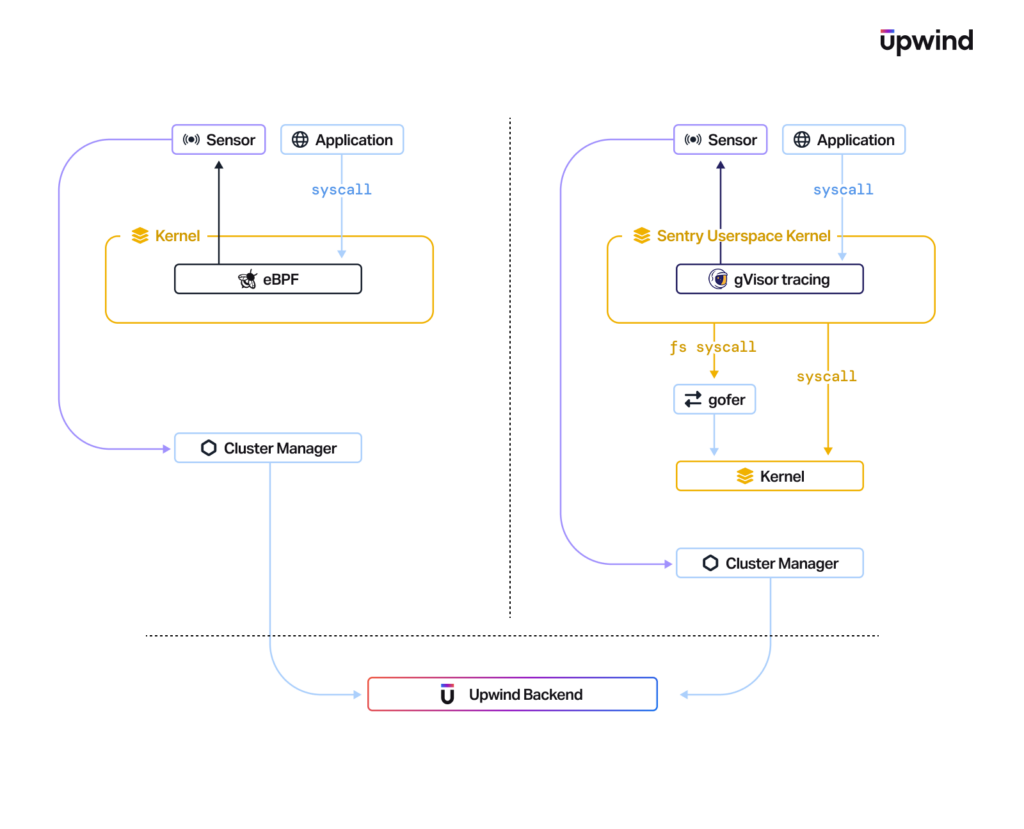
A comparison diagram showing two architectures: on the left, eBPF in the Kernel; on the right, gVisor tracing in Sentry Userspace Kernel. Both interact with sensors, applications, cluster managers, and the Upwind Backend.
By enabling gVisor tracing within the Upwind Sensor, we’ve extended observability into sandboxed container environments that were previously opaque.

Our integration taps into gVisor’s remote sink protocol and syscall trace points to deliver real-time visibility into container behavior. Even within a user-space kernel, you get the runtime insights needed for effective threat detection – ensuring comprehensive protection for isolated workloads.

AD_4nXd-r2PJD4NRud9Eak9DHBxZxESj4ZGM6cxEXzkjpbHniefw5jOf9LfYvf8EZW67ULsGh_kqGbGIxa7f5msQ73ao65w_wZLqFGbAb3x8N5T5KAriQm9jp9YhmLeGG2sPGmhcf3A3?key=cmyymCzar0UG8WcUcrXS372f
Container image vulnerability detection in the Upwind Platform

Running gVisor? Let us show you how to gain full runtime visibility without giving up the isolation your security depends on – schedule a demo or drop us a line at [email protected]

Contents

Further Reading

Blue-agent-blog

Introducing the Upwind Blue Agent: Autonomous Threat Investigation for the SOC

We’re excited to announce that the Upwind Blue Agent is now available in Beta. Blue is an AI-powered SOC investigator that autonomously investigates Upwind Threat Stories end to end. It gathers and correlates security context across the customer environment, evaluates the available evidence, and delivers one of three clear verdicts: Each verdict includes supporting reasoning…
AI-will-make-software-more-secure

AI Will Make Software More Secure. The Transition Won’t Be Pretty

I believe AI is going to make us much more secure. But probably not tomorrow. In fact, I think the next two years may be exactly the opposite: attackers will have the upper hand before defenders eventually turn the economics of cybersecurity in their favor. For decades, we have built software with vulnerabilities and then…
Vulnerability Management

Vulnerability Management Requires Real-Time Intelligence

Security teams aren't short on data. But they’re often short on context and time. The average vulnerability management program is buried in alerts, running on scan results that are hours or days old, and facing both savvy and unskilled attackers that can leverage AI to develop sophisticated exploits in minutes. That combination is why backlogs…
Add the Upwind RSS Feed to Slack
Connect the Upwind RSS Feed to your Slack.
Follow the how-to here.
Threat RSS
Add the Upwind RSS Feed to Slack
Connect the Upwind RSS Feed to your Slack.
Follow the how-to here.
Main RSS