
Get a Demo
Under Attack?
Illustration of a cargo dock with stacks of blue and pink shipping containers, some bearing the logo Upwind. The scene includes overhead structures and rows of containers along a dock under bright lighting.

Automatically Discover API Sensitive Data Flows

<br />
<b>Warning</b>:  Undefined variable $photo in <b>/nas/content/live/landing173/wp-content/themes/bricks/includes/elements/code.php(236) : eval()'d code</b> on line <b>24</b><br />
<br />
<b>Warning</b>:  Trying to access array offset on value of type null in <b>/nas/content/live/landing173/wp-content/themes/bricks/includes/elements/code.php(236) : eval()'d code</b> on line <b>24</b><br />
Joshua Burgin October 22, 2024

Automatically Discover API Sensitive Data Flows

We are excited to announce a significant new addition to Upwind’s API Security capability – the automatic discovery and classification of sensitive data flows.

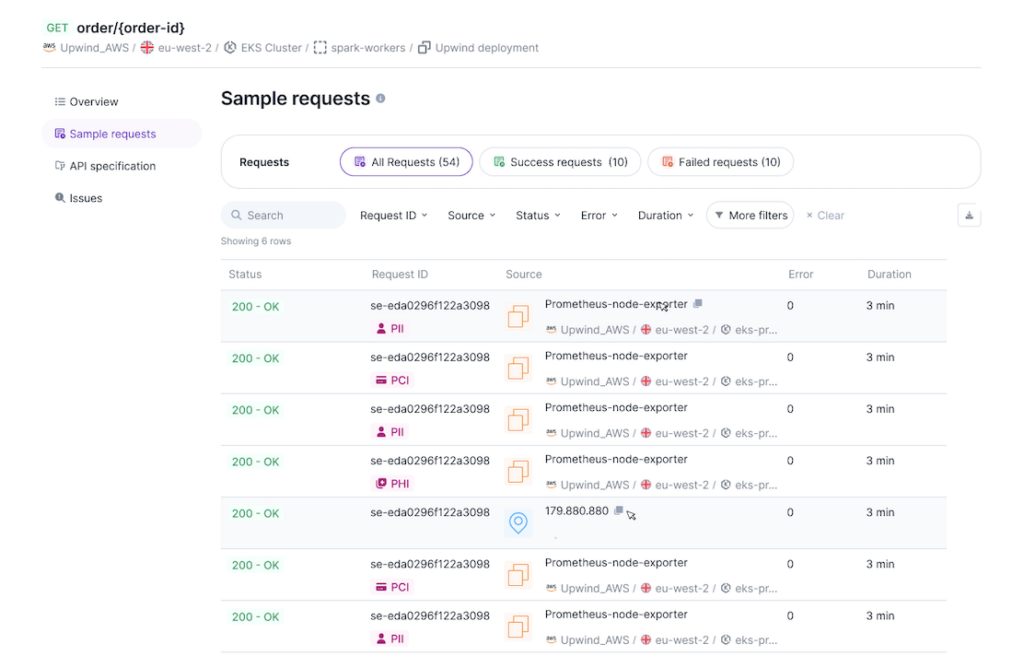
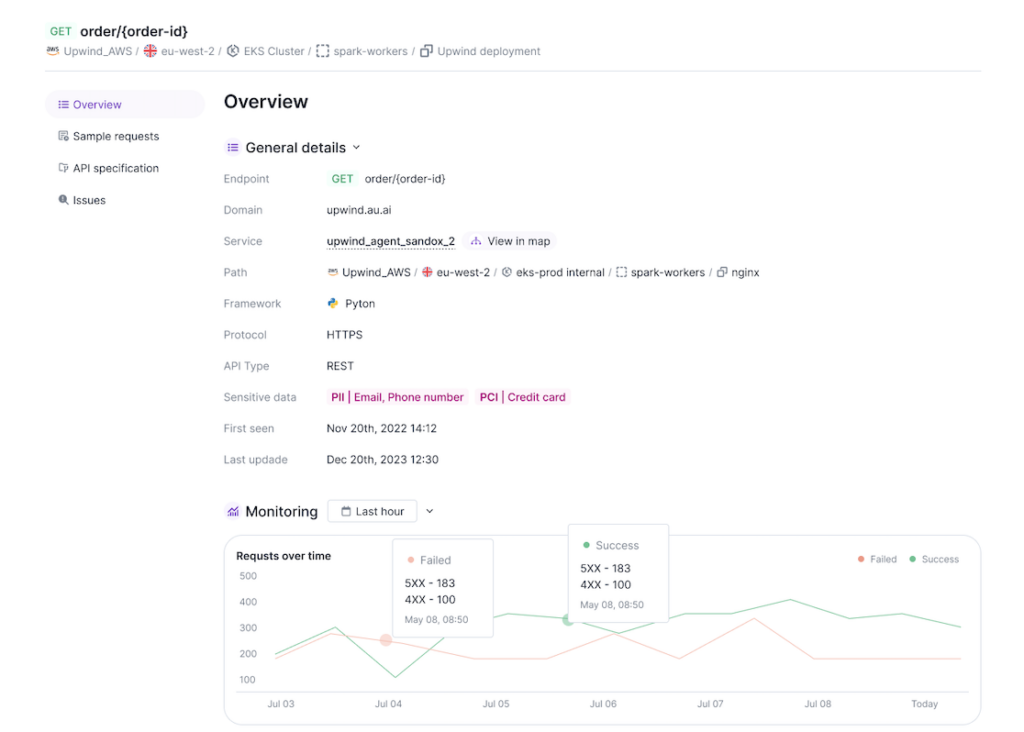
Upwind automatically tracks sensitive data routes and classifies sensitive data as PCI, PII, and PHI by analyzing API samples recognized by the Upwind sensor, making it easy to identify where you are at elevated risk.
Screenshot-2024-08-30-at-9.50.26%E2%80%AFAM-1024x656

Examples of sensitive data that Upwind identifies include:

  • PHI data: patient information, medical records & insurance information
  • PII data: SSNs, IDs and emails
  • PCI data: credit cards and billing information
Screenshot-2024-08-30-at-9.50.02%E2%80%AFAM-1024x732

How Upwind Identifies Sensitive Data Flows

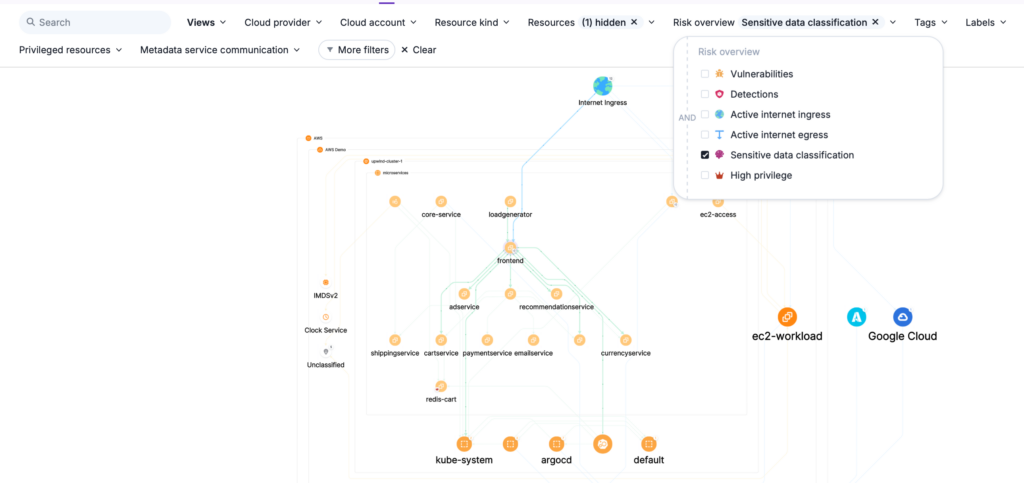
In order to identify sensitive data flows, Upwind searches for patterns at the packet level and then masks any data found, ensuring it remains secure and is never sent outside of your environment. When an API request for sensitive data  is detected, Upwind labels it with a sensitive data tag and classifies it by its type and category, such as PCI for a MasterCard number. We are continuing to extend this capability, and customers will soon be able to create their own custom regular expression (regex) to classify sensitive data.
Screenshot-2024-09-04-at-6.13.58%E2%80%AFAM-1024x483

Use Upwind’s automated sensitive data flow tracking to easily understand API data security risks, prioritize remediation efforts for APIs with sensitive data flows, and ensure a proactive approach to data security. 

Learn More

To learn more about Upwind API Security, visit the Upwind Documentation Center (login required), or schedule a demo.

Contents

Further Reading

ArgoCD repoURL XSS

ArgoCD repoURL XSS: How a Missing Scheme Check Becomes Cluster Takeover (CVE-2026-62341)

Executive Summary  CVE-2026-62341 is a stored cross-site scripting (XSS) vulnerability in ArgoCD [versions <= 3.4.6] that lets an attacker who can create or modify an Application persist a malicious repoURL, which then executes in an administrator's browser inside the ArgoCD origin. Because the payload rides the admin's authenticated session, and because ArgoCD's controller typically runs…
The Risk Isn't What You Prompt, It's What You Built.

The Risk Isn’t What You Prompt, It’s What You Built

Key Takeaways: Agentic AI security is an architecture problem, not a policy problem. Most organizations have adopted AI agents in the form of coding assistants, autonomous workflow tools, internal chatbots connected to production systems, but without establishing the foundational security frameworks those systems require. The adoption pressure is real. Telling your engineering team to stop…
Upwind is a Visionary Leader in Frost & Sullivan report

Upwind Named a Strong Visionary Leader in Frost & Sullivan’s 2026 Cloud/Application Runtime Security Radar

We're excited to share that Frost & Sullivan has recognized Upwind as a Strong Visionary Leader in the Frost Radar™: Cloud/Application Runtime Security, 2026. This recognition highlights the company's innovation, growth, and leadership in the emerging Cloud-Native Application Detection and Response (CNADR) market. For us, the recognition is meaningful not simply because of where Upwind…
Add the Upwind RSS Feed to Slack
Connect the Upwind RSS Feed to your Slack.
Follow the how-to here.
Threat RSS
Add the Upwind RSS Feed to Slack
Connect the Upwind RSS Feed to your Slack.
Follow the how-to here.
Main RSS