
Running containers on Amazon Web Services (AWS) offers flexibility and scalability for modern application architectures, but it also introduces unique security, management, and compliance challenges. We’ve already discussed unique aspects of AWS container security. In this article, we take a broader view of the unique features of AWS containers that you need to know about before you address specific security concerns. How can your organization address complex issues such as container orchestration and compliance using AWS containers? We’re mapping the basics.
Understanding AWS and Containers
The advent of containerization has reshaped how applications are developed and deployed, enabling teams to package software with all its dependencies for consistent performance across environments. AWS doesn’t create its own container runtime (like services such as Docker or Podman), though it has its own runtime designed for lightweight microVMs. Instead, it provides several managed services to run, scale, and secure containers within the AWS cloud environment.
AWS’s core container services include:
- Amazon ECS (Elastic Container Service): A fully managed service for deploying containers, designed for simple orchestration and seamless integration with AWS services.
- Amazon EKS (Elastic Kubernetes Service): A managed Kubernetes service for teams looking to use Kubernetes as their container orchestration platform.
- AWS Fargate: A serverless compute engine that removes the need to manage infrastructure by running containers directly without provisioning or managing servers.
These services simplify container orchestration and management by integrating tightly with AWS’s broader suite of cloud tools. This tight integration offers advantages like seamless scaling and managed runtime patching but also introduces unique challenges. For instance, configuring secure access control requires effective use of AWS Identity and Access Management (IAM), while maintaining network isolation depends on correctly setting up Virtual Private Cloud (VPC) environments.
Moreover, while AWS automates tasks like patching and updates for the container runtime (in Fargate and in managed node groups with EKS and ECS), teams remain responsible for securing their container workloads. That includes gaining visibility into running containers, addressing vulnerabilities in application code or third-party dependencies, and ensuring compliance with organizational security policies.
Runtime and Container Scanning with Upwind
Upwind offers runtime-powered container scanning features so you get real-time threat detection, contextualized analysis, remediation, and root cause analysis that’s 10X faster than traditional methods.
Get a DemoCore AWS Container Services
Building on AWS’s managed container ecosystem, its core services—ECS, EKS, and Fargate—offer flexible solutions for running and scaling containers based on organizational needs. These services address the complexities of container runtime, orchestration, and serverless execution while seamlessly integrating into AWS’s infrastructure.
- Amazon ECS (Elastic Container Service): Designed for simplicity, ECS provides AWS-native container orchestration tailored for users who prefer a managed, non-Kubernetes environment. By relying on Docker for runtime and leveraging IAM for access control, ECS enables organizations to quickly deploy and manage containerized workloads.
- Amazon EKS (Elastic Kubernetes Service): For teams invested in Kubernetes, EKS offers a managed version of the open-source platform integrated with AWS’s networking and security tools. It eliminates the operational burden of running Kubernetes while maintaining compatibility with upstream Kubernetes configurations.
- AWS Fargate: Fargate takes serverless execution a step further by abstracting away infrastructure concerns. Developers can focus on building and deploying containers without managing clusters, instances, or scaling policies.
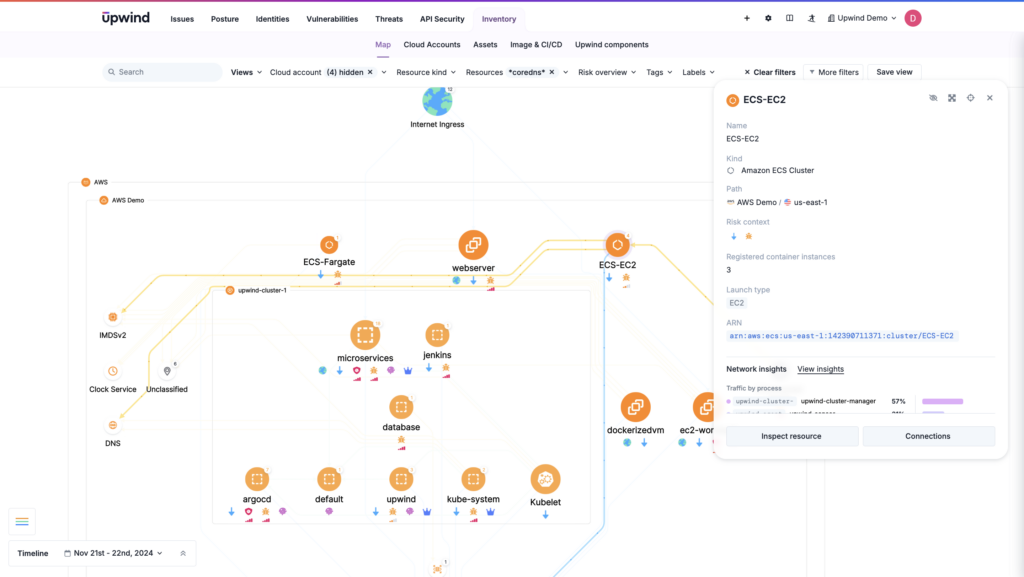
These services collectively address diverse needs, from managing large Kubernetes clusters to running lightweight, serverless applications. Additionally, AWS tools like Lambda complement containerized workloads by enabling event-driven functionality outside the runtime environment.
Container Orchestration in AWS
Container orchestration in AWS involves managing the deployment, scaling, and communication of containerized applications across ECS, EKS, or Fargate.
While AWS simplifies many of these tasks, the orchestration layer introduces both security risks and operational challenges that vary depending on the service you use.
For example:
- ECS provides AWS-native orchestration but relies heavily on AWS integrations for networking and task scheduling.
- EKS introduces Kubernetes-specific complexities, such as cluster node scaling and management of open-source Kubernetes configurations.
- Fargate abstracts most of the orchestration responsibilities, but its serverless model limits direct control over resource allocation.
Understanding how these orchestration features behave across AWS services can help teams optimize containerized workloads and mitigate risks.
| Key Features | Risks to Address | Applicability | |
| Cluster Management and Scheduling | Automates container placement based on resource needs | Misconfigurations can disrupt workloads. Fargate reduces user control since scheduling is abstracted, and Kubernetes (EKS) adds complexity with pod scheduling (e.g., node affinities, tolerations). | ECS: Simplifies task scheduling.EKS: Requires Kubernetes-specific scheduling policies. Fargate: Fully AWS-managed with no direct control over scheduling. |
| Automatic Scaling | Dynamically adjusts container resources based on workload demand to optimize performance and cost. | Over-provisioning wastes resources; under-provisioning degrades performance. Scaling delays can cause apps to fail during traffic spikes. | ECS: Uses AWS-native scaling rules.EKS: Integrates Kubernetes Horizontal Pod Autoscaler. Fargate: Scaling is fully automated, without user configuration. |
| High Availability and Fault Tolerance | Ensures workloads are distributed across AWS availability zones, maintaining uptime during failures. | Communication between zones must be secured to prevent exposure. Regulatory requirements (e.g., data sovereignty) add complexity for multi-region deployments. Fargate’s abstraction limits visibility into fault management. | Applies universally across ECS, EKS, and Fargate, but user control varies (less in Fargate). |
| Service Discovery and Load Balancing | Ensures seamless communication between containers and balances traffic across services to maintain performance. | Misconfigurations may expose containers to unauthorized traffic. Inefficient load balancing could cause downtime or bottlenecks. | ECS: Integrates AWS Cloud Map for service discovery.EKS: Uses Kubernetes DNS or IP-based discovery. Fargate: AWS manages these functions automatically. |
| CI/CD Integration and Automation | Communication between zones must be secured to prevent exposure. Regulatory requirements (e.g., data sovereignty) add complexity to multi-region deployments. Fargate’s abstraction limits visibility into fault management. | It supports pipelines (e.g., CodePipeline, Jenkins) to automate the build, test, and deployment stages. | Applies universally to ECS, EKS, and Fargate, though manual setup is required for ECS and EKS pipelines. |
Container Use Cases and Architecture Patterns
Container orchestration lays the foundation for how containers are deployed, scaled, and managed within AWS, but how do these capabilities translate to real-world applications? The choice between services like ECS, EKS, and Fargate depends not only on orchestration features but also on how they fit into broader use cases and operational strategies.
Building Microservices-based Applications
Containers enable the isolation of microservices, allowing each service to be developed, tested, and deployed independently. This modularity is a natural fit for AWS container orchestration services like ECS, EKS, and Fargate, which handle scaling, updates, and service discovery across distributed microservices.
However, as the number of microservices grows, so does the potential attack surface. Securing communication between services (e.g., API calls) and managing service-to-service permissions becomes increasingly complex. Organizations can address these challenges by implementing granular IAM roles for each service and enforcing network segmentation using VPCs and security groups.
Running Apps Across On-Premises and Cloud Environments
Hybrid and multi-cloud architectures are becoming the norm, with 76% of companies now leveraging these strategies for flexibility and resilience. Containers offer the portability required to manage workloads across both on-premises and cloud environments seamlessly. AWS services like ECS and EKS enable organizations to orchestrate containers consistently, ensuring uniform deployment and scaling across environments.
That said, maintaining consistent security policies across hybrid setups presents unique challenges. Ensuring data is encrypted both in transit and at rest while uniformly enforcing access control policies is especially important when containers span both on-premises and cloud resources.
Accelerating Development and Deployment Cycles
For the most part, containers integrate seamlessly into CI/CD pipelines, enabling rapid application builds, testing, and deployments with minimal friction. AWS tools like CodePipeline, CodeBuild, and CodeDeploy work with ECS and EKS to automate workflows and streamline development processes.
However, the speed of modern CI/CD workflows can sometimes come at the expense of security. Automated container vulnerability scanning and runtime defenses are critical to maintaining secure pipelines. Organizations should configure CI/CD tools with least privilege access to prevent unauthorized code changes and ensure secure deployment configurations.
Serverless Computing
AWS Fargate abstracts the underlying infrastructure, enabling developers to focus entirely on application logic rather than server management. This serverless model automatically scales workloads based on demand and is cost-effective for applications with variable or unpredictable resource needs.
Despite its simplicity, organizations must remain vigilant about vulnerabilities within their containerized applications. Insecure coding practices and insufficient runtime defenses can expose applications to risks. Proper IAM roles and policies are essential to restrict container access to only the services and resources they require.
Running Batch and Stream Data Processing Jobs
Containers are ideal for scalable data processing, where each container can be spun up or down based on data load. And services like ECS and EKS integrate seamlessly with AWS data tools, enabling parallel processing of data streams and batch jobs.
However, data-heavy use cases come with unique risks. Ensuring secure handling of sensitive data, particularly during processing and at rest, is critical for compliance. Organizations must enforce encryption standards and tightly control container access to prevent unauthorized data exposure.
The Future of AWS Containers
As organizations increasingly adopt containerization, containers and container services will evolve to meet the demands of emerging technologies, security practices, and multi-cloud architectures. The future of AWS containers lies in addressing the challenges of scalability, security, and interoperability across diverse environments. Here are some emerging trends and their potential impact on the AWS ecosystem:
- Containerized AI workloads: As organizations increasingly turn to artificial intelligence (AI) and machine learning (ML), containerized AI workloads will become more common. Running AI/ML models in containers on AWS enables portability, scalability, and flexibility. Securing these AI/ML workloads in containers — especially in terms of data privacy, model security, and intellectual property protection — will become a priority as the adoption of AI-driven applications continues to expand.
- Zero-trust container security: In a zero-trust approach, no user or service is inherently trusted, and every request between containers, APIs, and microservices is authenticated and authorized before being allowed. As AWS container environments become more dynamic, complex, and distributed, implementing zero-trust container security will be a key tactic for mitigating risks from both internal and external threats.
- Cross-cloud container security: Many organizations are adopting hybrid cloud or multi-cloud strategies. Going forward, tools and strategies that can manage and secure containers across AWS, Azure, Google Cloud, and private data centers are likely to become more important. Without unified solutions, the burden of managing separate security tools for each cloud environment can lead to fragmented oversight, increased operational complexity, and potential blind spots in threat detection and compliance enforcement.
Advance Container Security with Upwind
Upwind integrates with AWS environments and container services to help protect container workloads, even if you’re already operating in multi- or hybrid-cloud environments. Activity-based analysis builds smarter alerts into your mitigation strategy, while the eBPF-based sensor identifies anomalies and enforces process-level controls.
Want to see how a runtime-powered CNAPP protects containers like those running in AWS best? Get a demo.
FAQs
What are AWS container security best practices?
Prepare a container security strategy in-depth. In the meantime, remember that container security is built on four pillars:
- Container image hardening
Use trusted base images, keep layers minimal, and remove unnecessary software or dependencies helps to reduce the attack surface in containers. Regularly scan images for vulnerabilities using tools like AWS Inspector or third-party integrations.
- Network segmentation and service meshing
Use VPCs and security groups to segment container workloads and control traffic. For interservice communication, implement service meshes like Istio or AWS App Mesh.
- Securing the runtime for container workloads
Implement continuous monitoring of container runtime environments to detect and respond to threats in real time. Employ tools that track network activity, file access, and process execution.
- Regular container-focused incident response tests
Simulate container-specific incidents (e.g., image compromise, cluster misconfigurations) Use tools like AWS Fault Injection Simulator or live-fire cyber ranges for testing. Employ predefined templates for refining responses to container-specific incidents such as data breaches or unauthorized access to a compromised AWS account.
Is Kubernetes a container?
No, Kubernetes is not a container. Kubernetes is an open-source container orchestration platform that manages containerized applications’ deployment, scaling, and operation, including those running on AWS.
On AWS, containers are units of software packaged with an application and its dependencies, designed to run consistently across environments. AWS services like ECS, EKS, and Fargate are used to deploy and manage these containers.
Kubernetes, provided on AWS through EKS, is a platform to orchestrate these containers.
What is the difference between ECS and containers?
Amazon Elastic Container Service (ECS) is a fully managed container orchestration service provided by AWS. It runs and manages containers, automating deployment, scaling, and load-balancing tasks.
ECS allows containers to run consistently across different environments. Containers are the building blocks, while ECS is a tool to manage those blocks at scale.
Why Use Containers on AWS?
Using containers on AWS offers scalability, portability, and cost efficiency, with seamless integration into AWS’s ecosystem, where security and compliance features are built-in. AWS services like ECS, EKS, and Fargate simplify container orchestration, simplifying container use. AWS offers:
- Scalability: Automatically adjusts workloads to meet demand across multiple availability zones.
- Portability: Enables consistent application performance across cloud and on-premises environments.
- Cost Efficiency: Optimizes resource use and supports pay-as-you-go models.
- Simplified Management: Provides built-in tools for orchestration, monitoring, and security.
- Security and Compliance: Leverages AWS-native tools to ensure secure workloads and regulatory adherence.