

Security orchestration, automation, and response (SOAR) refers to a collection of tools and technologies that enables organizations to streamline their security operations and improve response times. Thus SOAR isn’t just a single tool — SOAR platforms integrate multiple functionalities that were once standalone tools, including:
- Incident management, historically handled by separate ticketing or IT service management systems
- Automation, often executed by custom scripts or automation-specific tools
- Orchestration: before integration, teams coordinated workflows.
- Threat intelligence, which was typically sourced from specialized feeds.
Through the integration and automation of various security tools, processes, and workflows, SOAR platforms help teams respond to threats faster, reduce manual effort, and improve overall efficiency. That lets security teams orchestrate actions across multiple systems with more straightforward, continuous adherence to best practices and compliance standards.
We’ve already covered the differences between SOAR tools and their Security Information and Event Management (SIEM) counterparts. In this article, we’ll explore what SOAR is and how it fits into a modern cybersecurity strategy.
Defining SOAR in Cybersecurity
So if SOAR is an integration of multiple tools, what is SOAR, exactly? Gartner first introduced the term in 2017 to describe platforms that integrate security orchestration, automation, and response capabilities. These platforms help security teams streamline workflows, automate responses to threats, and improve overall incident management. Why these capabilities at this time? In short, the cloud demanded it. Teams considering SOAR were originally, and still are, challenged by:
- Explosive data volumes with alerts originating from cloud services, IoT devices, and remote endpoints. Teams need to automatically correlate them, but also filter and prioritize critical threats.
- Accelerated attack timelines which can propagate in seconds and require real-time responses.
- Complex IT environments with multi-cloud, on-premises, and hybrid infrastructures.
- Regulator and compliance pressures, with modern regulatory frameworks demanding comprehensive audit trails.
- Ease of integration, with advances in APIs, machine learning, data analytics, and interoperability making integration simpler than standalone solutions.
By integrating outputs from multiple security tools — namely security information and event management (SIEM) solutions, firewalls, and endpoint detection and response (EDR) systems — into a unified system, SOAR allows organizations to automate and orchestrate their security operations, response procedures, and threat management processes for faster and more coordinated threat detection and response efforts.
Additionally, runtime insights from cloud-native application protection platforms (CNAPPs), such as real-time telemetry, container behavior, and dynamic network activity, can provide contextual data that informs better responses.
This automation of repetitive tasks like alert triage, data collection, and incident resolution reduces the workload of security teams, freeing bandwidth for more complex tasks, deeper investigations, proactive threat hunting, and high-level strategic security initiatives.
Predefined workflows and playbooks are key components of SOAR that enable enhanced response times. By ensuring that security incidents are addressed consistently, quickly, and in compliance with the organization’s policies, SOAR playbooks boost the efficiency and effectiveness of security operations across an organization.
The TL;DR on CNAPP
Want the actual TL;DR on CNAPP (hint – it starts with runtime security)? Don’t spend days reading someone’s PhD dissertation – check out our comprehensive 8 step CNAPP guide.
Get the E-BookThe Two Core Components of SOAR
Most experts view SOAR as comprising two primary capabilities: orchestration and automation, plus threat and incident response. Here’s what each component involves.
Security Orchestration and Automation
SOAR platforms integrate various security tools, such as:
- Firewalls: For blocking malicious traffic
- Intrusion Detection/Prevention Systems (IDS/IPS): For identifying and stopping network-based threats
- Endpoint Protection & EDR: For monitoring and securing endpoints
- SIEM Systems: For log aggregation, event correlation, and alerting
- CNAPP (Cloud-Native Application Protection Platforms): For real-time insights into cloud workloads, containers, and Kubernetes environments
SOAR orchestrates the coordination of tools, making sure they issue alerts and that actions move seamlessly through otherwise distinct systems.
These integrations provide security teams with a unified view of security alerts across their infrastructure. It also automates responses, executing tasks following predefined playbooks, based on insights from multiple tools.
For example, if a security alert is triggered by a suspicious login attempt, a SOAR platform can automatically gather relevant log data, run predefined analysis, and even initiate remediation steps, like blocking the malicious IP address to isolate the affected system. It happens without human intervention so teams can focus on higher-level tasks. Without SOAR, they’d need to:
- Correlate data from disparate tools to understand their alerts and the true risks of each
- Initiate response workflows manually
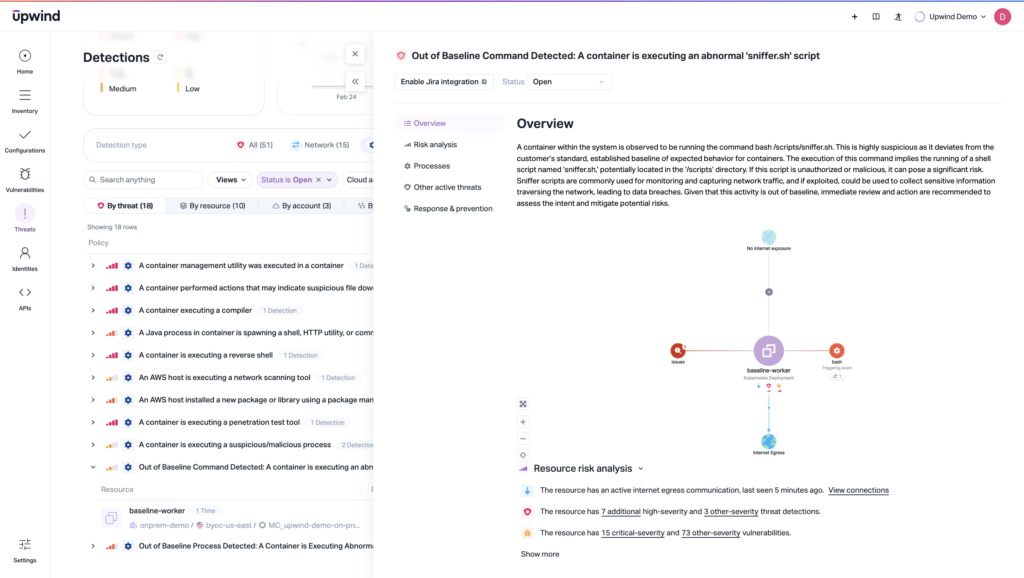
Incident Response Management
SOAR serves as a centralized platform for managing the entire incident lifecycle, evolving traditional incident response by automating triage, investigation, and containment. Instead of relying on manual processes, SOAR lets security teams respond faster and more efficiently by integrating data from multiple sources and automating their most routine tasks.
Here’s what SOAR contributes:
- It automates triage and prioritization, with alerts ingested from SIEM, EDR, CNAPP, and other tools
- It collects data and correlates with events once an incident is flagged.
- It runs automated investigation queries and threat intelligence lookups
- It responds, blocking IPs, isolating endpoints, revoking credentials, or triggering additional monitoring rules.
- It documents and reports on incidents for compliance and future analysis
Success Metrics for SOAR
To get the most out of SOAR capabilities, teams should consider the following metrics.
- Mean time to detect (MTTD): measures the average time it takes for an organization to identify a security threat or incident after it has occurred.
- Mean time to remediate (MTTR): measures the average time it takes to fully resolve a security incident after detection.
- Response time: measures the time between when an incident is logged and when remediation action starts.
- Incident resolution rate: tracks the percentage of security incidents that are successfully mitigated via automated workflows and response actions.
- Higher resolution rates indicate the SOAR platform is effectively containing and addressing security threats.
- Lower resolution rates may point to gaps in the platform’s automation or integration with other security tools.
- False positive rate: refers to the proportion of benign activities that a security system incorrectly classifies as threats. A low value indicates the SOAR platform is configured well and not falsely flagging benign events, which could result in unnecessary interventions and wasted resources.
- False negative rate: measures the proportion of actual security threats that a detection system fails to identify. A high false negative rate indicates that a large number of real threats are slipping through undetected, increasing the risk of security breaches.
- Resource efficiency metrics: these metrics include the degree to which manual effort has been reduced and the number of alerts handled per security analyst.
SOAR success metrics should serve to quantify the degree to which security analysts are freed from repetitive tasks.
By tracking how many incidents are handled automatically versus manually, organizations can evaluate the platform’s impact on operational efficiency and whether they are achieving the desired ROI from their SOAR investment. These success metrics provide a data-driven way to assess SOAR’s impact and help refine its implementation for continued improvement.
Traditional Security Tools vs. SOAR: Where it Fits (And Where it Doesn’t)
Traditional security tools like SIEMs, firewalls, and EDR solutions have been foundational for monitoring, detecting, and responding to threats, but they often require manual correlation, investigation, and response actions. After all, each of these tools generates large volumes of alerts, which can overwhelm security teams and slow down response times. Add them together, and teams might be right to investigate SOAR solutions instead.
SOAR platforms are designed to address the challenges, automating workflows and orchestrating responses across multiple security systems. But rather than replacing traditional tools, SOAR acts as a force multiplier — integrating with existing security infrastructure to streamline their processes.
When Does SOAR Make Sense?
SOAR is particularly beneficial for organizations that:
- Face high alert volumes and need automation to reduce manual triage.
- Use multiple security tools but are challenged by fragmented visibility and slow coordination.
- Have structured incident response playbooks that could be automated easily.
- Require compliance enforcement with automated reporting and audit trails.
- Need to scale security operations without significantly increasing headcount.
However, SOAR is not a one-size-fits-all solution. Teams without standardized playbooks, high volumes of alerts, or compliance requirements may not need a SOAR solution.
| Feature/Capability | Traditional Security Tools | SOAR Platforms |
| Automation | Limited or none — requires human intervention | Automates repetitive tasks and workflows |
| Incident Response | Manual investigation and mitigation | Automated response with predefined playbooks |
| Data Correlation | Basic correlation, often requiring manual effort | Advanced correlation across multiple sources using AI/ML |
| Efficiency | Slower response time due to manual processes | Faster response through automation and orchestration |
| Alert Management | High levels of operator alert fatigue due to the volume of notifications | Reduces noise by filtering and prioritizing threats |
| Integration | Limited integration with other security tools | Seamless integration across multiple security platforms |
| Scalability | Requires additional staff and security to scale | Easily scalable with automation and adaptive workflows |
| Compliance | Requires manual compliance checks and reporting | Automates compliance enforcement and reporting |
A Checklist for SOAR Success
Adopting SOAR solves many operational challenges, but creates new complexities, too. Further, platforms require consistent tuning, validation, and integration management. Organizations will need to find their own perfect balance between operational efficiency and oversight.
This checklist outlines some of the future challenges teams will face and some questions to help direct teams toward a balanced and flexible use of SOAR.
- Automation Overconfidence
Ask: Does the team regularly test and refine automation workflows to prevent false positives and unintended actions? Are human-in-the-loop approvals built into critical response playbooks? Is automation refined to avoid disrupting operations?
- Playbook Stagnation
Ask: Are playbooks reviewed and updated often? Is there a process for deprecating ineffective and outdated rules? Do playbooks include conditional branching to handle edge cases?
- Integration Drift
Ask: Are integrated security tools maintained and updated? Does the team have a defined process for onboarding new security tools without interrupting automations? Are critical dependencies documented?
- Alert Volume Overload
Has automation reduced alerts? Or added more noise? Are low-priority alerts filtered out appropriately? Is threat intelligence enrichment used to reduce false positives before alerts trigger playbooks?
- Lack of Compliance Auditability
Ask: Are automated actions logged with clear justification for compliance reviews? Do SOAR playbooks align with industry regulations? Is there a mechanism for auditors to trace security actions?
SOAR platforms are neither “drop-in” or “set it and forget it” solutions; organizations should expect to dedicate adequate resources for their SOAR implementations. Sustained evaluation and enhancement are necessary to counter evolving threats, accommodate ongoing changes in infrastructure, and adhere to shifting regulatory requirements.
Future Trends and Innovations in SOAR
Will some of the challenges facing SOAR users evaporate in the future?
It’s unlikely. But some tech advances promise more efficient implementations.
For instance, SOAR platforms increasingly leverage artificial intelligence and machine learning (AI/ML) to power more sophisticated threat detection and predictive analytics. These predictive analytics technologies allow SOAR systems to learn from past incidents, improve response actions intelligently, and identify emerging threats more proactively.
In the future, expect SOAR to handle adaptive decision-making using machine learning, even recommending new response strategies before an attack pattern is even known.
Further, cloud computing has helped accelerate tighter links between SOAR and CNAPP for added runtime security and will continue to feed SOAR workflows. Expect Security-as-Code integration, as SOAR becomes more developer-friendly, letting teams define playbooks as code for infrastructure-as-code (IaC) pipelines.
Upwind Brings Runtime Insights to Your Security Integrations
While Upwind works as a comprehensive CNAPP, protecting both runtimes and posture for cloud, hybrid, and on-prem assets, it can also be a good partner for SOAR implementations. With runtime insight, upwind helps hone SOAR alerts and prioritize the most critical issues, so your team doesn’t have to.
Want to see it in action? Schedule a demo.
Frequently Asked Questions
What’s the difference between SOAR and SIEM?
SIEM focuses on collecting, aggregating, and analyzing security data from across an organization’s infrastructure, providing real-time visibility into potential threats through log management and event correlation. It helps security teams detect anomalies, identify security incidents, and monitor compliance. However, SIEM systems typically require manual intervention for incident investigation and response.
In contrast, SOAR goes beyond detection to automate response actions, orchestrate workflows across different security tools, and enable security teams to handle incidents more efficiently. While SIEM provides the visibility and insights needed to detect security events, SOAR automates and streamlines the response process, ensuring faster and more consistent threat mitigation.
How does SOAR improve incident response?
SOAR significantly improves incident response by automating and streamlining key processes, enabling security teams to act faster and more efficiently in response to security incidents. With SOAR, predefined playbooks guide response actions, automating repetitive tasks such as alert triage, data collection, and incident classification, which reduces the burden on security analysts and accelerates response times.
What are common SOAR use cases?
SOAR platforms are used in a variety of common scenarios to enhance security operations and improve incident response. A primary use case is automated incident response, where SOAR platforms help organizations quickly detect, analyze, and respond to security incidents by automating tasks like alert triage, data enrichment, and incident remediation.
Another key use case is threat intelligence integration, where SOAR platforms automatically ingest and correlate threat intelligence from external sources, allowing for more proactive identification and mitigation of emerging threats. SOAR also streamlines compliance reporting and auditing, enabling organizations to automatically generate reports that demonstrate adherence to industry regulations and security best practices.
What should you look for in a SOAR platform?
A SOAR platform should offer automation and orchestration features that
seamlessly integrate with your existing security tools — and give you the biggest boost in identifying and reducing threats. While specific features may vary per vendor, SOAR offerings in general should be capable of automating repetitive tasks like alert triage, data enrichment, and incident response workflows. The solution should scale on demand, with strong analytics and reporting capabilities. Finally, a good SOAR platform should provide customizable playbooks that can be tailored to your organization’s specific needs and security policies.