Get a Demo
Under Attack?
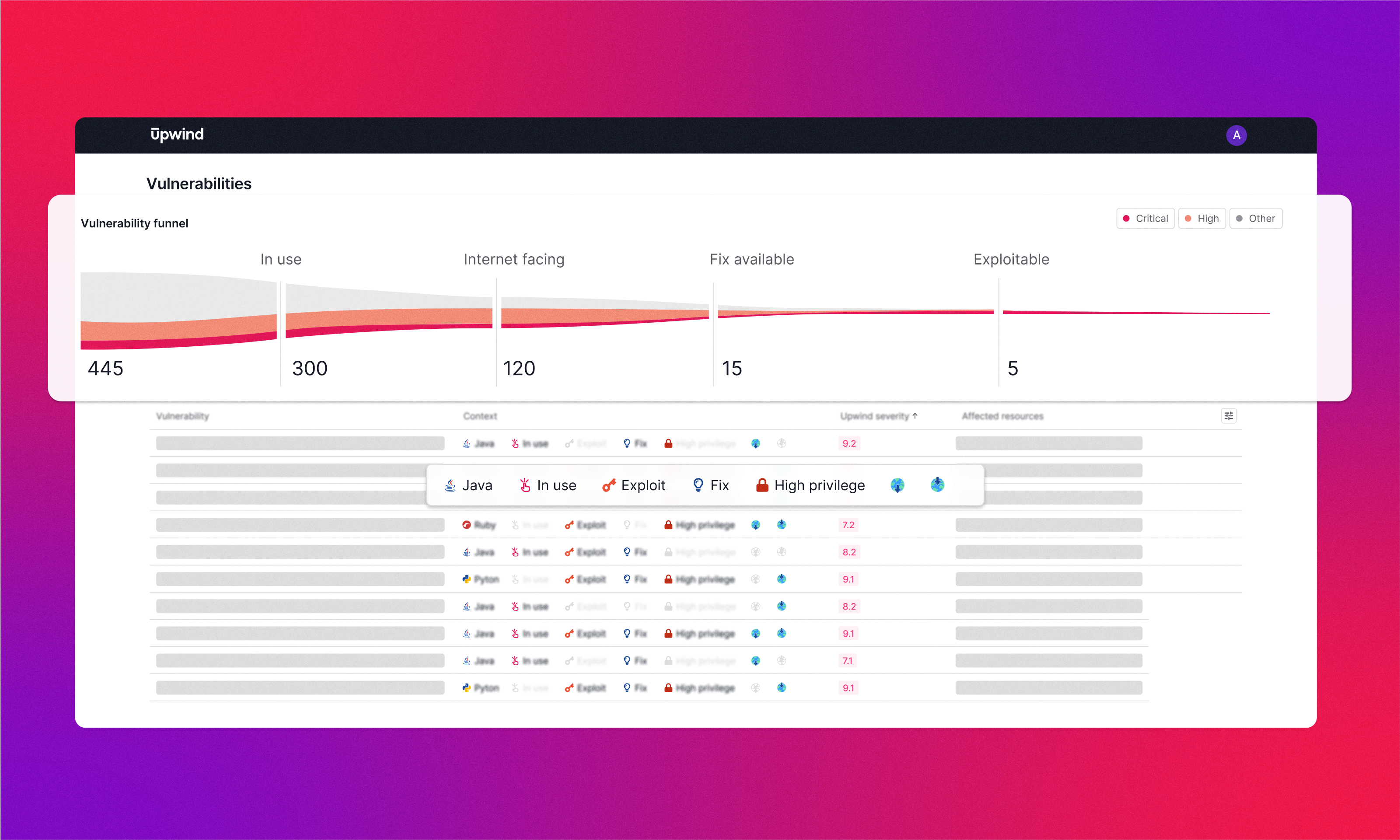
A dashboard displays a vulnerability funnel with stages: low, internet-facing, fix available, and exploitable, showing decreasing counts. Below, a list details vulnerabilities with categories like Jira, use, exploit, and fix, using color-coded indicators.

Filter Out the Noise And Focus on the Vulnerabilities that Actually Matter

<br />
<b>Warning</b>:  Undefined variable $photo in <b>/nas/content/live/landing173/wp-content/themes/bricks/includes/elements/code.php(236) : eval()'d code</b> on line <b>24</b><br />
<br />
<b>Warning</b>:  Trying to access array offset on value of type null in <b>/nas/content/live/landing173/wp-content/themes/bricks/includes/elements/code.php(236) : eval()'d code</b> on line <b>24</b><br />
Denise Ashur September 29, 2023

Filter Out the Noise And Focus on the Vulnerabilities that Actually Matter

We’re excited to release an important capability for our Runtime Vulnerability management. Starting today, you can view an end-to-end funnel of your vulnerabilities, apply critical filters to your vulnerabilities data and answer these tough questions within seconds: 

  • Is the package loaded into memory or actively in use?
  • Is the package exposed to the Internet?
  • Is remote execution possible?
  • Is there active ingress or egress traffic related to the package?
  • Does the package have access to sensitive data?
  • Is there an available exploit for the vulnerability?
  • Is a vendor-supplied fix available?

You can now customize your vulnerability reports and filter vulnerabilities that are in use, Internet facing, have a fix available and are exploitable – helping you rapidly filter and prioritize the alerts that actually matter to your organization. 

Use Upwind’s Vulnerability Funnel to run custom reports by vulnerability, image or resource type and streamline your remediation by getting highly personalized alert information to the right members of your security team, in record time. 
Contents

Further Reading

The Risk Isn't What You Prompt, It's What You Built.

The Risk Isn’t What You Prompt, It’s What You Built

Key Takeaways: Agentic AI security is an architecture problem, not a policy problem. Most organizations have adopted AI agents in the form of coding assistants, autonomous workflow tools, internal chatbots connected to production systems, but without establishing the foundational security frameworks those systems require. The adoption pressure is real. Telling your engineering team to stop…
Upwind is a Visionary Leader in Frost & Sullivan report

Upwind Named a Strong Visionary Leader in Frost & Sullivan’s 2026 Cloud/Application Runtime Security Radar

We're excited to share that Frost & Sullivan has recognized Upwind as a Strong Visionary Leader in the Frost Radar™: Cloud/Application Runtime Security, 2026. This recognition highlights the company's innovation, growth, and leadership in the emerging Cloud-Native Application Detection and Response (CNADR) market. For us, the recognition is meaningful not simply because of where Upwind…
API Custom Threat Detection

Upwind brings Custom Detection Policies for APIs

Every API has a different risk profile. An internal billing endpoint and a public-facing authorization endpoint don't fail the same way. They don't get attacked the same way either. A generic ruleset can't account for that. Custom rules can, and now those rules can see sensitive data too. This new release brings two things together…
Add the Upwind RSS Feed to Slack
Connect the Upwind RSS Feed to your Slack.
Follow the how-to here.
Threat RSS
Add the Upwind RSS Feed to Slack
Connect the Upwind RSS Feed to your Slack.
Follow the how-to here.
Main RSS