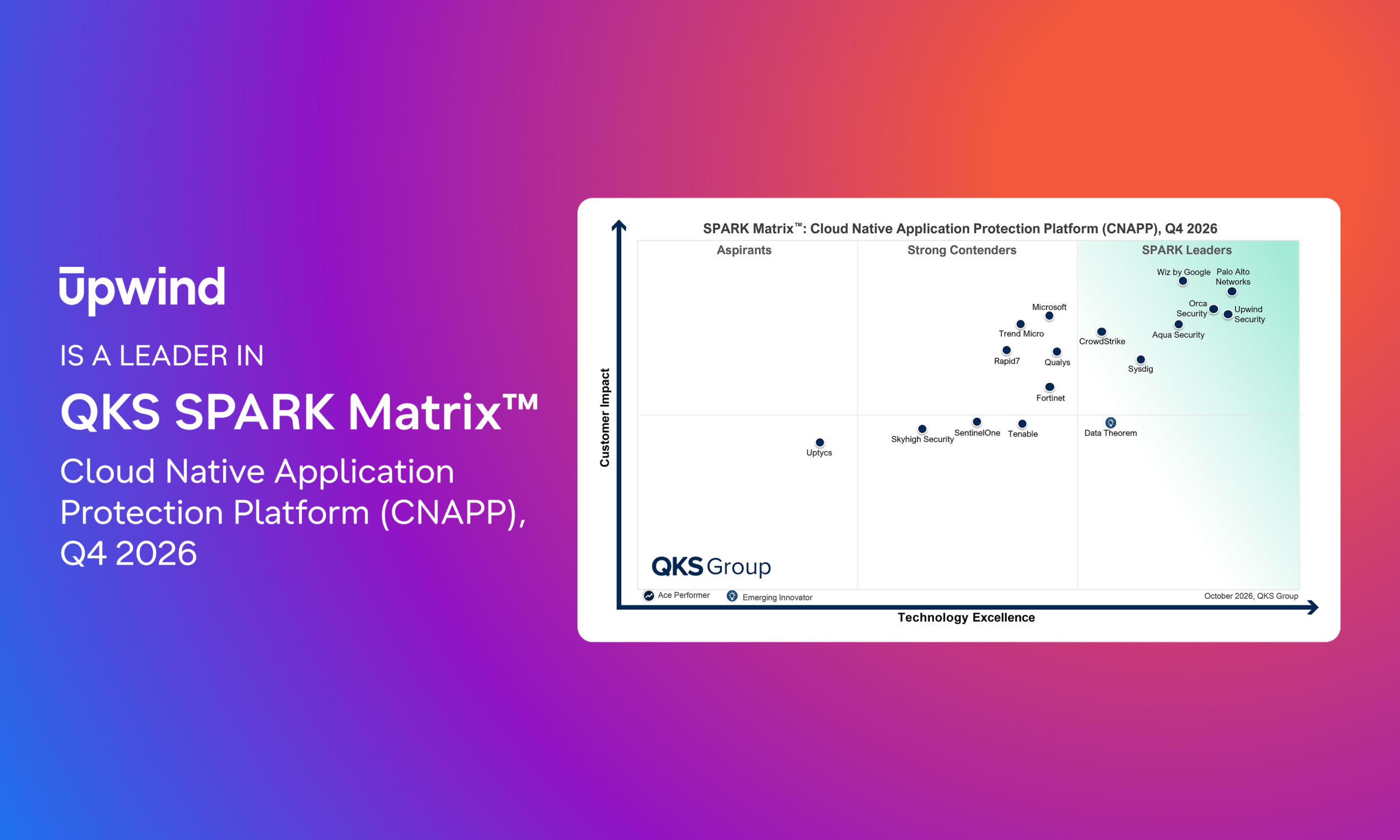

Upwind earned the second highest technology excellence score of 17 vendors, and QKS named runtime evidence our strongest differentiation.
For years, the cloud security market rewarded whoever could fit the most tools into one console. QKS’s latest CNAPP research argues that phase is maturing, and that the platforms that matter now are the ones that can explain how risk forms when an exposed workload and an over-privileged identity meet.
In its SPARK Matrix™: Cloud Native Application Protection Platform (CNAPP), Q4 2026, QKS named Upwind a Leader with the second highest technology excellence score of the 17 vendors it evaluated. It’s our second year in a row as a Leader, and we improved on both axes: our capabilities across the core CNAPP pillars and the overall customer value of the platform. We believe much of this comes from building Upwind around runtime evidence, which QKS named our strongest differentiation.
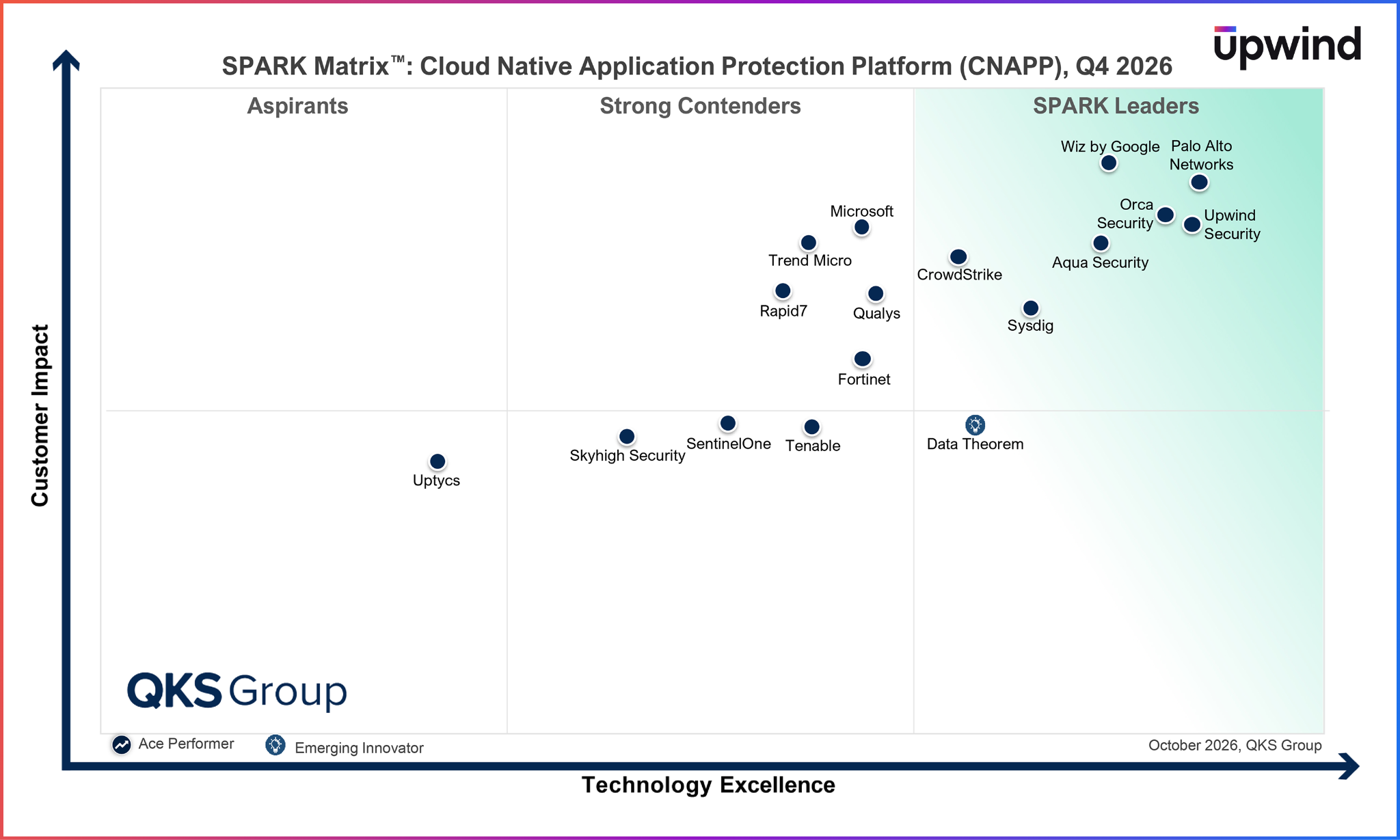
Technology excellence is scored across 11 criteria, with posture management and workload protection weighted highest. In our view, three strengths did the most to earn our placement:
- Runtime evidence that decides what to fix
- Runtime depth with agentless coverage
- One platform for cloud and AI
Runtime evidence that decides what to fix
Most cloud security tools surface thousands of issues, according to QKS, and the harder part is deciding which of them could lead to a breach.
For each exposure, the report notes, Upwind adds whether the vulnerable package is loaded and whether sensitive data is reachable on the same path. If someone starts exploiting the vulnerability, the sensor sees it as it happens. In QKS’s words, this significantly improves prioritization in environments where the primary problem is no longer discovering vulnerabilities but deciding which ones warrant immediate action.
“Upwind helps us secure our cloud and the AI workloads we’re building on it, so our team can focus on the risks that matter most.”
Eli Edelkind, Chief Information Security Officer, Infrastructure, and TechOps, Cava
Runtime depth with agentless coverage
Several platforms in this market lead with agentless scanning and treat a runtime sensor as optional. QKS credits our hybrid architecture with avoiding the coverage limitations of a sensor-only approach while keeping the exploitability and behavioral evidence that agentless assessment cannot provide.
Agentless scanning covers an account the day you connect it, and the sensor adds process and network activity, including APIs seen in live traffic, as it reaches each workload. Runtime-heavy platforms are often hard to roll out, QKS notes, and it credits Upwind with relatively straightforward cloud onboarding. Investigations also stay in one place, since analysts can move from an exposed resource to its communication graph, identities, data, and attack path without switching products.
One platform for cloud and AI
QKS describes Upwind as a cloud and AI security platform. Our AI capabilities, including MCP Security and AI Detection & Response, are built into the same platform and share its runtime context, so AI risk is assessed as part of the wider cloud attack surface instead of in a separate tool. Runtime findings also trace back to the repository or pipeline that produced them, where the Green agent in our Agentic Pack works out the root cause and the fix.
Since the 2025 SPARK Matrix, we’ve kept building on that model:
- In September we acquired Aegis and launched the Upwind AI Security Lab, which brings our production-first approach to the full AI stack.
- The AI Sensor for Endpoints extends runtime visibility to the agents and MCP servers on employee devices.
- Upwind Response cuts off an attacker’s access to a targeted service as soon as it sees an exploit attempt.
QKS’s final take is that for organizations that want CNAPP to move beyond static discovery toward evidence-based risk reduction, Upwind offers a technically differentiated architecture. We plan to keep extending that architecture to the AI agents now running in our customers’ clouds.
Check out the full report here: QKS SPARK Matrix™: Cloud Native Application Protection Platform (CNAPP), Q4 2026
SPARK Matrix™ is a trademark of QKS Group (Quadrant Knowledge Solutions). QKS Group does not endorse any vendor, product, or service depicted in its research publications. Source: QKS Group, SPARK Matrix™: CNAPP, Q4 2026. Used under license.