
Key Takeaways
- AI agents run as approved processes under the employee’s identity, so the risk signal moves from system calls into prompts, the most personal data on the machine.
- Watching content too aggressively turns the laptop into a surveillance device, and employees move their work to personal machines you can’t see.
- Inventory comes first: map the agents, MCP servers, and approval flags on every laptop before you read a single prompt.
- Cloud context lets the laptop judge agent activity locally and send only the verdict, not the prompt or the transcript.
In the third quarter of 2008, notebook shipments passed desktops worldwide for the first time, 38.6 million against 38.5 million. Matthew Wilkins, the iSuppli analyst who called it, described the moment as the start of the age of the notebook.
It was a major security event, barely noticed.
From that quarter on, the primary work machine went home at night. It runs the board deck and Netflix, the Salesforce pipeline and a personal Gmail tab, the production database client and the kid’s school portal.
The business agreed to that, because a machine that goes home extends the working day well past office hours.
Security agreed to it as well. EDR watched processes, system calls and network destinations, and for eighteen years that was both possible and enough.
You could see which process opened a connection and where it went without ever opening what it carried. Destination and behavior were enough to make the call.
Then, AI agents.
An agent is a legitimate process. Signed, IT-approved, EDR-approved, holding real tokens under the employee’s own identity, running on the machine that is half company property and half someone’s private life.
And it arrived faster than any shift the industry has had to absorb before.
Teams that answer aggressively turn the laptop into a surveillance device. Employees feel it within a week and route around it, onto personal machines and personal accounts, which ends in blindness.
Teams that answer softly keep the trust and lose the control. They end up perforated, with agents acting on production while the security program watches process trees.
Neither one is a security program. Both are what happens when protection and privacy get treated as a single dial.
When watching the agent means watching the person
No kernel hook is going to tell you that an approved application just did something catastrophic because a human asked it to.
The signal is not in the system call any more. It is in what was said to the agent, and what the agent did with it.
So collection moves up into content, and that is where the eighteen-year compromise breaks.
Full visibility on a dual-use laptop creates an invasive window into someone’s life: the bank the employee logs into, the medical portal they opened at lunch, the divorce lawyer’s PDF that arrived over personal mail, the job board they browsed on Sunday, the performance review a manager drafted for someone on their team.
That last one is not even private. It is company data, on a company machine, and it still has no business sitting in a security pipeline where the analyst on duty can read it.
With an assistant, the content is the signal: the prompt is both the thing you need to inspect and the most personal thing on the machine.
Which makes the real problem here larger than the agent. It is what watching the agent turns your security program into.
So start with intelligence, not with content
Every instinct says to go straight at the prompts, because that is where the leak happens and that is where the headline lives.
That instinct produces a pipeline of employee typing, a retention policy nobody wants to defend, and still no answer to the only question that matters, whether the thing that just happened was dangerous.
Intelligence comes first, and intelligence is not volume. It is knowing what the asset is, what it can reach, and what would make an action on it consequential.
Visibility without context is surveillance.
Aligning security and privacy effectively
Here is the fair objection to everything above. Security teams do need this visibility, and pretending otherwise is not a privacy position, it is negligence.
They need fleet inventory of which models and agents are installed, an AI-BOM the same way they keep an SBOM. They need to know which MCP servers got wired up last Thursday, what skills an agent holds, what tools it can call. And yes, at some point they need a view of content: prompts, commands, the input and output crossing the boundary.
So the demand is legitimate. The mistake is assuming the only way to satisfy it is to point a firehose at the employee.
Bruce Schneier took apart the single dial in Security vs. Privacy, published in January 2008 (nine months before the laptop became the dominant machine). Security and privacy are not opposite ends of a seesaw. The real axis is liberty against control, and most people reaching for control are actually reaching for volume.
True understanding requires meaningful context.
Telemetry is not evidence. A prompt log is not a finding. An alert on every paste is not a security program, it is a reading assignment nobody will do.
So the strategy is not how much you can see.
The strategy is how little you need to see to make a correct call.
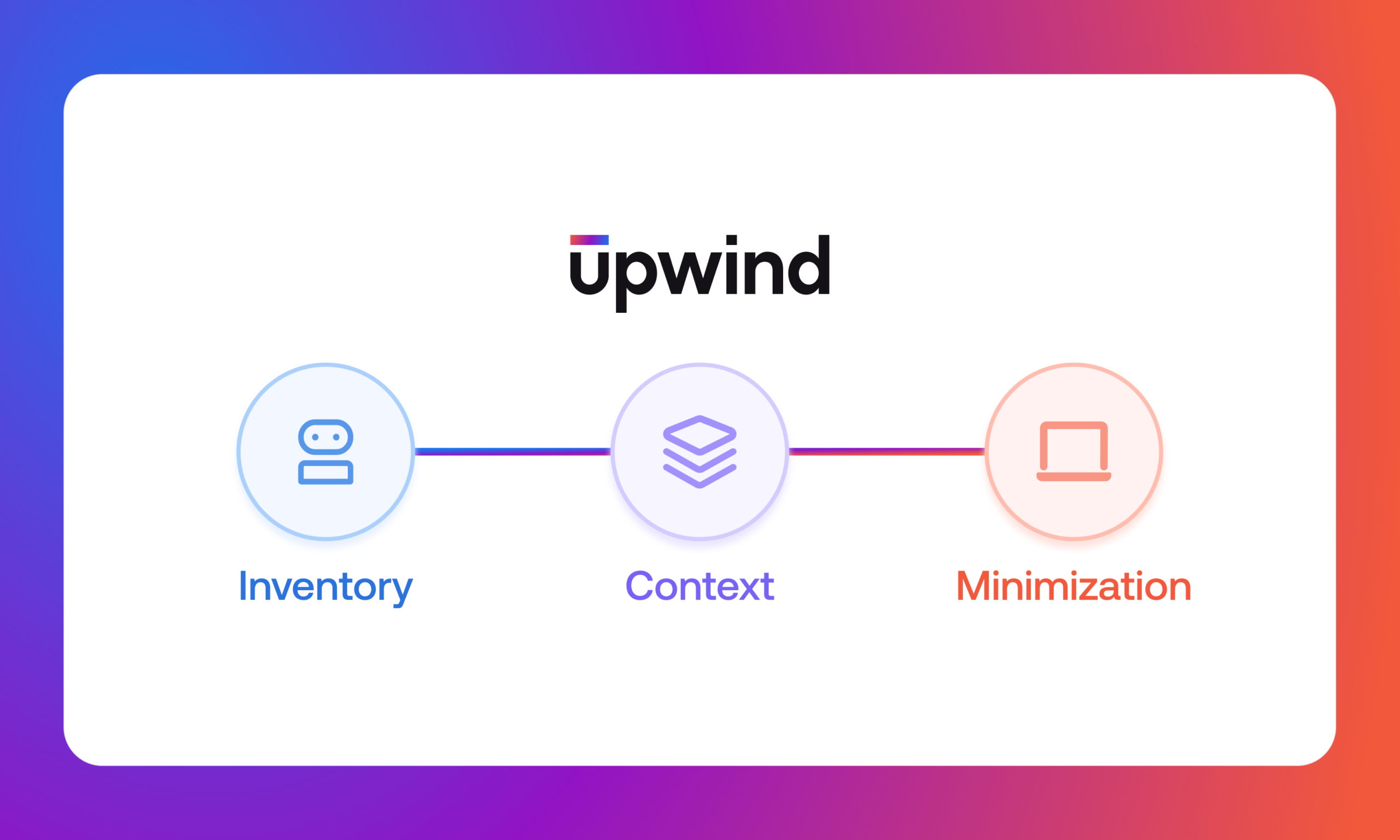
Three parts, in order:
- Inventory: mapping the agents before you read the prompts
- Context: judging activity against what the company actually owns
- Minimization: deciding what never leaves the laptop
Mapping the network of human & agent relationships first
Start one layer up. Metadata is cheap, non-invasive, and it is where the real attack surface sits.
Build the AI-BOM to protect engineers before reading prompts
You already do this for software dependencies. Do it for agents.
Which assistants are installed across the fleet, at which versions, from which vendors. Which run inference locally and which ship every keystroke to somebody else’s endpoint. Which MCP servers are connected, who connected them, and what those servers can reach.
A model. A tool. A credential.
That is the entire risk chain, and not one link in it requires reading a word an employee wrote.
MCP servers are unmanaged software with production access
MCP servers are the part that should keep you up.
An MCP server is software an engineer installed in four minutes, from a repository nobody reviewed, wired to an agent holding a token to your cloud account. It is shadow IT with hands.
The old version of this problem was a browser extension that could read a page. This one can open a pull request, drop a table, or email a supplier.
Understanding the human decisions hidden in agent settings
The most dangerous artifact on a developer laptop right now is not a binary. It is a config file.
Agent configuration directories (Claude and its equivalents across every vendor) carry approval settings, allowed tool lists, and auto-run permissions. One flag flips an agent from asking before it acts to acting and reporting afterwards.
An engineer sets that flag on a Tuesday to stop the confirmation prompts from interrupting a refactor. It stays set. Nobody logs it, nobody reviews it, and it is not in any inventory you currently run.
Treat agent approval settings as a privileged configuration change, and diff them like you diff firewall rules.
That check invades nobody, and it closes the gap where an autonomous process gets permission to touch production without a human in the loop.
Context: judging activity against what the company actually owns
Here is where endpoint-only tooling fails, and it is structural rather than a tuning problem.
An agent on a laptop opens a connection and moves 40MB. Is that a build artifact, a backup, or your customer database walking out the door?
The laptop cannot answer that. It has no idea what your S3 bucket is, let alone what it holds, which of your databases carries regulated data, which internal ranges are production and which are a demo environment somebody spun up last month.
So it does the only thing available to it. It flags everything, or it flags nothing.
Flagging everything is the default, and this is the moment endpoint-only AI protection stops being a control and becomes a liability. Every ambiguous transfer becomes a ticket, and a team already at capacity triages hundreds of alerts a week that no human can adjudicate, because the deciding fact was never on the machine.
Alert volume does not just waste analyst hours. It trains the team to close things fast, which is exactly how the real one gets closed too.
Connecting cloud insights to everyday work
Companies that built a wide security posture across their cloud are holding the missing half of the picture.
They know which workloads process regulated data. They know which identities are over-permissioned, which buckets are public, which addresses belong to production and which to staging.
Point that at the laptop and the same 40MB transfer resolves in one step, with nobody reading a prompt.
“I just gave it the export so it could summarize the churn numbers, it was faster than waiting on the analyst…”
That sentence is either completely fine or a reportable incident, and the only thing that decides which is what was in the export. The cloud context knows. The laptop never will.
How context safeguards employee privacy and trust
Security teams underestimate the privacy cost and it is the part employees feel every day.
Without context, every interaction looks equally suspicious, so everything gets collected and everything gets retained. That is the privacy tax, and it is charged in full to the person doing their job.
With context, the surface where deep inspection is justified collapses to a handful of specific interactions. An agent querying public documentation needs no prompt inspection at all. An agent authenticating to your identity provider with a token minted eleven seconds ago is a different conversation entirely.
Your goal is to detect when sensitive information leaves the building.
Minimization: deciding what never leaves the laptop
Every organization will pay a privacy tax. The choice is how it gets assessed.
The first obvious answer is hard separation. Corporate laptop for work, personal laptop for life, and anyone who wants privacy buys their own.
It sounds clean, and it is the worst option on the table.
The boundary is blurry by nature, not by policy. Employees who buy a personal machine to protect their privacy will absolutely use it for work (the quick fix on a Sunday, the agent they prefer and cannot install on the corporate image).
Pushing your workforce toward two laptops does not shrink the attack surface. It doubles it, and hands you the half you cannot see, with no visibility, no inventory, and no standing to look.
The second obvious answer is surrender, and it fails the way described at the top, quiet compliance that behaves like decay, with nobody filing a ticket about it.
Asking the right questions before watching every action
The third option is to evaluate on the laptop and ship only the verdict.
The agent activity gets judged locally, against a policy that already knows which addresses, workloads, identities and data stores are sensitive. Then the finding travels. Not the prompt, not the transcript, not the file.
Collect what you can act on, judge it where it happened, and send only the conclusion.
That model only works if the policy arriving at the laptop is built from a processed, current picture of your cloud. Without that, local evaluation is just a smaller machine guessing at the same question, and you are back to flagging everything.
Balancing hardware costs and the employee experience
There is a budget line hiding in all of this.
Local evaluation costs cycles, and AI workloads on employee machines are already climbing fast enough that nobody wants a second inference tax stacked on the first. Refreshing a fleet because the security agent needs more RAM is a conversation no security leader wins twice.
Wide context is what makes local judgment affordable. When the platform hands the laptop a scoped list (these workloads, these IP ranges, these buckets, these identities matter), the laptop stops reasoning about the world and starts matching against a short list.
Cheap on the machine. Precise in the console. Nearly invisible to the person trying to work.
That is the fine line, and nothing narrower than full-company context can walk it.
Building security around where people and data meet
The companies that spent the last several years mapping cloud security posture, and specifically runtime intelligence, are sitting on exactly the asset graph the laptop is missing.
They already resolve which bucket holds regulated data, which identity is over-permissioned, which address is production, and which workload is actually executing right now. That is not adjacent to the endpoint problem. It is the deciding half of it.
The laptop has been a dual-use machine since 2008. Only now does it act on its own.
Collecting is easy. Judging is the job.