Dan Gansel

What IAM Sees That You Don’t

Every IAM policy you write depends on condition keys - they're the precision layer that turns "can call S3" into "can call S3 only from our VPC, using our identity, on resources we own." They're the backbone of least-privilege, data perimeters, and SCP guardrails. But here's the thing: for every request, the IAM engine assembles…
Let Me Speak to Your Manager (Account)
The management account is the most privileged account in any AWS Organization. It controls SCPs, creates and deletes member accounts, manages IAM Identity Center, and is itself exempt from SCPs. Getting its 12-digit account ID is the first step in targeting it. The documented way to get it is organizations:DescribeOrganization - but security-conscious environments restrict…
What You Could Build If IAM Let You: New Policies From Undocumented Condition Keys
In the previous post, we mapped 36 condition keys that the IAM engine evaluates but has never documented. The decomposition model, the service-specific resource identifiers, the organizational metadata - all of it sitting in the request context, invisible unless you probe for it. That post was about discovery. This one is about what you can…
Show Me the Context: Building the Full Request Context for AWS IAM
This post was written in early August 2026, ahead of our fwd:cloudsec Europe talk. On August 25, AWS launched the Access Troubleshooter (currently in public preview), a first-party feature that surfaces the request context for denied requests. We've updated this post to account for it. When the IAM engine evaluates your request, it matches your…

What’s Behind the Curtain? AWS Bedrock AgentCore Runtime Tear Down – Part III
Recap In Part I and Part II, we: Networking and VPC Mode Network Isolation Testing The microVM is assigned an IPv6 address matching the value in the JWT. Across multiple runs, all addresses shared the same 2600:1f18::/32 prefix, but cross-microVM communication always failed. We attempted to reach the host EC2 IMDS by manipulating the route…

What’s Behind the Curtain? AWS Bedrock AgentCore Runtime Tear Down – Part II
Recap In Part I, we explored the AgentCore Runtime microVM from the inside and discovered we weren't alone - four platform binaries were running alongside our code, and one of them was quietly shipping logs to an AWS-internal S3 bucket. We left off with a question: what can we learn from these internal components, and…

What’s Behind the Curtain? AWS Bedrock AgentCore Runtime Tear Down – Part I
Introduction When you deploy an AI agent to AWS Bedrock AgentCore Runtime, your code runs inside a Firecracker microVM - but it doesn't run alone. In this three-part series, we tear down the platform internals, document what we found, and assess how well the isolation holds up. Setting the Stage AWS Bedrock AgentCore Runtime is…
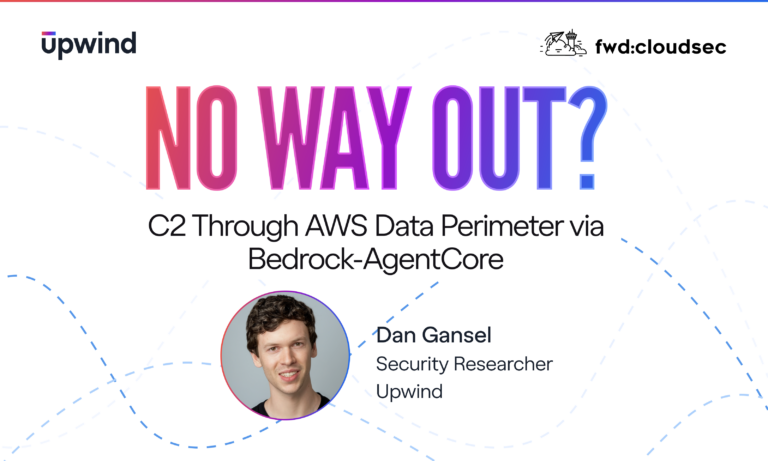
No Way Out? Bypassing the AWS Data Perimeter with Bedrock AgentCore
A novel Command-and-Control (C2) channel weaponizes legitimate AWS services to establish two data channels, successfully circumventing one of the cloud's strongest security defenses. Status: Infiltration Channel is FIXED, Exfiltration Channel is OPEN. TL;DR This research was presented at fwd:cloudsec North America 2026. Watch the full talk below. What Is the AWS Data Perimeter? For the…
Amazon Bedrock Security: Everything Security Practitioners Need to Know
Amazon Bedrock is AWS’s managed platform for building generative AI applications using foundation models, agents, and Retrieval-Augmented Generation (RAG). It allows organizations to integrate powerful language models directly into their AWS environments, connecting probabilistic AI systems with deterministic cloud services such as IAM, S3, and Lambda. But for cloud security teams, this integration creates a…