
Cloud security is no longer just about securing infrastructure or worrying about data. It’s also about protecting highly dynamic workloads, ephemeral resources, and complex multi-cloud environments that evolve in real time. Many teams know the basics: shared responsibility, identity security, prioritizing vulnerabilities, etc. But what issues should make them pause and rethink their current approach? And what’s the best way to build a strategy from scratch?
This article explores how organizations can build a modern cloud security strategy that goes beyond the traditional approaches to focus on runtime security, workload protection, automated policy enforcement, and continuous risk assessment.
What is a Cloud Security Strategy?
A cloud security strategy is a deliberate, long-term plan for protecting cloud environments that includes guidance for:
- Risk management
- Security architecture
- Operational decisions
Guidance cuts across the software development lifecycle and various security layers, including identity management, threat detection, compliance enforcement, and continuous monitoring to mitigate risks. And because cloud computing includes ephemeral workloads, accounting for that dynamism is also part of an effective cloud security strategy. Further, an effective strategy adapts to evolving threats while ensuring resilience, scalability, and regulatory compliance.
With so many moving parts, a cloud security strategy is more than just a collection of security controls to put in place — it’s a holistic, evolving framework that aligns security with the way cloud environments operate.
In a world of evolving threat landscapes and digital transformation, attention to the unique aspects of cloud computing is increasingly crucial.
Companies that adopt modern artificial intelligence and automation in the prevention of security incidents saw $2.22 million in cost savings compared to those that went without. Machine learning can detect anomalies in live workloads and automate instant remediation, which can be indispensable for ephemeral workloads.
Today, 50% of the world’s data is stored in the cloud, so securing those rapidly scaling resources is more important than ever.
Runtime and Container Scanning with Upwind
Upwind offers runtime-powered container scanning features so you get real-time threat detection, contextualized analysis, remediation, and root cause analysis that’s 10X faster than traditional methods.
Get a DemoCore Components of Cloud Security Strategy
The areas on which an effective cloud security strategy provides guidance are themselves complex domains. Let’s break it down:
Risk Management
Risk management in cloud security is about identifying, assessing, and mitigating security risks in cloud environments. It includes:
- Risk categorization and prioritization, from clarifying risks based on impact to distinguishing between risks unique to the cloud, like IAM misconfigurations, vs. traditional security risks
- Threat modeling for cloud workloads, evaluating potential attack vectors for specific cloud workloads, from serverless to Kubernetes clusters
- Shared responsibility model risk management, like assessing which risks fall under any given cloud service provider (CSP), and evaluating gaps in CSP security tooling vs. 3rd-party solutions
- Reviewing risks from integrations and vendors, including API dependencies and other 3rd-party integrations, and managing the risks of vendors with weak security postures
- Managing supply chain risks like open-source dependencies and cloud-native CI/CD pipelines, and evaluating risks in managed services
Security Architecture
Security architecture defines the design principles and technical controls needed to enforce security at scale. It includes:
- Zero-trust for cloud (ZTNA, micro-segmentation, workload identity), including designing granular access policies and preventing lateral movement in cloud environments
- Multi-cloud security design, like standardizing security controls across AWS, Azure, and Google Cloud Platform (GCP) and making sure security policies are interoperable in hybrid cloud environments
- Cloud network security, like enforcing security boundaries as with network segmentation and designing secure container and Kubernetes architectures with least privilege service-to-service communication
- Data security and sovereignty, Encrypting data at rest, in transit, and in use, and managing its residency for cross-border cloud deployments.
Operational Decisions
Operational decisions determine how cloud security is managed in day-to-day operations. Key areas include:
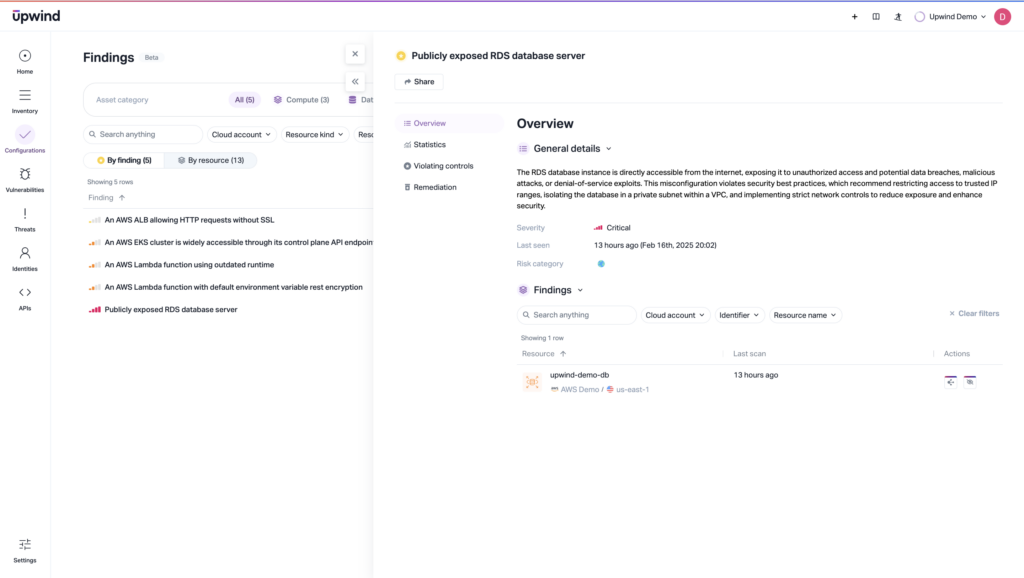
- Cloud Security and Posture Management (CSPM), including assessing and remediating misconfigurations in cloud environments, and automating policy enforcement and infrastructure as code (IaC) security checks.
- Security automation and orchestration, like adopting machine learning for real-time response to anomaly detection and remediation
- Cloud security incident response and forensics, from preparing incident response playbooks to ensuring forensic visibility in cloud environments
- DevSecOps and CI/CD Security, embedding security in development pipelines and adopting policy-based enforcement to prevent insecure deployments
- Identity and access governance, monitoring continuously for permission misconfigurations and unused IAM roles, and automating privilege adjustments based on behavioral analytics.
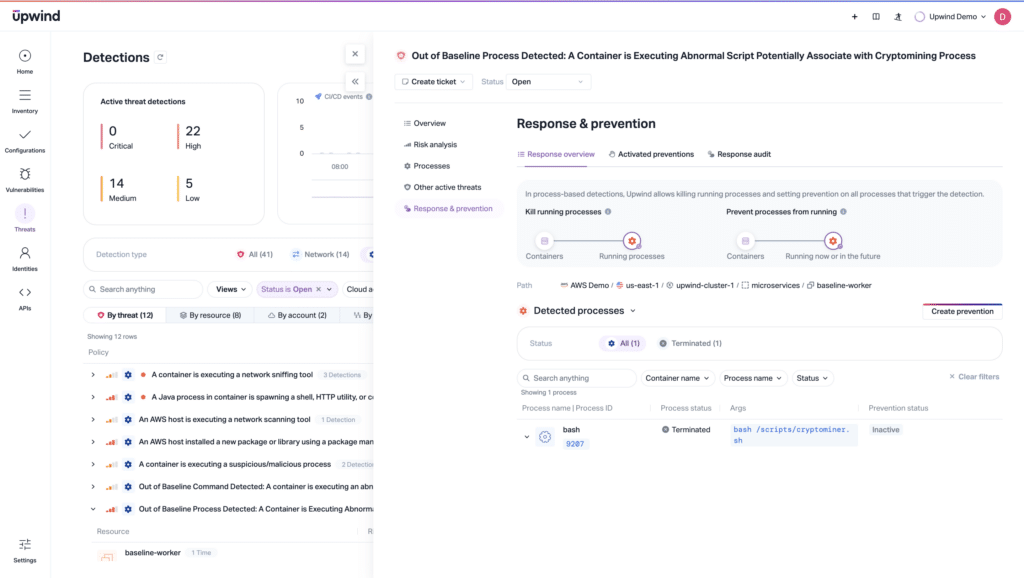
Mapping Cloud Security Components to their Functions
To implement an effective cloud security strategy, organizations must integrate security across multiple layers, from identity management and threat detection to compliance enforcement and continuous monitoring.
The table below outlines some of the core components that underpin cloud security strategy, showing how each contributes to securing modern cloud environments.
| Sub-Component | Main Component | What it Does |
| Identity and Access Governance | Security Architecture | Prevents excessive permissions, misconfigured IAM roles, and privilege escalation risks in cloud environments. |
| Data Protection Frameworks | Security Architecture, Risk Management | Addresses encryption management, data residency compliance, and securing PHI and sensitive assets across multi-cloud. |
| Network Security Architecture | Security Architecture | Mitigates cloud-native attack vectors by enforcing segmentation, restricting open ports, and securing east-west traffic. |
| Continuous Security Monitoring | Operational Decisions | Detects real-time threats, identifies misconfigurations, and prevents security drift in ephemeral workloads. |
| Incident Response Planning | Operational Decisions | Ensures rapid detection, forensic investigation, and automated containment of cloud-based breaches and API exploits. |
While the table outlines the key sub-components of cloud security strategy, effective implementation requires understanding the interdependencies between these components and optimizing security in dynamic, real-world environments.
For example, Identity and Access Governance doesn’t prevent excessive permissions out of the box; it needs to be continuously enforced across multi-cloud environments where IAM models differ significantly. Additionally, many organizations struggle with identity drift, where permissions that were once necessary become excessive over time due to role changes or cloud sprawl. Teams should ask:
- How often are we reassessing cloud permissions at scale?
- Are we enforcing just-in-time access for sensitive workloads, or do static permissions linger?
- Do our IAM policies adapt dynamically to behavior-based risk rather than just following predefined rules?
Similarly, Data Protection Frameworks must evolve beyond encryption policies to account for real-world data access risks. Encryption is a given, but many breaches occur due to excessive data exposure from misconfigured storage policies or overly broad access permissions. In high-scale environments, ask:
- Are we tracking anomalous access to sensitive data in real time?
- Can we identify lateral movement when an attacker pivots between cloud storage, databases, and applications?
- Are we using automated classification of data sensitivity, or is our data security policy static and manually enforced?
Network Security Architecture often gets reduced to segmentation and firewalls, but in cloud-native environments, the bigger challenge is observability and context-aware security. Since cloud workloads frequently spin up and down, teams need to ask:
- Are we securing workload-to-workload communication at a granular level, or are we relying on broad security group rules?
- Do we have real-time insight into which workloads are making unauthorized outbound connections?
- How do we enforce segmentation dynamically as new microservices and applications are deployed?
Continuous Security Monitoring requires correlating disparate signals across cloud providers and integrating security into the development workflow. Many security teams drown in cloud alerts that lack context, so effective implementation means asking:
- Are we able to filter out noisy, low-impact security events and focus only on high-risk anomalies?
- Can we detect supply chain attacks where compromised workloads behave normally but originate from an untrusted source?
- How do we integrate continuous monitoring into developer pipelines without slowing down innovation?
Finally, Incident Response Planning includes automating response actions without human intervention whenever possible. Teams should ask:
- How do we ensure forensic investigation remains possible for ephemeral workloads that no longer exist?
- Are our automated remediation policies reducing mean time to detect (MTTD) and mean time to respond (MTTR), or are we still dependent on manual intervention?
- Do we have pre-configured response playbooks for cloud-native attack patterns, such as IAM credential theft or container breakout attempts?
Ultimately, the strongest cloud security strategies don’t just contain each sub-component for its own sake. They incorporate components in strategic ways that allow for business growth, cloud scalability, and a cloud security posture that is increasingly able to anticipate and remediate threats.
Implementation Phases for Cloud Security
Operationalizing a cloud security strategy and all its components doesn’t happen overnight. A structured, phased approach that ensures security is built into visibility, risk management, automation, and response workflows. Here are the steps to take (or the gaps to investigate):
Phase 1: Gaining Comprehensive Visibility
Before security teams can secure cloud workloads, they need to see them. Modern cloud environments are highly dynamic, with new workloads, services, and machine identities spinning up constantly.
Key steps:
- Discover all cloud assets, including Kubernetes clusters, containers, serverless functions, and IAM roles.
- Map interdependencies between workloads, APIs, and identities to uncover hidden risks.
- Use agentless scanning to assess security posture without impacting performance.
Phase 2: Identifying and Remediating Critical Risks
After mapping cloud environments, the next step is prioritizing and remediating security risks. Not all misconfigurations, vulnerabilities, or permissions issues present equal danger—security teams must prioritize risks based on real exploitability and cloud context.
Key steps:
- Identify exploitable vulnerabilities by correlating them with runtime activity (not just CVSS scores).
- Detect overprivileged IAM roles, API keys, and service accounts that could be used for lateral movement.
- Automate remediation workflows for misconfigurations and vulnerabilities to eliminate risk at scale.
Phase 3: Implementing Security Controls
Security teams must establish guardrails to prevent future misconfigurations, privilege escalations, or policy drift. Controls should be enforced dynamically and integrated into cloud-native architectures.
Key steps:
- Implement identity-based security using least privilege policies and conditional access controls.
- Apply microsegmentation to limit lateral movement between workloads and environments.
- Deploy runtime security controls to detect and stop active threats without disrupting applications.
Phase 4: Establishing Continuous Monitoring
Cloud environments change constantly, and security controls must be continuously validated.
Key steps:
- Set up real-time monitoring of workloads, identity access patterns, and network behaviors.
- Continuously validate security posture against compliance frameworks (SOC 2, NIST, ISO).
- Automate detection of drift between intended security policies and actual runtime behavior.
Phase 5: Developing Incident Response Capabilities
Even with strong security controls, breaches and misconfigurations can still happen. Security teams must be ready to detect, contain, and remediate threats in real time — not after an attack has already spread.
Key steps:
- Establish automated containment actions for cloud workloads under attack (quarantine, kill processes, revoke access).
- Consider integrating cloud-native SIEM and SOAR tools for rapid response.
- Conduct regular security drills (red teaming, tabletop exercises) to refine incident response plans.
Addressing Common Vulnerabilities in Cloud Security Strategy
While it might be useful to note where a cloud security strategy is lacking, there’s a more comprehensive and, well, strategic, way to identify holes in an existing strategy.
A well-defined cloud security strategy is only as effective as its execution. So, while organizations invest in frameworks, tools, and policies, operational realities introduce gaps that attackers exploit. Cloud-native environments demand a shift in visibility, skillsets, and security workflows, yet many organizations remain anchored to legacy security thinking. The following challenges illustrate the hidden friction points in cloud security strategies and how they need to evolve.
Work through this checklist to ensure a new, or even mature, implementation, isn’t developing cracks. Here are the three most common issues in a cloud security strategy:
- Lack of Visibility Across Environments
Security teams cannot protect what they can’t see — yet cloud environments generate fragmented, transient, and API-driven workloads that evade traditional monitoring approaches. Shadow cloud resources, untracked IAM roles, unmonitored API endpoints, and unlogged container activity all introduce security debt that compounds over time.
- Cloud security strategies must prioritize mapping over-reactive alerting.
- Real-time security must extend to workload behaviors rather than just configurations.
- Security teams must recognize data flow visibility as critical, not just infrastructure visibility.
The challenge isn’t just about logging more data but correlating it to security risk in real time before attackers do.
- Lack of Cohesion Across Clouds
Many businesses use multiple cloud providers because different service providers often offer unique features suited to specific business use cases. But each provider’s security model is different, which can lead to mismatched IAM policies, divergent logging formats, and inconsistent compliance postures.
- Cloud security strategies must recognize that consistency is an illusion and controls must be adaptable across providers.
- Federated identity models need to be tightly controlled to prevent cascading access risks across platforms.
- Security misconfiguration management must be cloud-agnostic — tied to a unified risk model rather than per-platform policies.
- Skill Gaps and Training Needs
Security practitioners sometimes lack the deep cloud knowledge needed to configure and monitor cloud-native services securely. The result can be over-permissioned roles, misconfigured network security groups, and reliance on default cloud provider settings — all prime targets for exploitation.
- Security strategy must embed learning into operational workflows, not just rely on periodic training.
- Automation should augment human expertise by surfacing high-impact misconfigurations that need intervention.
- Red-teaming for cloud environments should be standard practice to expose common security weaknesses before attackers do.
Runtime Security in Modern Cloud Strategy
The shift from static, infrastructure-focused cloud adoption to highly dynamic, application-driven cloud environments has made runtime security a critical component of modern cloud strategies.
Cloud security concerns were initially centered around data protection, network segmentation, and identity management — essentially, securing cloud-based storage and services that defined early cloud use cases. But today, cloud workloads don’t just store data; they execute business-critical applications in ephemeral, auto-scaling environments.
This transformation has expanded the attack surface in ways traditional security models never anticipated:
- Living-Off-the-Cloud Attacks: Attackers leverage built-in cloud services (e.g., AWS Systems Manager, Azure Runbooks) to execute malicious actions while blending into normal operations.
- Memory-Resident Malware: Fileless threats never touch disk, evading traditional endpoint detection. Without runtime security, these go unnoticed.
- Workload Identity Takeover: Attackers compromise Kubernetes service accounts or federated IAM roles, granting persistent access without dropping a single binary.
Why do traditional tools fall short?
- CSPM (Cloud Security Posture Management) stops at misconfigurations but doesn’t detect when an attacker exploits a misconfiguration in real time.
- Agent-based security often fails in serverless and containerized environments where workloads spin up and down rapidly.
- Perimeter-based controls (firewalls, WAFs) protect access but don’t monitor what’s happening inside the environment at runtime.
Runtime security is a must, but integrating it closely with other tools and layers is also key.
A modern cloud security strategy must include real-time visibility and enforcement at the workload level. Teams must make sure their cloud security strategy includes:
- Process Behavior Analysis: Advanced machine learning to detect anomalous activity inside workloads, such as an Nginx process spawning a shell, which shouldn’t happen in a container.
- Cloud Workload Telemetry: To capture detailed runtime events (e.g., API calls, memory execution, network flows) across VMs, containers, and serverless environments.
- Just-in-Time Enforcement: To automatically isolate workloads exhibiting suspicious behavior without shutting down an entire system (e.g., kill a single compromised container instead of blocking an entire cluster).
Future-Proofing Your Cloud Security Strategy
Future-proofing cloud security is about building an adaptable, intelligence-driven security posture that evolves with the cloud itself.
Attackers are exploiting the same innovations that businesses use to accelerate cloud adoption, from AI-powered attack automation to sophisticated evasion techniques in ephemeral workloads. The next wave of cloud threats includes:
- AI-generated cyberattacks, where machine learning models generate polymorphic malware that adapts in real time.
- Identity-based attacks targeting non-human identities, such as API keys, service accounts, and machine identities, which often have excessive privileges.
- In-memory and fileless malware in cloud workloads, bypassing traditional endpoint and network defenses.
- Shadow AI risks, where employees integrate AI models or LLM-based tools into cloud environments without security oversight.
Zero Trust is quickly becoming the foundation for identity, workload, and data security in the cloud. But adopting Zero Trust isn’t about slapping MFA on everything; it requires:
- Continuous identity verification, ensuring every request is authenticated, regardless of origin.
- Just-in-time access controls, granting privileges dynamically based on real-time risk analysis.
- Microsegmentation, enforcing workload isolation to prevent lateral movement inside cloud environments.
With increasing scrutiny on data privacy, supply chain security, and AI governance, cloud security strategies must stay ahead of regulatory shifts.
Key trends to watch include AI regulations that impose security controls on cloud-hosted AI models and datasets, expanding data sovereignty laws requiring organizations to manage regional data residency and access controls, and cyber resilience mandates pushing for continuous compliance monitoring rather than periodic audits.
Organizations that succeed with a modern cloud security strategy will embed runtime security into cloud workloads to catch threats before they escalate, use AI-driven automation to reduce security overhead and improve response speed, and adopt continuous compliance monitoring so that cloud environments remain audit-ready without disrupting operations.
Upwind Lays the Foundation for Cloud Security Strategy
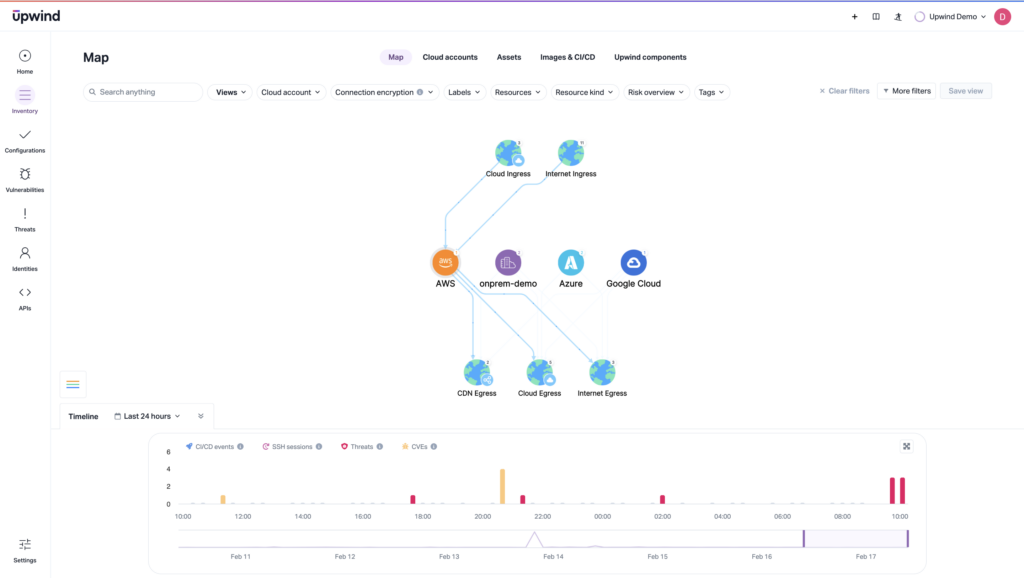
Upwind delivers a modern, adaptive security platform built to help fill the gaps in modern cloud security, starting from securing runtimes. Its runtime-powered CNAPP provides the automation, visibility, and real-time enforcement needed to execute an effective cloud security strategy at scale without slowing down cloud operations.
Upwind’s agentless scanning provides visibility across containers, Kubernetes clusters, serverless functions, and running cloud workloads. In parallel, Upwind’s runtime sensors provide risk-based prioritization that shows which vulnerabilities, misconfigurations, and permissions are actually exploitable — so teams focus on what truly matters. This agentless + sensor approach provides comprehensive, robust protection for cloud infrastructure and security.
To see how to transform cloud security from a fragmented, manual effort into an automated, intelligence-driven process, schedule a demo.
Frequently Asked Questions
What are the essential elements of a cloud security strategy?
A cloud security strategy includes visibility, risk management, access control, continuous monitoring, automation, and compliance enforcement. It should address identity security, workload protection, runtime threat detection, and policy enforcement to secure cloud environments effectively.
How do you implement a cloud security strategy across multiple environments?
Implementing a cloud security strategy across multiple environments requires standardized security controls, visibility across cloud providers, and automated policy enforcement to maintain consistency. Organizations must align three core components: security architecture, risk management, and operational processes across AWS, Azure, GCP, and hybrid setups while accounting for platform differences.
That includes:
- Standardized Identity and Access Management (IAM)
- Implementing least privilege access and centralized authentication (e.g., AWS IAM, Azure AD, Google IAM).
- Using cross-cloud IAM policies via identity federation or third-party platforms.
- Unified Security Posture Management
- Deploying CSPM solutions to continuously assess misconfigurations across all environments.
- Setting up organization-wide guardrails (e.g., AWS Organizations, Azure Policy, GCP Organization Policies).
- Consistent Network Security Architecture
- Enforcing segmentation and traffic controls uniformly (e.g., AWS Security Groups, Azure NSGs, GCP Firewall Rules).
- Applying private connectivity solutions (e.g., AWS PrivateLink, Azure Private Endpoint) to limit exposure.
- Multi-Cloud Threat Detection and Response
- Centralizing logging and considering monitoring with SIEM/SOAR integrations.
- Deploying runtime security tools for active threat detection across workloads (e.g., CNAPPs like Upwind with agentless monitoring).
- Cross-Cloud Compliance and Governance
- Automating compliance enforcement with policy-as-code tools like Open Policy Agent (OPA).
- Continuously validating security baselines against standards (e.g., NIST, CIS Benchmarks, ISO 27001).
All these factors add up to unified control, reduced operational complexity, and greater resilience against cloud-native threats.
What role does automation play in cloud security strategy?
Automation eliminates manual security gaps, accelerates risk detection, and enforces security policies dynamically. That paves the way for real-time misconfiguration detection, auto-remediation of vulnerabilities, and identity access control enforcement so that security scales at the speed of cloud changes.
How do you measure the effectiveness of a cloud security strategy?
Measuring the effectiveness of a cloud security strategy means tracking key security metrics, assessing compliance, and validating real-world threat resilience. Organizations should use quantifiable indicators and continuous testing to ensure security controls function as intended across cloud environments. Here’s a blueprint:
- Incident Detection & Response Metrics: Measure mean time to detect (MTTD) and mean time to respond (MTTR) to security incidents.
- Cloud Misconfiguration & Risk Posture: Track the number and severity of misconfigurations identified by CSPM tools.
- Identity & Access Governance Effectiveness: Assess privileged access violations, excessive permissions, and IAM drift over time.
- Compliance & Audit Readiness: Monitor adherence to frameworks like NIST, CIS, and ISO 27001 through automated compliance scans.
- Penetration Testing & Red Team Exercises: Evaluate the ability to detect and mitigate simulated attacks on cloud workloads.
What are the best practices for maintaining continuous compliance?
Continuous compliance requires real-time misconfiguration detection, automated policy enforcement, least privilege access control, and continuous monitoring against security frameworks (SOC 2, NIST, ISO). Using IaC scanning and runtime security solutions ensures compliance is built into cloud environments from development to production.
What are the differences between legacy security and cloud security?
Security strategies weren’t designed for the scale, speed, and autonomy of modern cloud environments. The problem isn’t just ephemeral workloads, it’s also that cloud security is fundamentally a different problem from traditional IT security.
In the past, security teams controlled the stack — from physical servers to application access. In the cloud, that control is fragmented:
- Dev teams deploy infrastructure as code, often without security oversight.
- Cloud service configurations change dynamically, with thousands of interdependencies between workloads, APIs, and machine identities.
- Attackers don’t need to break in — they exploit gaps in automation, misconfigured permissions, and overly permissive IAM roles.
To regain visibility and control over sprawling cloud environments, security teams need agentless cloud scanners that continuously discover, assess, and monitor security posture without adding operational friction.