

Whether it’s from ephemerality visibility gaps, attempting to gain granular control of supply chain components, or potentially exploited sidecars – containers come with risks. We’ve already covered some of the fundamentals of container security (including securing orchestration platforms and container tools), container vulnerability scanning, and container runtime security. In this article, you’ll find deeper information on what the risks of containerization are in the first place and what secondary challenges you’ll come across while securing them. We’ll also cover actionable tips to make sure teams reap all the benefits of these modular, efficient computing technologies without sacrificing security.
What are Container Security Risks?
Container security risks are the threats and vulnerabilities that arise from how containerized applications are built and orchestrated. Unlike traditional infrastructure, containers are ephemeral, share resources, and rely heavily on dependencies. That reality makes them susceptible to:
- Breakout Attacks: Exploiting container runtime flaws to escape isolation.
- Supply Chain Risks: Malicious or vulnerable dependencies introduced via base images and registries.
- Orchestrator Exploits: Attacks on Kubernetes or other orchestration layers that control container lifecycles.
- Runtime Evasion: Techniques that bypass detection by operating only in-memory or manipulating system calls.
- Data Exfiltration via Shared Storage: Exposing secrets, logs, or sensitive data through persistent volumes.
Because containers are often deployed at scale across distributed environments, security solutions have to evolve, too. Today, container security goes beyond traditional workload protection and integrates real-time visibility, drift detection, and proactive security controls that work in ephemeral and highly dynamic ecosystems.
Runtime and Container Scanning with Upwind
Upwind offers runtime-powered container scanning features so you get real-time threat detection, contextualized analysis, remediation, and root cause analysis that’s 10X faster than traditional methods.
Get a DemoFundamental Risks in Container Security
Containers come with efficiencies that make cloud computing more tenable: they package dependencies so apps run seamlessly in multiple environments. They allow for automated scalability. And they reduce overhead.
According to a recent study on containerization, container use skyrocketed from 23% in 2016 to 92% by 2023, with profound impacts: container use has helped boost developer productivity 78% with a 66% reduction in errors at deployment.
In spite of benefits, containers come with inherent security risks due to their design, architecture, and operational model. These risks exist before an attacker even gets involved, meaning security teams must account for them by default rather than treating them as edge cases.
Instead of listing risks one by one, we’ll break them into three core categories that highlight where security challenges originate:
- Container Execution Risks: Containers are ephemeral, shared, and hard to monitor
- Container Dependencies Risks: Containers may contain untrusted code, supply chain risks from open-source components, and API exposure.
- Container Orchestration & Networking Risks: Containers come with cluster-level risks, misconfigurations, and lateral movement.
Container Execution Risks
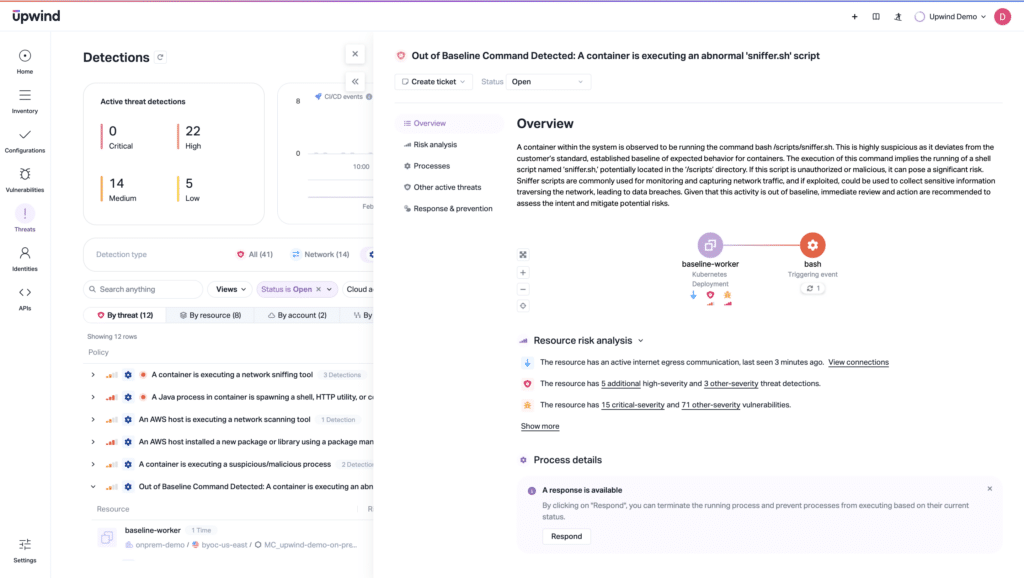
Unlike traditional servers or even VMs, containers exist in a transient, highly dynamic environment that prevents teams from applying traditional monitoring and control techniques. Challenges are borne of the reality that:
- Containers are ephemeral:
- They spin up and disappear in seconds, making forensic investigations difficult.
- If an attack occurs inside a container that no longer exists, evidence is lost unless logs were offloaded in real time.
- Containers share host resources:
- Unlike VMs, containers don’t have a dedicated OS but share the same kernel.
- A kernel exploit can lead to container escape, which can affect the workload on that host.
- Containers don’t necessarily work with security tooling:
- Many legacy security solutions rely on agent-based monitoring of persistent workloads.
- Since containers are designed for automation and fast lifecycles, security tools must integrate natively into CI/CD pipelines and runtime layers.
Container Dependency Risks
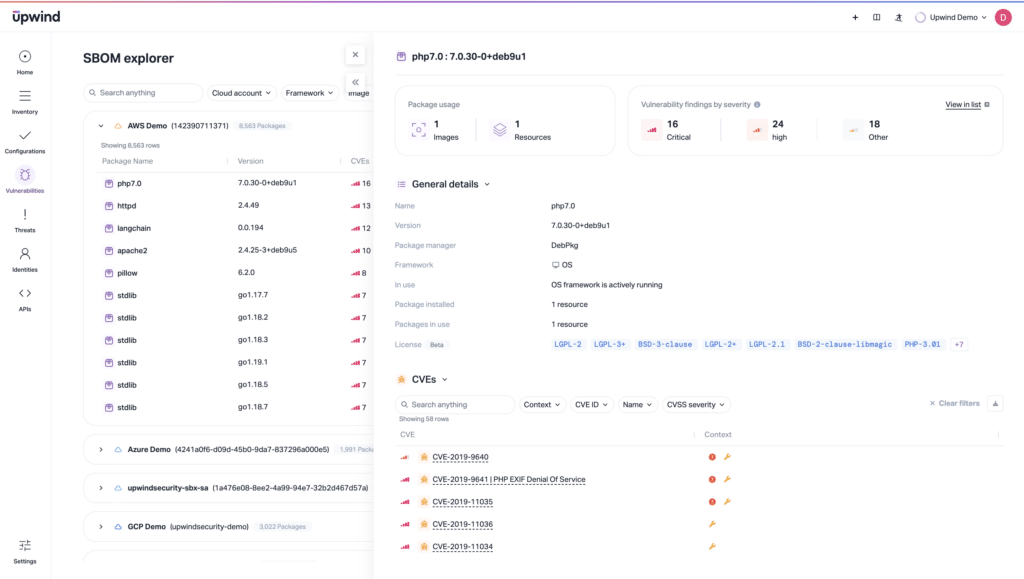
Security starts at build time. But containers rarely contain code that is developed 100% internally, leading to risks inherited from external dependencies.
- Base images introduce vulnerabilities:
- Many organizations pull images from public registries (e.g., Docker Hub) without validating their security.
- Even “official” images often contain outdated dependencies that introduce known CVEs.
- API exposure is difficult to control:
- Containers rely on extensive API communication, both internally, in a cluster, and externally.
- If API access control isn’t well-defined, containers may accidentally expose internal functions to the internet.
- CI/CD pipelines can introduce compromised components:
- Attackers may target CI/CD systems to introduce malicious code into the build process.
- Even trusted dependencies can become attack vectors if a popular open-source package is compromised, as in the Log4j vulnerability.
Container Orchestration & Networking Risks
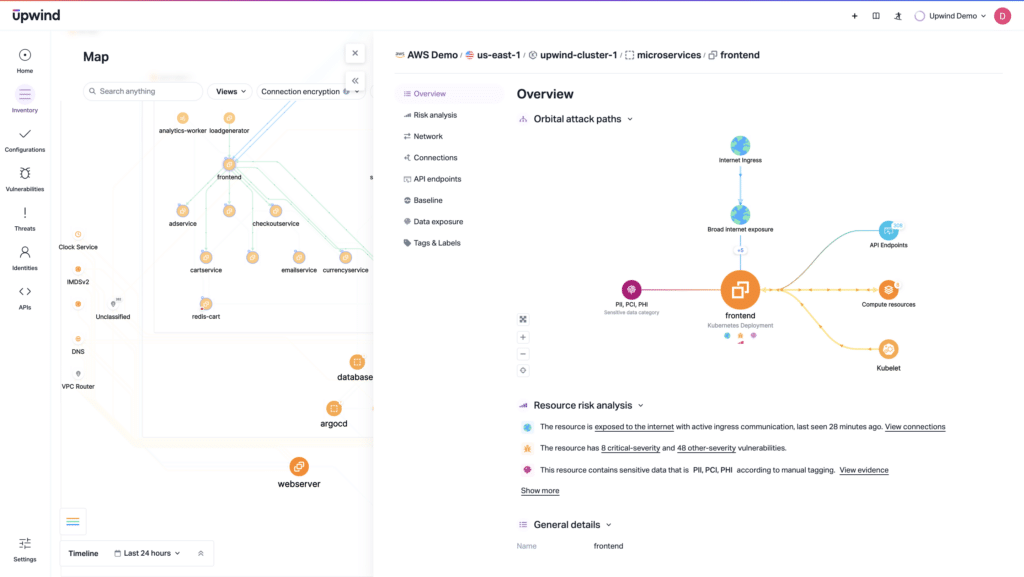
A containerized environment can contain thousands of containers dynamically orchestrated across cloud-native infrastructure. This creates a new set of security risks that are often overlooked:
- Misconfigured Kubernetes clusters are a significant threat:
- Kubernetes default configurations are not secure, leading to overly permissive access and exposed APIs.
- Attackers frequently exploit weak role-based access control (RBAC) policies or misconfigured Kubernetes API servers to gain control over entire clusters.
- Service discovery and networking expose lateral movement paths:
- Containers communicate through software-defined networks, which need to be segmented to stop attackers from moving laterally once inside.
- Security teams may forget to enforce Zero Trust between containers.
- Orchestration creates complexity that security teams must monitor:
- Unlike traditional workloads, containers and microservices don’t exist in a static environment.
- Security teams must keep up with rapid scaling, auto-healing, and load balancing, all of which obscure visibility.
Advanced Container Security Risks
Attackers don’t just take advantage of the vulnerabilities of containers themselves. They also leverage the dynamics of containerized environments to evade detection, move laterally, and persist in ways that traditional security models struggle to address.
So, while teams may know the basics of pre-deployment scanning and basic runtime protection, they don’t always adopt more comprehensive strategies to address real-world operational risks. Let’s look at risks that go beyond container architecture, including ways to address them.
| Risk | Why it’s a Threat | Actionable Steps |
| Ephemeral Workload Evasion | Attackers can exploit short-lived containers to conduct attacks that disappear before security tools can detect them. | Implement real-time runtime threat detection. Offload logs to immutable storage for forensic analysis. Use container-specific behavioral monitoring. |
| Supply Chain Poisoning | Attackers can target base images, Helm charts, and registries to introduce backdoors before deployment. | Enforce strict image signing and verification. Regularly scan all dependencies, even in official repositories. Use Software Bills of Materials (SBOMs) to track changes. |
| Sidecar & Service Mesh Exploits | Attackers can compromise sidecars, proxies, or service meshes to manipulate or intercept container traffic. | Monitor sidecars and service mesh components like any other workload. Enforce mutual TLS (mTLS) for internal container communication. Use network segmentation to isolate service meshes. |
| Kubernetes API Takeover | Overly permissive RBAC roles, exposed APIs, or weak authentication can all allow attackers to control Kubernetes itself. | Apply least-privilege RBAC policies. Continuously audit Kubernetes configurations. Limit API exposure to only necessary users/services. |
| Stealthy Runtime Attacks | Attackers can use fileless malware, kernel-level evasion, or LD_PRELOAD hijacking to bypass traditional runtime security. | Implement eBPF-based threat detection to monitor syscalls. Use runtime security. Regularly audit running containers for unexpected behaviors. |
| Data Exfiltration via Shared Resources | Attackers can use persistent storage, message queues, or log files to leak sensitive data. | Implement strict volume access controls. Monitor unexpected data flows between containers. Use DLP (Data Loss Prevention) tailored for containerized environments. |
| Hidden API & Debugging Exposure | Containers can expose internal APIs, debugging ports, or unintended interfaces. | Conduct regular API discovery and access audits. Use WAF and API gateways to limit external exposure. Block public access to debugging and admin interfaces. |
| False Sense of Security from “Shift Left” | Pre-deployment scanning can catch some risks, but it misses runtime misconfigurations, drift, and zero-day exploits. | Extend security beyond CI/CD to runtime. Implement configuration drift detection. Continuously monitor for post-deployment vulnerabilities. |
These risks represent advanced ways that attackers weaponize the baseline images that all containers share, turning them into active attack techniques.
For instance, many security teams focus heavily on shift-left strategies, assuming that catching vulnerabilities before deployment is enough. But attackers continue to adapt even after software is built, exploiting operational realities that can’t be addressed by pre-deployment scanning alone.
In reality, attackers may use runtime evasion tactics, such as deploying a containerized payload just long enough to execute their attack. Without real-time monitoring, threats like kernel-level obfuscation or ephemeral container hopping could remain completely invisible.
Similarly, Kubernetes API takeover is a growing attack vector by which attackers take over the administrative control plane that lets them modify workloads at scale. Using RBAC settings? You may think your clusters are secure. But overly permissive roles are one of the most common ways to exploit misconfigurations in real-world breaches.
Teams must recognize that supply chain security is no longer just about external vendors. Attackers can target internal dependencies, private registries, and CI/CD pipelines before a container reaches production, poisoning images or injecting malicious code.
Overall, the broad attack surface that comes with container use has given rise to multiple real-life approaches. To stay secure, teams need runtime protection, continuous API and network monitoring, and comprehensive Kubernetes hardening to protect containers from build to deployment and beyond.
Consequences of Container Security Breaches
Attacks aren’t hypothetical. When they happen, they can have far-reaching impacts on operations, including:
- Data exposure and theft: Misconfigurations in the container environment, such as open APIs or exposed ports, can lead to unintentional data exposures. Once threat actors gain access, they can exploit shared resources to steal sensitive data.
- Service disruption and availability issues: The #1 concern for CISOs in 2025, operations disruptions are a core worry, only exacerbated by the broadened attack surface of containerization. Container breaches can disrupt services by overloading system resources or compromising critical application components. Containers rely on intricate interdependencies, meaning that a single compromised container can have cascading effects on availability.
- Compliance violations and regulatory penalties: Container breaches often expose organizations to compliance risks, especially in industries governed by strict data protection laws such as GDPR, HIPAA, or PCI DSS. A breach may result in violations, leading to fines, audits, or loss of certifications.
- Reputational damage: Security incidents involving containers can harm an organization’s reputation, especially when sensitive customer data is involved. Public disclosure of breaches, mandatory in many jurisdictions, can diminish stakeholder trust, impact brand perception, and lead to customer attrition. Organizations with frequent or poorly handled breaches may struggle to retain existing customers and attract new ones.
- Financial consequences: The financial fallout from container breaches can be substantial, encompassing direct costs like incident response, forensics, and system recovery, as well as indirect losses from operational downtime and diminished sales. Additionally, regulatory fines, legal fees, and long-term damage to customer relationships can amplify the financial impact. In 2024, the average cost of a data breach hit $4.88 million, up 10% over the previous year.
Strengthen Container Defense with Upwind
Upwind’s Cloud Native Application Protection Platform (CNAPP) is purpose-built to secure the modern cloud environment, from containerized applications to microservices architectures, and at every stage of the container lifecycle:
- Comprehensive protection regardless of environments: With cross-environment protection for containers running on Amazon EKS & ECS, Google GKE, Microsoft AKS, and OpenShift, Upwind ensures consistent policy enforcement.
- Enhanced visibility with DevOps context: Get real-time, graph-based network and process-level views of your entire container infrastructure. It all helps teams correlate runtime behavior with misconfigurations and incorporate insights into the CI/CD pipeline.
- Timeline-based detections and event correlation: Detect and respond to container and Kubernetes threats in real time, such as abnormal data access, lateral movements, and privilege escalations. With automated response capabilities, Upwind can kill malicious processes and apply preventive policies to ensure the rapid containment of threats.
To learn more about Upwind’s container security and get advice on best practices, schedule a demo.
Frequently Asked Questions
What are the most common container security risks?
The most common container security risks are:
- Misconfigurations: Weak RBAC, exposed Kubernetes APIs, and overly permissive privileges.
- Supply Chain Vulnerabilities: Untrusted base images, outdated dependencies, and poisoned registries.
- Runtime Threats: Container escapes, kernel exploits, and in-memory malware.
- Ephemeral Workloads: Short-lived containers erase forensic data, making attacks harder to detect.
- API & Networking Exposure: Unintended API access, open debug ports, and lateral movement risks.
That’s why the basics of securing containers include hardening configurations, enforcing least privilege, monitoring runtime behavior, and securing the software supply chain.
How do containers get compromised?
Container attack vectors typically follow those common container security risks closely. They include:
- Exploiting Misconfigurations: Attackers abuse weak RBAC settings, exposed Kubernetes APIs, or default credentials.
- Supply Chain Attacks: Malicious or vulnerable base images, dependencies, or CI/CD pipeline components introduce backdoors.
- Container Escape: Exploiting kernel vulnerabilities or improper isolation to break out of a container and access the host system.
- Runtime Exploits: Using fileless malware, syscall manipulation, or memory injection to evade detection while inside a running container.
- API & Networking Weaknesses: Attackers can exploit unprotected APIs, open ports, or service meshes to move laterally.
- Credential Theft: Containers with hardcoded secrets, environment variable leaks, or weak authentication help attackers escalate privileges.
What’s the difference between container and traditional security risks?
While traditional security focuses on securing individual systems like servers or applications, container security introduces additional risks due to their dynamic, ephemeral, and highly automated nature. Unlike traditional workloads, containers share a host OS kernel, deploy rapidly through automated pipelines, and often expose APIs and orchestrators (like Kubernetes) that each expands the attack surface.
These differences introduce new security challenges like misconfigured privileges, malicious container images, API exposure, and difficulty maintaining visibility into ephemeral workloads and inter-container network activity. These differences mean that securing containers requires a specialized approach that integrates image validation, runtime threat detection, Kubernetes hardening, and supply chain security across the entire container lifecycle.
How can organizations prevent container escapes?
To prevent container escapes, organizations should focus on minimizing the attack surface within the containerized environment. Here are some recommendations:
- Use minimal base images: Reduce the attack surface by using lightweight, security-hardened images.
- Limit container privileges: Run containers as non-root, disable privilege escalation, and avoid system administrator privileges.
- Regularly scan for vulnerabilities: Continuously scan container images, runtime workloads, and dependencies for CVEs.
- Apply Linux Security Modules: Restrict syscalls, enforce process confinement, and limit container interactions with the host.
- Utilize network segmentation: Implement strict pod-to-pod and container-to-host isolation or service meshes.
- Enforce strict access controls: Use RBAC to control Kubernetes API permissions, prevent direct host access, and enforce least privilege policies.
- Enable read-only filesystems: Reduce persistence risks by running containers with read-only root filesystems and immutable infrastructure principles.
- Monitor for abnormal behavior: Use eBPF-based runtime monitoring, like Upwind, to detect unexpected syscall activity and privilege escalation attempts.
What are the best practices for securing container registries?
Here are some key best practices for securing container registries:
- Use trusted registries and libraries, and only use images from trusted sources.
- Limit who can push and pull images. Use RBAC to control access.
- Regularly scan images for vulnerabilities and misconfigurations, then apply updates promptly.
- Use secure storage for artifacts and ensure all communications with the registry are encrypted.
- Use signed images to ensure that the image has not been tampered with.
- Use specialized container monitoring tools to gain visibility into containerized workloads.
- Perform integrity validation checks throughout CI/CD.
- Securely manage access to sensitive data and secrets used within containers.
- Segment the network to prevent unauthorized access between containers.
- Establish validation policies and regular audit schedules.