Get a Demo
Under Attack?
A blue circle with the Kubernetes logo inside is in the center. The background features multiple faded, overlapping Kubernetes logos on a white backdrop. The word upwind is in the top left corner.

Proactively Secure Kubernetes Workloads with Upwind’s Runtime-Powered KSPM

<br />
<b>Warning</b>:  Undefined variable $photo in <b>/nas/content/live/landing173/wp-content/themes/bricks/includes/elements/code.php(236) : eval()'d code</b> on line <b>24</b><br />
<br />
<b>Warning</b>:  Trying to access array offset on value of type null in <b>/nas/content/live/landing173/wp-content/themes/bricks/includes/elements/code.php(236) : eval()'d code</b> on line <b>24</b><br />
Denise Ashur January 21, 2025

Proactively Secure Kubernetes Workloads with Upwind’s Runtime-Powered KSPM

With the rise of containerized environments and Kubernetes adoption, Kubernetes security posture management (KSPM) has risen to the forefront of cloud security posture initiates. KSPM generally requires the use of security tools or processes to help ensure the security of Kubernetes clusters, with most focusing on policies and configurations.

However, this focus on static configuration findings can create noise and make it difficult to prioritize which misconfigurations should be prioritized for remediation. Upwind solves this by marrying runtime risk prioritization and KSPM findings, providing advanced Kubernetes security with both real-time container protection and prioritized configuration findings based on deep environmental context.
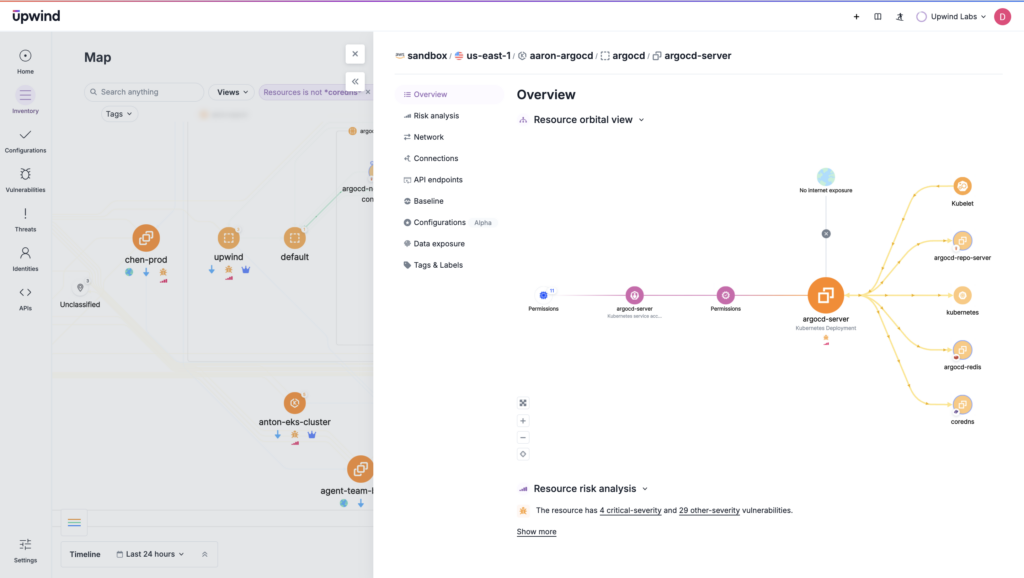
Screenshot of a server management interface displaying a network map. The main section shows argocd-server connected to various resources. The left sidebar contains configuration and monitoring options. Header includes navigation and user profile links.

Key Features of KSPM

KSPM is essential for cloud-native security, helping teams assess, monitor, and strengthen security configurations in Kubernetes environments. KSPM simplifies compliance and detects vulnerabilities across Kubernetes clusters and workloads, increasing visibility and enforcing policies. This includes:

  • Enforcing API authentication and access control
  • Detecting misconfigured network policies
  • Applying Admission control and policy enforcement
  • Enforcing Pod security policies 
  • Managing ingress and egress traffic controls
  • Monitoring cluster resource security
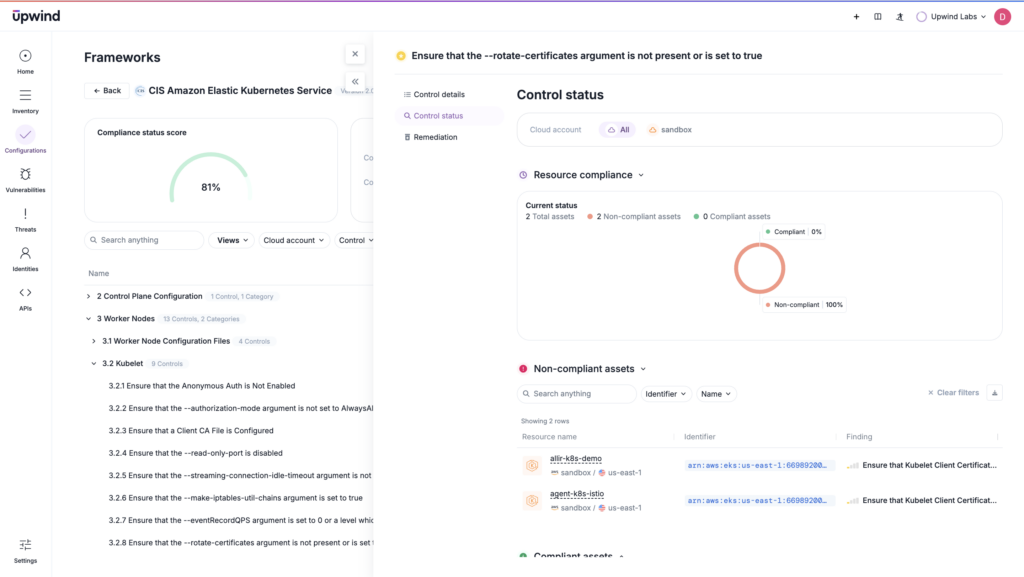
Screenshot of a compliance framework dashboard showing an 81% compliance rate for AWS Kubernetes service. The display includes a circular compliance status chart, a list of non-compliant assets, and recommendations for remediation.

Upwind simplifies implementing and monitoring KSPM controls using industry frameworks like the Center for Internet Security (CIS) Amazon Elastic Kubernetes Service (EKS) Benchmark (CIS EKS) and the Center for Internet Security Kubernetes Benchmark (CIS Kubernetes). 

Runtime-Powered KSPM

While legacy KSPM solutions can identify static configuration findings, the lack of runtime insights makes it difficult to prioritize findings. Upwind’s next-generation KSPM solves this with deep Kubernetes security context – marrying runtime context with posture findings.
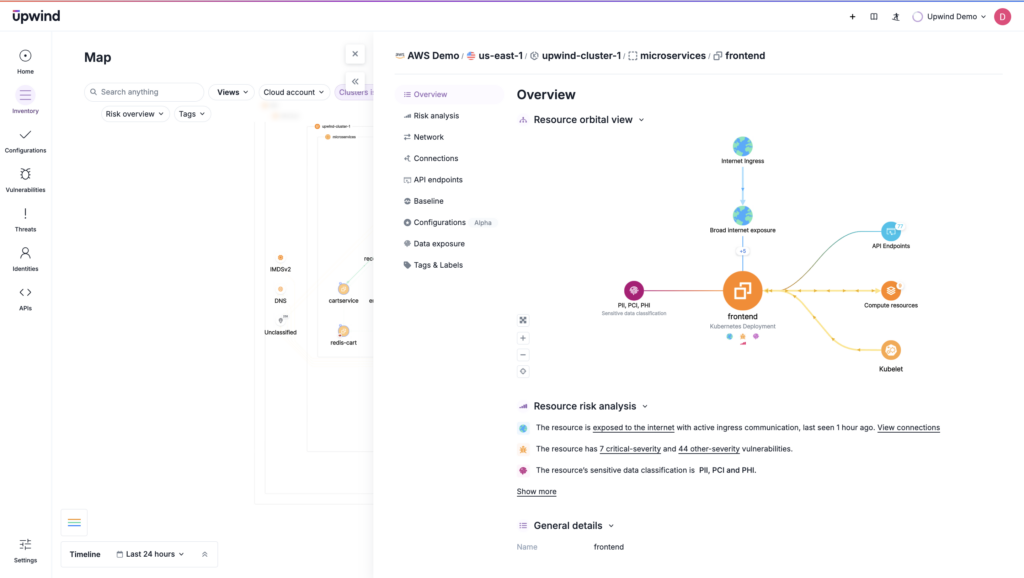
Screenshot of a web interface displaying a resource map and overview. The map is on the left, showing resource connections, while the right side provides details about a frontend resource, including its internet exposure and risk analysis.

Through the use of a lightweight, high-performance eBPF sensor operating at the kernel level, Upwind is able to collect deep Kubernetes security context including:

  • Awareness of Kubernetes identities and if they have privileged access to the host or system
  • Real-time visibility of Kubernetes network topology
  • Communication flow tracking from containerized resources within the cluster, within the account, to the Internet, and to cloud services.

With this extensive Kubernetes runtime context, Upwind streamlines risk prioritization, highlighting critical risks such as misconfigurations on a resource containing sensitive data, which also has a critical vulnerability and is communicating with the Internet.

Teams can easily leverage Upwind’s runtime-powered KSPM to go beyond static configuration findings and focus on their highest-risk KSPM findings that should be prioritized for remediation. To discover how Upwind’s runtime-powered KSPM can help you secure Kubernetes workloads more effectively, schedule a demo today.

Contents

Further Reading

gemini-svg

Metabase Instances Actively Exploited: Unauthenticated Admin Takeover via BI Layer Reset Password SQL Injection (CVE-2026-72898)

Executive Summary Upwind recently observed multiple Advanced Persistent Threat (APT) groups actively exploiting CVE-2026-72898. This vulnerability - an unauthenticated SQL injection in the Metabase password reset endpoint carrying a critical CVSS score of 10.0, was actively exploited as a zero-day before a patch became available. An unauthenticated remote attacker can craft a malicious SQL injection…
Buyers Demos

Why Buyers Remember Solving a Demo, Not Watching One

Key Takeaways I recently sat down with Upwind Solutions Architect, Evan Grace to learn more about his process. After some intros, he told me about his new hobby, hydroponics. For those who don’t know, hydroponics is a method of growing plants without soil. This was unbelievable to me but after Evan explained his deep dive…
PagerDuty-Hero

Upwind Integrates with PagerDuty for Instant Incident Response

Upwind now integrates with PagerDuty, enabling security teams to create workflows that automatically route Upwind findings and detections to the appropriate on-call team based on existing incident management workflows. This integration expands Upwind's growing library of native workflow integrations, giving security and platform teams even more ways to turn real-time detections into immediate action. What's…
Add the Upwind RSS Feed to Slack
Connect the Upwind RSS Feed to your Slack.
Follow the how-to here.
Threat RSS
Add the Upwind RSS Feed to Slack
Connect the Upwind RSS Feed to your Slack.
Follow the how-to here.
Main RSS