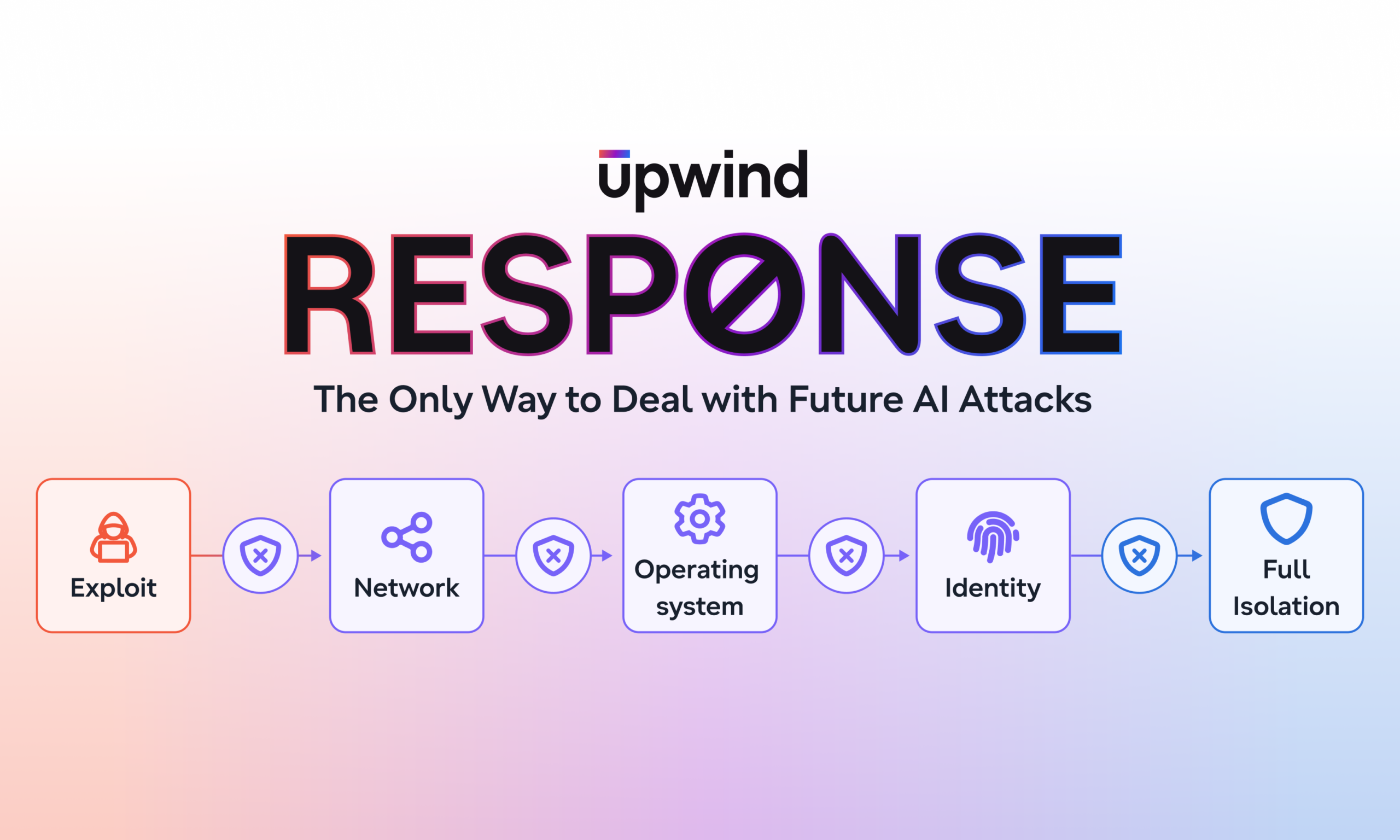

In the past year, my team and I have dealt with hundreds of incidents, more than in any year before. I no longer think detection alone can protect a company. So we built Upwind Response to contain an attacker in your cloud in near real time, without disrupting your services.
Key Takeaways
- Contain an attacker in near real time, even when the vulnerability is only hours old, and you have not patched yet.
- Keep your service running. Response blocks the attacker at the network first, and isolates the host only as a last resort.
- Act only on a real attack. Response triggers on an attacker Upwind sees executing, never on a risk score or a scanner finding.
- You decide what runs automatically, and you can roll back blocks and restrictions as well as host isolation.
Anyone with an agent now has APT capabilities
Not long ago, a vulnerability researcher could spend three months turning a single CVE into a working exploit, and that time was the defender’s buffer. That buffer no longer exists. CVEs now arrive by the hundreds every day, attackers use AI agents to probe environments around the clock, and exploitation often starts the day a CVE is published. When React2Shell (CVE-2025-55182) was disclosed on December 3, 2025, Amazon’s threat intelligence teams saw exploitation attempts within hours. In my experience, very few teams can patch production in hours.
The same agents also work without a CVE. They fuzz your APIs, chain valid requests into a business-logic bypass, and pivot with whatever credentials the workload holds. A scanner has nothing to match and you have nothing to patch.
Anyone who can run an agent now has the capabilities that used to separate an APT from everyone else. To me, that means detecting an attack and blocking it have to happen in the same product, at the same speed, because there is no time left for a handoff.
“You detected it, can you stop it?”
Every security team gets to that question eventually. Even the fastest detection leaves a gap between “we see it” and “it’s stopped.” In that gap the security team waits on the cloud team, and the attacker waits on no one.
We built Upwind Response to close that gap. It triggers when Upwind sees an attacker executing: exploiting a vulnerability through remote code execution, or taking remote control of a server.
Every containment action traces back to what Upwind observed at runtime: the process, the connection, or the payload. We do not let Response act on a risk score, which is an estimate of what might happen.
Four gates on the attack chain
Most teams know one kind of response: isolate the machine. It works, and it takes the service down with the attacker, so people hesitate to use it.
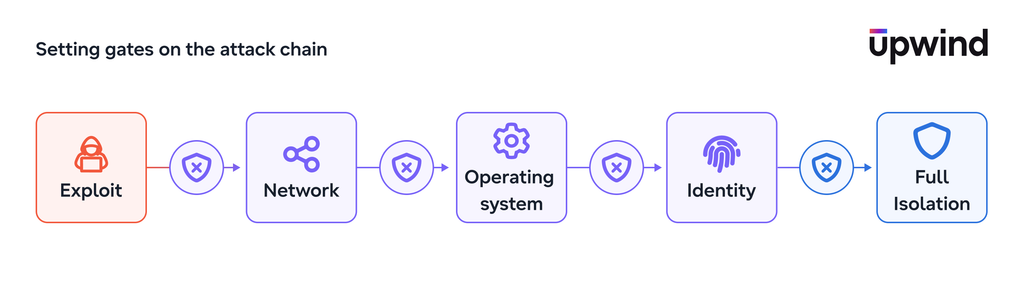
An attack on a cloud workload usually moves in a known order. The attacker reaches a service over the network, gets code running on the host, and then acts through an identity. Upwind Response places a gate at each of those steps, plus a fourth, full isolation, as a last resort. Each gate narrows the attacker’s options as the attack unfolds.
Response starts with the least disruptive gate and moves to the next one only if needed.
Gate 1: Block the attacker at the network
Upwind blocks the attacker’s access to the specific service under attack, at the cloud network level, in near real time. Customer traffic keeps flowing. The service stays up for everyone who is supposed to use it.
Response adds its own blocking rules and never changes or deletes yours. It tags every rule it adds, so you can see where Upwind has acted.
Gate 2: Stop the malicious process on the host
A network block stops new access, but it does not undo code that is already running. If the attacker is already further in, Upwind terminates the malicious process on the host and works to prevent it from starting again.
Gate 3: Restrict the compromised identity
An attacker who has reached the host may be acting through an identity. If needed, Upwind restricts the compromised identity’s permissions so it can’t keep acting.
Gate 4: Isolate the host completely
The last resort is the red button: the host is isolated entirely. Full isolation can disrupt legitimate activity, which is why it comes last and only if needed.
Each gate answers a different question. Can we cut the attacker off? Can we stop what is already running? Can we take away what they are acting as? Taking a host offline is expensive, so you only do it when the first three aren’t enough.
You decide how far containment goes
Anything that acts in production needs guardrails. We built Response around three:
- Containment touches only the service under attack, and works only in the cloud accounts you choose to connect. It acts through a separate role that you deploy yourself.
- Network blocks, identity restrictions, and host isolation are temporary and can be rolled back. A terminated process stays terminated.
- You choose what runs automatically and what waits for approval. Upwind logs every action as well as who took it and when.
An attack on one customer becomes protection for every customer
When we see an attack run against one customer, we see it at runtime. The next time that attack shows up in another customer’s environment, Upwind already knows it and blocks it.
Attackers reuse what works. An attack that hits one company today will be pointed at many others tomorrow, by people who did not build it. Collective defense turns that reuse against them, because the first attempt becomes the warning for everyone else.
What to do when the next zero-day drops
You can’t patch every CVE the day it lands, and not every attack comes with one. You can stop the attacker at the first gate, while your service stays up. Here is what each team does first:
- Security leaders: open Threat Feed to see whether the threat affects your environment and what is exposed.
- SOC and IR analysts: check which affected resources are under attack, and contain the attacker from the investigation, without waiting on the cloud team.
- Vulnerability and cloud teams: start with what is exposed and what Upwind has validated as reachable, then work the fixes.
If you are an Upwind MDR customer, our engineers can contain threats on your behalf, with your prior approval.
Upwind Response is available to every Upwind customer, existing or new. Book a demo to see it in action.