Feed
Upwind Feed
Feed
Grid
MDR
November 8, 2026
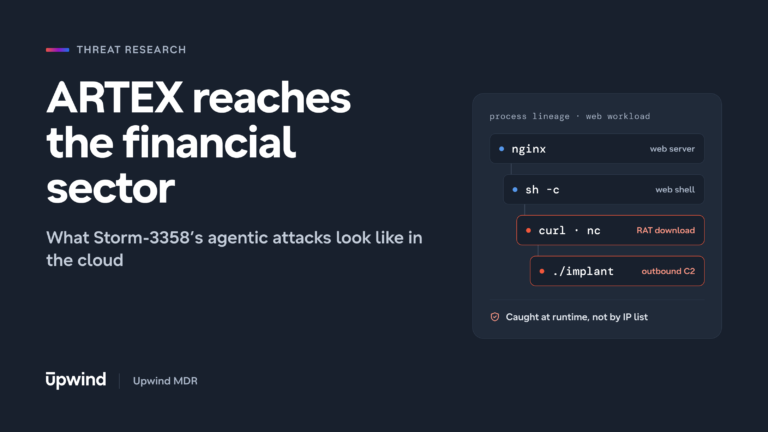
ARTEX Reaches the Financial Sector: What Storm-3358’s Agentic Attacks Look Like in the Cloud
A financially motivated actor that Microsoft tracks as Storm-3358 is now running the ARTEX agentic attack framework against banks and other financial organizations. What we found in the public record: the techniques are not new, the tooling is noisy, and in cloud workloads the most useful signal is not an IP address but a web…
November 8, 2026
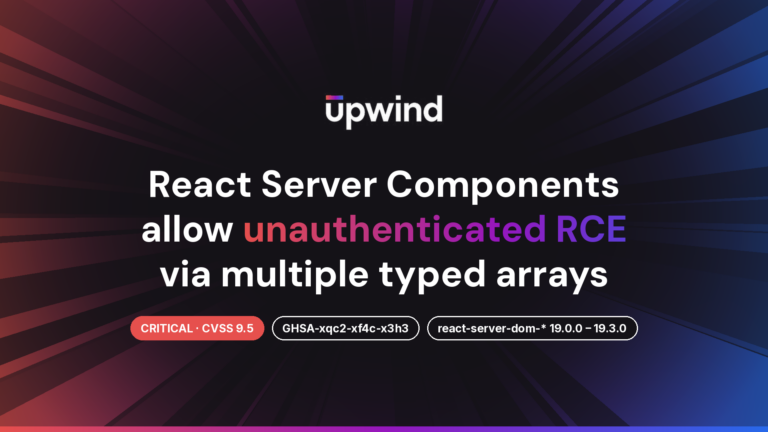
GHSA-xqc2-xf4c-x3h3: What the React Server Components Typed-Array RCE Means for Your Next.js Apps
React fixed a critical, unauthenticated remote code execution flaw in its Server Components packages on 14 October 2026 (GHSA-xqc2-xf4c-x3h3, CVSS v4 9.5). What we found: the trigger is narrow and this is not React2Shell 2.0, but the flaw is easy to miss because it has no CVE, it hides in a copy of React that…
November 2, 2026
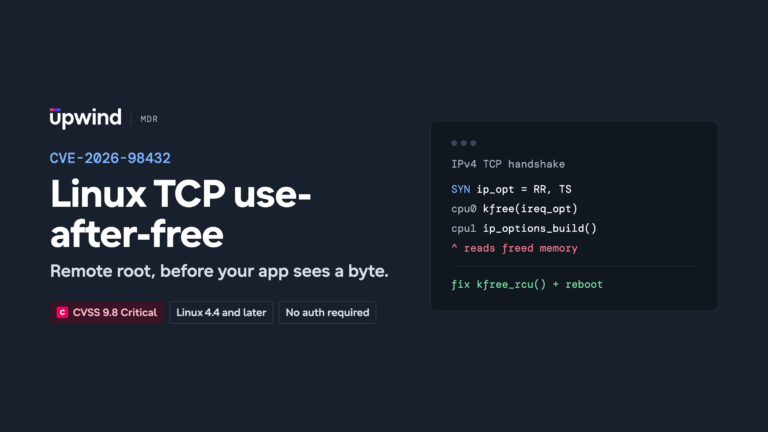
CVE-2026-98432: Inside the Critical Linux TCP Use-After-Free That Fires Before Your App Sees a Byte
A use-after-free in the Linux kernel's IPv4 TCP handshake (CVE-2026-98432, CVSS 9.8) was fixed upstream in October and is still landing in distribution kernels. What we found: any unauthenticated peer can reach it on any IPv4 TCP port; the working root exploit has been described but not published; and the setup it needs is more…
October 24, 2026
HTTP2Shell (CVE-2026-111497): one Brotli bug, RCE across the HTTP stack
TL;DR HTTP2Shell (CVE-2026-111497) is an out-of-bounds write in Google's Brotli decoder, versions 1.0.3 through 1.2.0. An unauthenticated attacker who gets crafted Brotli data into a vulnerable decoder can crash the process, read its memory, or in some cases run code. It was first reported as a Node.js bug ("Node2Shell"), but the flaw is in the…
ARTEX Reaches the Financial Sector: What Storm-3358’s Agentic Attacks Look Like in the Cloud
A financially motivated actor that Microsoft tracks as Storm-3358 is now running the ARTEX agentic attack framework against banks and other financial organizations. What we found in the public record: the techniques are not new, the tooling is noisy, and in cloud workloads the most useful signal is not an IP address but a web…
GHSA-xqc2-xf4c-x3h3: What the React Server Components Typed-Array RCE Means for Your Next.js Apps
React fixed a critical, unauthenticated remote code execution flaw in its Server Components packages on 14 October 2026 (GHSA-xqc2-xf4c-x3h3, CVSS v4 9.5). What we found: the trigger is narrow and this is not React2Shell 2.0, but the flaw is easy to miss because it has no CVE, it hides in a copy of React that…
CVE-2026-98432: Inside the Critical Linux TCP Use-After-Free That Fires Before Your App Sees a Byte
A use-after-free in the Linux kernel's IPv4 TCP handshake (CVE-2026-98432, CVSS 9.8) was fixed upstream in October and is still landing in distribution kernels. What we found: any unauthenticated peer can reach it on any IPv4 TCP port; the working root exploit has been described but not published; and the setup it needs is more…
HTTP2Shell (CVE-2026-111497): one Brotli bug, RCE across the HTTP stack
TL;DR HTTP2Shell (CVE-2026-111497) is an out-of-bounds write in Google's Brotli decoder, versions 1.0.3 through 1.2.0. An unauthenticated attacker who gets crafted Brotli data into a vulnerable decoder can crash the process, read its memory, or in some cases run code. It was first reported as a Node.js bug ("Node2Shell"), but the flaw is in the…