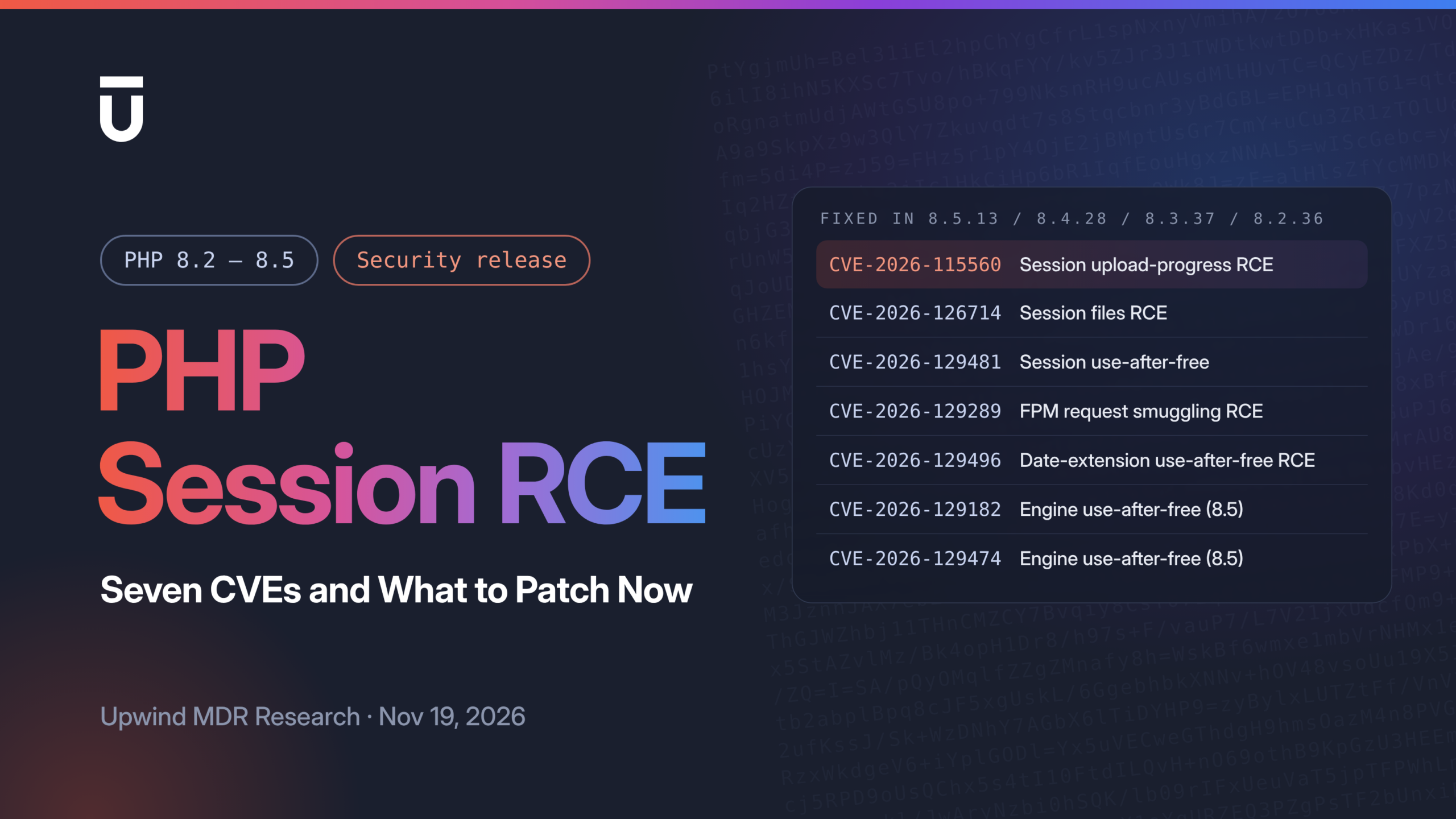
PHP fixed seven Critical vulnerabilities in today’s security releases, across session handling, the engine, the date extension, and PHP-FPM. What we found: the most direct route to code execution is the PHP-FPM request smuggling bug, not the session bug that drew attention in October. The session serializer bug is far broader than October’s advisory suggested, three of the new fixes trace back to October’s PHP2Shell patch, and the one-line October mitigation covers only part of the risk.
TL;DR
On 19 November 2026, PHP released 8.5.13, 8.4.28, 8.3.37, and 8.2.36. This post covers the seven fixes PHP rates Critical, each scoring 9.2 on CVSS v4: three session bugs (one a use-after-free), three use-after-free bugs in the engine and the date extension, and one PHP-FPM request smuggling bug. The best known of the seven is CVE-2026-115560 (GHSA-658j-r8rw-q6mx), the session serializer bug. PHP first disclosed it on 23 October, two days after the emergency PHP2Shell fixes, as a short informational notice with a one-line mitigation and no patch. Today’s full advisories change the picture.
The PHP-FPM bug is the one to close first. CVE-2026-129289 gives an unauthenticated attacker PHP code execution with a single request. It needs no memory corruption, race or gadget chain. It does need a front end that reuses FastCGI connections and an application path that opens php://input without reading it to the end.
The October framing of the session bug was too narrow. In October, PHP’s own notice said applications that never change the serialize handler at runtime could keep upload progress enabled. The full advisory says separate apps, FPM pools, vhosts or CLI jobs that share one session store with different serializers are exposed too.
Working command execution is documented. The advisory reports command execution with a Guzzle gadget on PHP 8.2.35, 8.3.36, 8.4.27 and 8.5.12, the releases that carried the October PHP2Shell fixes, and with a Monolog 2.11.1 gadget.
The October PHP2Shell fix left gaps and opened one. PHP ties CVE-2026-129481 and CVE-2026-129182 to cases the October fix for CVE-2026-109619 did not cover. A third, CVE-2026-129474, became remotely reachable through a change introduced in 8.5.12.
The INI line is not the whole fix. session.upload_progress.enabled=0 addresses CVE-2026-115560 and removes one input path for CVE-2026-126714. It does nothing for the four use-after-frees, and the FPM bug needs a different setting.
Fixed versions: 8.5.13, 8.4.28, 8.3.37 and 8.2.36. PHP 8.6.0, released the same day, already includes these fixes. Not every bug reaches every branch: 8.2 is hit by four of the seven, 8.3 and 8.4 by five, 8.5 by all seven. None of the seven is in CISA KEV or reported as exploited in the wild as of 19 November. PHP says older unsupported releases may also be affected by CVE-2026-115560, and the FPM bug was introduced in PHP 5.6.0. End-of-life branches get no upstream fix.
What changed between October and today?
The documented exposure is much wider than October’s notice described.
The session bug comes down to one sentence: PHP writes upload-progress data into a session with one serializer, and something else reads it back with another. When the formats disagree, text the attacker sent in a multipart upload is read back as PHP objects. If the application loads libraries with useful “gadget” classes, those objects can run code.
The October notice described a single path to that mismatch: the configuration sets session.serialize_handler to php_binary or php_serialize, the code switches it to php with ini_set() before session_start(), and upload progress is enabled. It said applications that never change the handler at runtime could keep the feature enabled.
Today’s advisory adds a much more common path. A legacy app and a new app on the same server, two FPM pools, two vhosts, or a web app and a CLI job can all read and write one session store. If any of them uses a different serializer, the mismatch exists without a single ini_set() call.
What the fix does
The patch makes session upload progress disabled by default, so applications that rely on it must now enable it explicitly. While upload progress is enabled, PHP rejects runtime changes to session settings, including session.serialize_handler. An explicit enable overrides the new default, and PHP states that the fix does not enforce matching serializers across separate configurations.
Who is exposed?
The exposure is about how session storage and the web server are set up, not just the PHP version.
nginx, Apache or HAProxy in front of PHP-FPM with connection reuse: exposed to CVE-2026-129289 on every branch, when the application opens php://input without fully reading it. Frameworks can do that before routing or authentication. Default configs that close the connection after each request are not affected.
Shared session storage with mixed serializers and upload progress on: the case most October guidance missed. Upload progress was on by default before today. Check shared session.save_path directories and shared Redis or Memcached backends across apps, pools and vhosts.
Applications that pull in Guzzle or Monolog: the gadget chains the advisory demonstrates. Both are common Composer dependencies.
Apps on the default files session handler that store user input in $_SESSION: exposed to CVE-2026-126714 even with upload progress off.
Configs that set session.upload_progress.enabled=1 explicitly: still exposed to the mismatch after patching, if serializers differ.
Servers that applied the October mitigation: covered for CVE-2026-115560 if the setting is in php.ini or the pool config and workers were restarted. Not covered for the FPM bug or the use-after-frees.
What’s true and what isn’t?
- “Only apps that call
ini_set()are affected.” No. Shared session storage with different serializers is enough. - “Separate FPM pools isolate us.” No. Pools that share session storage share the bug.
- “The October patch fixed it.” No. The October releases did not fix CVE-2026-115560, and PHP says two of today’s fixes cover cases the October PHP2Shell fix missed.
- “There is no working exploit.” No. Public proof-of-concept code has been on GitHub since 23–24 October, and the advisory documents command execution with two common gadget chains. We have not reproduced the chain ourselves.
- “Setting the mitigation with
ini_set()is fine.” No. Set it in php.ini or the pool config, where the application cannot change it. - “Recycling FPM workers after every request covers the memory bugs.” Not all of them. PHP documents
pm.max_requests=1as blocking the demonstrated CVE-2026-129481 sequence, at a performance cost. The date bug lives in a fresh worker’s first request, so recycling does not help there.
What are the seven Critical CVEs?
All seven are rated Critical, CVSS v4 9.2.
- CVE-2026-129289, PHP-FPM request smuggling (8.2 to 8.5): unread request-body bytes on a reused FastCGI connection can form a second request the front end never sent. An unauthenticated attacker who knows the path of one existing PHP script can run their own PHP code. It needs connection reuse, such as nginx
fastcgi_keep_conn onor Apacheenablereuse=on. On LiteSpeed LSAPI, PHP reports disruption but not code execution. - CVE-2026-115560, session upload-progress RCE (8.2 to 8.5): upload-progress data written with one session serializer is read back with another, so attacker text from a multipart upload becomes PHP objects. Command execution is documented with Guzzle and Monolog gadget chains.
- CVE-2026-126714, session files RCE (8.2 to 8.5): the default files handler rewrites a session file without clearing it. If a write is interrupted, the end of the old session can be read back as objects. Upload progress is one way to shape that data, large user-controlled strings in the session are another. Code execution also needs a gadget chain.
- CVE-2026-129481, session use-after-free (8.3 to 8.5): a fatal error during session shutdown leaves a stale pointer that a later request on the same worker can free. PHP calls it an incomplete fix for CVE-2026-109619. It does not need upload progress. Code execution has not been demonstrated.
- CVE-2026-129496, date-extension use-after-free (8.2 to 8.5): on non-thread-safe builds that log a startup diagnostic to a file-based
error_log, a crafted request can crash PHP-FPM, mod_php, or CGI workers. Code execution has been shown locally on FPM and mod_php with known memory addresses. - CVE-2026-129182, engine use-after-free (8.5 only): a stale fatal-error backtrace survives shutdown and is reused by the next request. It needs specific per-path or per-directory settings. PHP links it to further PHP2Shell scenarios and has not demonstrated code execution.
- CVE-2026-129474, engine use-after-free (8.5 only): a fatal error while entering a
__call()or__callStatic()call can corrupt memory through backtrace arguments. PHP confirms code execution, in a chain that needs known memory addresses. Settingzend.exception_ignore_args=On, the php.ini-production default, prevents it.
What should security teams do now?
Upgrade to 8.5.13, 8.4.28, 8.3.37 or 8.2.36. It is the only step that covers all seven. On distribution packages, check your vendor’s tracker, because backports keep older version numbers. PHP 8.2 reaches end of life on 31 December 2026.
Turn off FastCGI connection reuse until patched. Check nginx for fastcgi_keep_conn on and Apache for enablereuse=on, including front ends on another host or container. Some images ship it enabled: the wodby/nginx images hard-code fastcgi_keep_conn on.
Until you can patch, set session.upload_progress.enabled=0 in php.ini or the pool config, not with ini_set(), then restart every PHP worker. Search php.ini, conf.d files and pool configs for a value of 1, which overrides the new safe default.
On PHP 8.5, set fatal_error_backtraces=0 until patched. It covers both 8.5 engine bugs. zend.exception_ignore_args=On covers only CVE-2026-129474, and installs with no php.ini leave it off.
Clear startup warnings. Fix invalid or deprecated settings that log a diagnostic when PHP starts, or send PHP errors to syslog, then restart the PHP master process and all workers. Either removes the demonstrated trigger for the date bug.
Check the web workers, not the CLI. FPM pools and the command line can load different configuration.
Map your session stores. List which apps, pools, vhosts and CLI jobs share each session.save_path or backend, and make sure they all use the same session.serialize_handler.
Don’t forget container images and appliances that bundle their own PHP build. They need a rebuild or a vendor update.
How can Upwind help?
This release is a configuration and inventory problem as much as a version problem. Your risk depends on which workloads run which PHP build, which face the internet, how the web server talks to PHP-FPM, and which share session storage. Upwind’s sensor inventories hosts, containers and Kubernetes workloads with their installed packages and known CVEs, and maps internet exposure, so you can patch reachable PHP services first.
When a deserialization chain or a smuggled FastCGI request works, the visible step is what happens next. Upwind watches process execution and lineage at runtime, including shells or unexpected binaries spawned by PHP-FPM or Apache workers, and outbound connections that no application explains. In our lab, each smuggling attempt left two traces: a PHP-FPM access-log entry with no matching front-end request, and the PHP warning File Upload Mime headers garbled.
To learn more about how Upwind finds exposed PHP workloads and detects post-exploitation activity at runtime, schedule a demo.