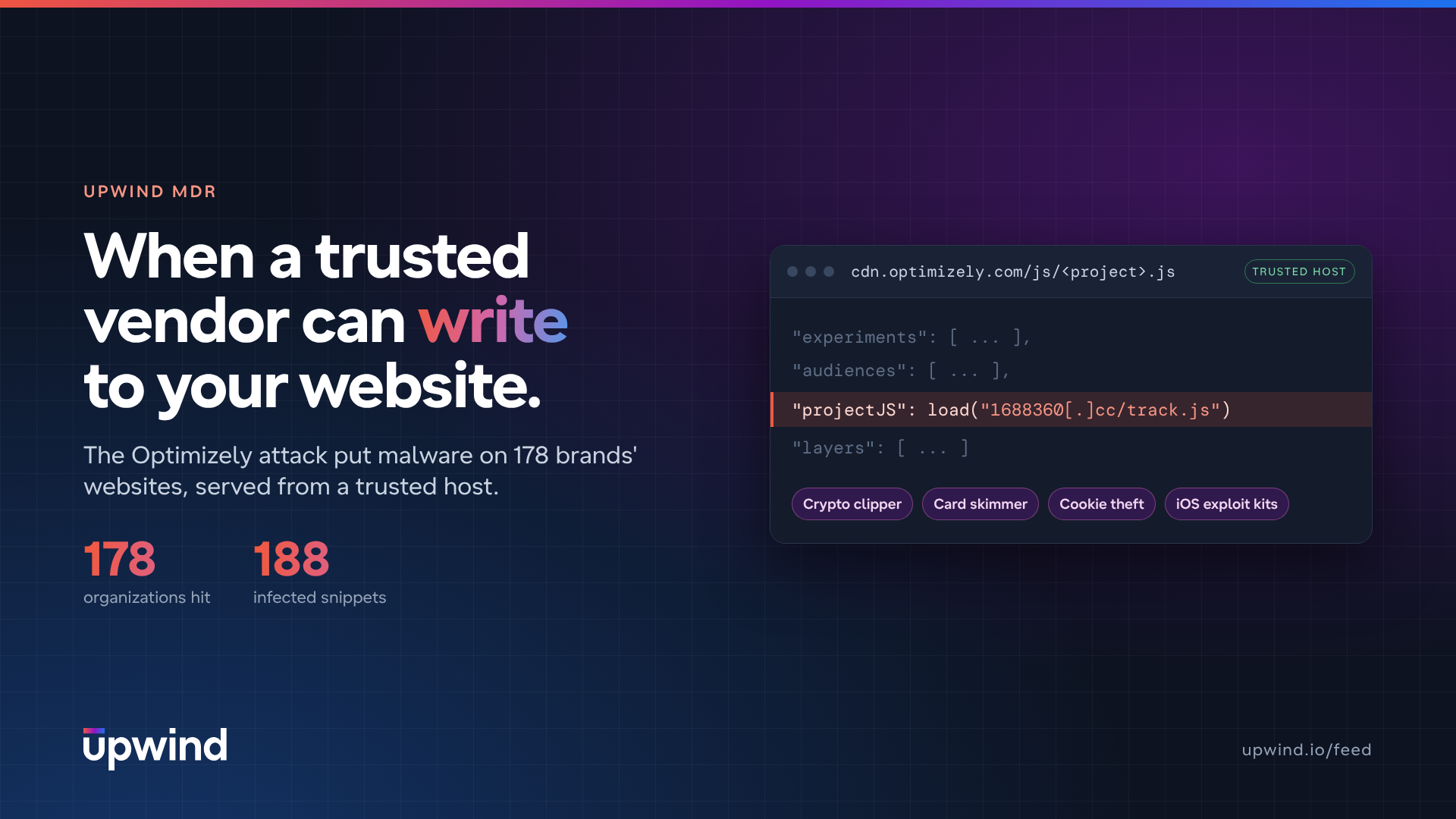
On 16 November 2026, malicious JavaScript was served to visitors of 178 organisations through Optimizely Web, including Zoom, the BBC, CNN, Salesforce, GitLab and HSBC. What we found: nobody hacked a CDN, the attacker only needed write access to customer projects, and that is exactly why trusting the vendor’s domain protected no one.
TL;DR
The first injection was seen at 04:21 UTC on 16 November, in the BBC’s Optimizely snippet. By 21:52 UTC, 187 of 188 infected snippets had been cleaned. At 01:02 UTC on 17 November, Optimizely confirmed that an unauthorized party had exploited a vulnerability in its Experimentation account signup flow to add JavaScript to customer projects.
- Optimizely’s CDN was not hacked. The attacker wrote code into a field customers are allowed to edit. The CDN served exactly what it was given, from
cdn.optimizely.com, with Optimizely’s valid certificate. - The real supply chain is write access. Any SaaS that can push code into your pages is part of your production. Whoever can edit that code can run JavaScript on your site.
- The payload was built to take money. It swapped crypto wallet addresses, skimmed cards typed into a site’s own forms, stole cookies and screenshots, and loaded iOS exploit kits on older iPhones and iPads.
- Trusting the vendor’s domain gave no protection. The malware came from the trusted host itself. Only sites with tight
script-srcandconnect-srcpolicies blocked it. - Optimizely was one channel, not the only one. An earlier wave from the same infrastructure ran through other third-party scripts from 13 November.
Affected: sites whose Optimizely Web snippet carried the code on 16 November, including snippets served from the customer’s own domain. Not affected: card numbers entered inside hosted payment iframes such as Stripe or Adyen.
Was Optimizely’s CDN hacked?
No. Each Optimizely Web customer loads a JavaScript snippet that holds Optimizely’s code, the customer’s experiments and an optional field called Project JavaScript. That field is custom code the customer writes in the dashboard, and it runs on every page.
The attacker added a small loader to that field in customer projects. The rest of each snippet was untouched. Three loader variants were seen:
- A plain script tag pointing at
hxxps://1688360[.]cc/track.js, in most snippets. - The same URL hidden in base64 and decoded with
atob(), so a text search for the domain misses it. - A full inline copy of the payload that runs through
evalif the domain is blocked.
Two details show this was account-level access, not a delivery bug:
- Customers who self-host the snippet were hit too. Snippets served from their own domains carried the same code, because the content comes from the same Optimizely project.
- A cleaned snippet was re-infected. Smartsheet’s snippet was cleaned once, then infected again with the base64 variant. The attacker still had write access at that point.
Optimizely says it blocked the vulnerable path, deployed a fix, removed the injected code, ended active sessions, revoked tokens and notified affected customers. It has not published how a signup-flow flaw gave write access across unrelated customer projects.
What did the payload do?
Every visitor received the same script, rebuilt 26 times during the day. All of its parts ran at once:
- Crypto address swapping. It replaced valid wallet addresses for BTC, ETH and EVM chains, TRON, Solana, TON, Litecoin, Bitcoin Cash and Dogecoin in page text, forms, the clipboard and outgoing requests.
- Card skimming, added at 13:43 UTC. It watched form submissions and POST requests for a card number, expiry and CVV, then sent them out with
navigator.sendBeacon. Hosted payment iframes were out of its reach. - Cookie and screenshot theft. When it swapped an address near payment wording, it sent the page URL, cookies without
HttpOnly, and a page screenshot. - iOS exploit delivery. On iPhones and iPads it loaded the Coruna or DarkSword exploit chains by iOS version. Devices on iOS 18.7.3 and later, or 26.3 and later, are patched.
By 19:25 UTC on 16 November, the attacker’s wallets had received about $7,040. One of those wallets was in use since March 2026, so not all of it came from this campaign. Nobody outside the attacker knows how many cards or cookies were collected.
Why didn’t trusting the vendor help?
Because the malicious code came from the trusted vendor itself. Allowing cdn.optimizely.com in a Content Security Policy did nothing. Of the affected organisations evaluated:
- No CSP at all: 68.
- CSP allowed the payload and the data theft: 50.
- Payload ran, but
connect-srcblocked the data theft: 17. Address swapping still worked, because it happens inside the page. - Payload blocked: 24.
What separated the 24 was a script-src that listed only the hosts they needed. Two common settings let the attack through. 'strict-dynamic' trusts any script the trusted snippet inserts. 'unsafe-eval', which Optimizely’s documentation asks customers to allow, ran the inline fallback even where track.js was blocked.
The practical takeaway: a vendor allowlist controls where code comes from, not who wrote it.
Was it only Optimizely?
No. From 13 to 16 November, the same actor injected a loader from webshell[.]lol through Kissmetrics, StorifyMe and Minute Media scripts on other sites. The actor moved between script vendors, and Optimizely was the largest channel found so far.
Indicators of Compromise
Network (all attacker-owned, block with subdomains):
1688360[.]cc(136.113.106.136): payload and collection host fortrack.js,card.phpandhit.php. Any request to it means the payload ran.5vobauua3ojpklx[.]icu(34.96.213.201) andeil786npto9u5bq[.]icu(34.87.36.58): iOS exploit routers.l7bcsnwc7nzr3uo[.]icu: Coruna telemetry.webshell[.]lolandlinkforge[.]cc: injector from the earlier wave.
Files and page markers:
track.jsSHA-256:814a963c0da480e2449d9b6664480156e1cd6d731014117401bf635badec3a0f(17:13 UTC build) andf7b84b9a94f749f8ced3f0112d0a66894e8bbc3b4aa5592021d1b8976a9bad40(17:57 UTC build).- Page globals
window._k7andwindow.__k7b: set by the payload. - Script attribute
data-channel-code="02111110": on the iOS loader.
Attacker wallets: BTC 19g9rZcPeiz8rUvyWpTRyXXhPnjsWrc3kW, ETH/EVM 0xC4026b06D82b0F0B363eda0642D61CfbDc17884e, TRON THvs6p56XkUiMkJeSc51cAP64u2RsTYqxa, LTC ltc1q3wp7g6ds0ggg6fl6kncpa4sepn0q3qfacgred5.
What should security teams do now?
- Check every Optimizely project. Open Project JavaScript and each experiment’s custom code. Search for
1688360,atob(,.icuand any script you did not write. - Hunt in your logs from 04:00 UTC on 16 November. Search DNS, proxy and CSP report logs for the domains above.
- Lock down write access. Review users, API tokens and integrations on the account, rotate credentials, and treat every script vendor that can push code to your pages the same way.
- Treat exposed data as stolen. Cards typed into your own forms on 16 November, and secrets in cookies without
HttpOnly, should be handled as exposed. Rotate those sessions. - Fix your CSP. Restrict
script-srcto the hosts you need, restrictconnect-src, avoid'unsafe-eval', and turn on reporting.
How can Upwind help?
This attack had no bug in the victims’ own code. It came through access to a trusted vendor. The same pattern, valid access that ends in attacker code, is what Upwind watches for across your cloud. Our runtime sensor detects it the moment it turns into execution: remote code execution, unexpected processes and shells in workloads, and outbound connections to known-malicious infrastructure such as the domains above.
Stolen sessions and tokens are the other half. Upwind flags suspicious API activity from identities and tokens in your cloud audit logs, so access stolen through one channel is caught when it is used in another.
To learn more about how Upwind detects attacker activity across your cloud at runtime, schedule a demo.