Feed
Upwind Feed
Feed
Grid
Research
June 4, 2026
Miasma: A Worming npm Supply Chain Attack on Red Hat Cloud Services


Executive Summary On June 1, 2026, unauthorized commits were pushed to repositories in the RedHatInsights GitHub organization and used to publish malicious versions of 32 packages under the @redhat-cloud-services npm scope.The campaign, tracked as Miasma, executes a 4.2 MB obfuscated payload through an npm preinstall hook the moment any of these packages is installed, directly…
June 3, 2026
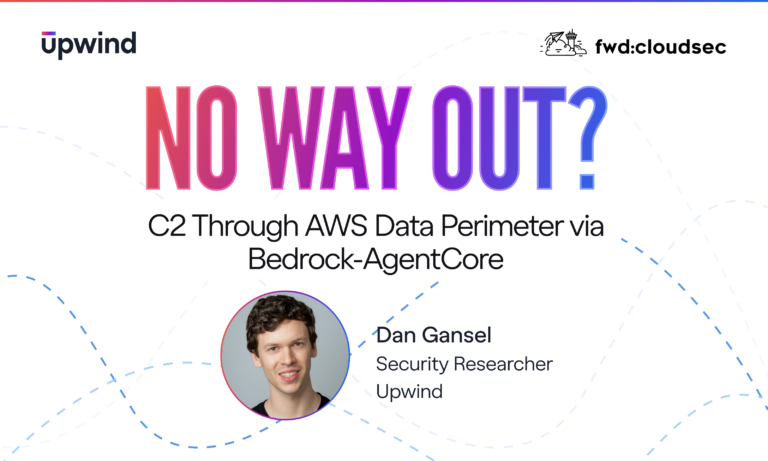
No Way Out? Bypassing the AWS Data Perimeter with Bedrock AgentCore

A novel Command-and-Control (C2) channel weaponizes legitimate AWS services to establish two data channels, successfully circumventing one of the cloud's strongest security defenses. Status: Infiltration Channel is FIXED, Exfiltration Channel is OPEN. TL;DR This research was presented at fwd:cloudsec North America 2026. Watch the full talk below. What Is the AWS Data Perimeter? For the…

May 28, 2026
Upwind Researcher Spotlight: Dan Gansel

"You have to map the core logic and syntax of the system before you can find the interesting primitives." This June 1st, Dan Gansel will walk on stage at fwd:cloudsec 2026 in North America to demonstrate a fully functional command-and-control channel that operates inside the AWS Data Perimeter, the cloud-native gold standard for keeping sensitive…
May 19, 2026
Newly Discovered durabletask Malware Targeted Kubernetes, Cloud Secrets, and CI/CD Infrastructure


Executive Summary Upwind identified a critical supply chain compromise involving durabletask==1.4.1, 1.4.2, and 1.4.3, three consecutive malicious releases of Microsoft's Azure Durable Task Python SDK published to PyPI. The malicious release contains a lightweight dropper embedded directly into durabletask/init.py. On import, the package downloads and executes a remote payload named rope.pyz from attacker-controlled infrastructure. The…
May 19, 2026
The New Face of Supply Chain Attacks: npm Malware Built for CI/CD and Cloud Compromise
Executive Summary Upwind is tracking an active software supply chain campaign impacting multiple npm packages commonly used across developer tooling, frontend frameworks, CI/CD pipelines, and cloud-native application environments. We identified malicious payloads designed specifically to target CI/CD systems, cloud identities, GitHub credentials, npm publishing workflows, developer machines, and AI developer tooling. The campaign includes install-time…
May 14, 2026
The Supply Chain Strikes Again: Credential-Stealing Malware Hidden in node-ipc
Executive Summary On May 14, 2026, malicious versions of the widely used node-ipc npm package were published through a legitimate maintainer account, introducing a sophisticated credential-stealing payload into a package with approximately 3.35 million monthly downloads. The malicious payload was hidden inside the CommonJS bundle (node-ipc.cjs) and silently executed whenever applications loaded the package through…
May 11, 2026
Shai-Hulud: Here We Go Again – Dissecting a Supply Chain Worm Across the TanStack Ecosystem
Executive Summary A new wave of the Mini Shai-Hulud campaign compromised dozens of official @tanstack/* npm packages by abusing CI/CD publishing workflows and trusted npm release mechanisms. Unlike traditional dependency malware focused only on downstream execution, this operation behaves as a self-propagating supply chain worm designed to continuously spread across repositories, developer environments, and CI/CD…
May 8, 2026
Dirty Frag: A Universal Linux Local Privilege Escalation via ESP and RxRPC (CVE-2026-43284 / CVE-2026-43500)

Executive Summary Dirty Frag is a new Linux kernel local privilege escalation that combines two kernel bugs - one in the IPsec subsystem and one in RxRPC, giving any unprivileged local user a root shell on every major distribution. The exploit is reliable and lasts until a reboot or cache fault Public PoC code has…
May 4, 2026
A Mini Shai-Hulud Has Appeared: Dissecting a Multi-Vector npm Supply Chain Worm
TL;DR: [email protected] is malicious. It uses Bun runtime smuggling for EDR evasion, scrapes GitHub Actions runner memory for secrets, harvests credentials from every major cloud provider and secrets management system, exfiltrates through RSA-4096 encrypted channels, injects a secret-dumping GitHub Actions workflow disguised as Dependabot, poisons every branch of compromised repos with files disguised as Claude…
April 30, 2026
[email protected] Supply Chain Attack Enables Credential Theft: Shai-Hulud Strikes Again

Executive Summary [email protected] is a compromised npm package used in a supply chain attack to steal GitHub, npm, and multi-cloud credentials. The malicious version introduces a preinstall hook that executes an obfuscated payload, harvesting secrets and exfiltrating them via GitHub APIs. This activity is part of the Shai-Hulud worm campaign targeting CI/CD pipelines. Detection Summary…
April 29, 2026
Mini Shai-Hulud Targets SAP npm Packages: CI/CD Publishing Pipeline Abused in Supply Chain Attack
Executive Summary Our research team identified a sophisticated supply chain attack targeting SAP Cloud Application Programming (CAP) framework packages. The campaign demonstrates advanced techniques for compromising trusted publishing pipelines and injecting malicious code directly into enterprise CI/CD workflows. The activity has been attributed to TeamPCP, a financially motivated threat actor known for large-scale supply chain…
April 24, 2026
When a Supply Chain Compromise Happens, Defenders Deserve More Than Starting From Zero


Notes on the Vercel / Context.ai OAuth incident, and how Upwind stands with its community through moments like these. On April 19, Vercel disclosed a security incident stemming from a compromise of a third-party AI tool, Context.ai, whose Google Workspace OAuth application was abused by an attacker. A Vercel employee signed into Context.ai using their…
Miasma: A Worming npm Supply Chain Attack on Red Hat Cloud Services
Executive Summary On June 1, 2026, unauthorized commits were pushed to repositories in the RedHatInsights GitHub organization and used to publish malicious versions of 32 packages under the @redhat-cloud-services npm scope.The campaign, tracked as Miasma, executes a 4.2 MB obfuscated payload through an npm preinstall hook the moment any of these packages is installed, directly…
No Way Out? Bypassing the AWS Data Perimeter with Bedrock AgentCore
A novel Command-and-Control (C2) channel weaponizes legitimate AWS services to establish two data channels, successfully circumventing one of the cloud's strongest security defenses. Status: Infiltration Channel is FIXED, Exfiltration Channel is OPEN. TL;DR This research was presented at fwd:cloudsec North America 2026. Watch the full talk below. What Is the AWS Data Perimeter? For the…
Upwind Researcher Spotlight: Dan Gansel
"You have to map the core logic and syntax of the system before you can find the interesting primitives." This June 1st, Dan Gansel will walk on stage at fwd:cloudsec 2026 in North America to demonstrate a fully functional command-and-control channel that operates inside the AWS Data Perimeter, the cloud-native gold standard for keeping sensitive…
Newly Discovered durabletask Malware Targeted Kubernetes, Cloud Secrets, and CI/CD Infrastructure
Executive Summary Upwind identified a critical supply chain compromise involving durabletask==1.4.1, 1.4.2, and 1.4.3, three consecutive malicious releases of Microsoft's Azure Durable Task Python SDK published to PyPI. The malicious release contains a lightweight dropper embedded directly into durabletask/init.py. On import, the package downloads and executes a remote payload named rope.pyz from attacker-controlled infrastructure. The…
The New Face of Supply Chain Attacks: npm Malware Built for CI/CD and Cloud Compromise
Executive Summary Upwind is tracking an active software supply chain campaign impacting multiple npm packages commonly used across developer tooling, frontend frameworks, CI/CD pipelines, and cloud-native application environments. We identified malicious payloads designed specifically to target CI/CD systems, cloud identities, GitHub credentials, npm publishing workflows, developer machines, and AI developer tooling. The campaign includes install-time…
The Supply Chain Strikes Again: Credential-Stealing Malware Hidden in node-ipc
Executive Summary On May 14, 2026, malicious versions of the widely used node-ipc npm package were published through a legitimate maintainer account, introducing a sophisticated credential-stealing payload into a package with approximately 3.35 million monthly downloads. The malicious payload was hidden inside the CommonJS bundle (node-ipc.cjs) and silently executed whenever applications loaded the package through…
Shai-Hulud: Here We Go Again – Dissecting a Supply Chain Worm Across the TanStack Ecosystem
Executive Summary A new wave of the Mini Shai-Hulud campaign compromised dozens of official @tanstack/* npm packages by abusing CI/CD publishing workflows and trusted npm release mechanisms. Unlike traditional dependency malware focused only on downstream execution, this operation behaves as a self-propagating supply chain worm designed to continuously spread across repositories, developer environments, and CI/CD…
Dirty Frag: A Universal Linux Local Privilege Escalation via ESP and RxRPC (CVE-2026-43284 / CVE-2026-43500)
Executive Summary Dirty Frag is a new Linux kernel local privilege escalation that combines two kernel bugs - one in the IPsec subsystem and one in RxRPC, giving any unprivileged local user a root shell on every major distribution. The exploit is reliable and lasts until a reboot or cache fault Public PoC code has…
A Mini Shai-Hulud Has Appeared: Dissecting a Multi-Vector npm Supply Chain Worm
TL;DR: [email protected] is malicious. It uses Bun runtime smuggling for EDR evasion, scrapes GitHub Actions runner memory for secrets, harvests credentials from every major cloud provider and secrets management system, exfiltrates through RSA-4096 encrypted channels, injects a secret-dumping GitHub Actions workflow disguised as Dependabot, poisons every branch of compromised repos with files disguised as Claude…
[email protected] Supply Chain Attack Enables Credential Theft: Shai-Hulud Strikes Again
Executive Summary [email protected] is a compromised npm package used in a supply chain attack to steal GitHub, npm, and multi-cloud credentials. The malicious version introduces a preinstall hook that executes an obfuscated payload, harvesting secrets and exfiltrating them via GitHub APIs. This activity is part of the Shai-Hulud worm campaign targeting CI/CD pipelines. Detection Summary…
Mini Shai-Hulud Targets SAP npm Packages: CI/CD Publishing Pipeline Abused in Supply Chain Attack
Executive Summary Our research team identified a sophisticated supply chain attack targeting SAP Cloud Application Programming (CAP) framework packages. The campaign demonstrates advanced techniques for compromising trusted publishing pipelines and injecting malicious code directly into enterprise CI/CD workflows. The activity has been attributed to TeamPCP, a financially motivated threat actor known for large-scale supply chain…
When a Supply Chain Compromise Happens, Defenders Deserve More Than Starting From Zero
Notes on the Vercel / Context.ai OAuth incident, and how Upwind stands with its community through moments like these. On April 19, Vercel disclosed a security incident stemming from a compromise of a third-party AI tool, Context.ai, whose Google Workspace OAuth application was abused by an attacker. A Vercel employee signed into Context.ai using their…