

Updated on November 11, 2026
The ability to track the activities of every user and application within an organization’s system and network can be key to detecting attacks in progress — it can also create a deluge of data that requires time and expertise to parse.
Security teams would do well to understand the role behavioral analytics plays in their defensive strategies, like how well it actually filters out false positives, how fast and accurately it creates a baseline for “normal” behavior, and what tools it needs to create and correlate signals across security tools. Adding advanced behavioral analysis into a cyberdefense strategy will absolutely improve the efficiency of security teams and systems, but what does your team need to know to make the most of it?
We’ve looked at AI security (using tools like machine learning that are central to behavioral analysis) and container security (including discussing the role of behavioral analysis in securing dynamic applications at runtime). Here, we’ll define terms around behavioral analytics more concretely, and differentiate it from related tools like EDR, as well as get into the nuts and bolts of implementation.
Introduction to Behavioral Analytics in Cybersecurity
So, what is behavioral analytics? It’s the practice of examining user activities and signals within networks and systems, as well as tracking the activities of entities such as:
- Application programming interfaces (APIs)
- Internet of Things (IoT) devices
- Cloud workloads
- Service accounts and machine identities
- Endpoints and laptops
- Privileged accounts
- Network traffic flows
- SaaS and cloud apps
Behavioral analytics is a discipline, meaning there’s no single “behavioral analytics tool” to examine the behaviors of all the working parts of an ecosystem. Rather, behavioral analytics is an approach. Many tools might employ it as part of how they work, but it also includes theories about how observed behaviors, rather than static indicators, are best poised to detect security threats.
Ultimately, behavioral analytics identifies anomalous behavior, which helps defenders unravel the who, how, and when of system activity.
How? Security teams and technologies collect these activities of users and entities as data points and telemetry. They then use algorithms to analyze behaviors to ensure that all activities are within expected, normal parameters.
But here’s the problem: any anomalous behavior can be an indicator of an attack in progress. Tracking user and application activities results in a lot of telemetry data for analysis, which means the technologies required often need the ability to present this information in a way that’s easy to understand, and to raise suspicions that correctly identify potential cyberattacks rather than create yet more false alerts to chase.
What is User Behavior Analytics (UBA)?
User behavior analytics (UBA) is a subset of behavioral analysis.
It uses data analytics, artificial intelligence, and machine learning to track the behavior of human users in a network, model their normal patterns, and detect deviations that might indicate a threat. It looks at those human users’:
- Identities
- Activities
- Habits
- Anomalies
UBA involves collecting data points like IP address, files accessed, login attempts, and websites that the user regularly accesses. Defenders use this information to determine expected behaviors and track potentially suspicious actions like logging in from a new IP address or trying to access sensitive data that isn’t normally used.
UBA tools can detect subtle variations in behavior, which makes them a powerful addition to a defense-in-depth strategy. As a result, leveraging UBA techniques can often provide far earlier warning of an attack in progress.
Deploying behavioral analysis on human identities is key to detecting issues like insider threats. But it’s not the same as behavioral analysis overall, and it can’t protect everything. In fact, today, machine identities far outnumber human users.
In modern environments, watching human users alone isn’t enough. There are also service accounts, APIs, automated jobs, and now AI agents to watch, and an agent that uses an unexpected tool or accesses data outside its purpose can look legitimate when events are reviewed in isolation. Today, behavioral analytics must reach beyond UBA.
Refresher: Key Concepts and Terminology
Within behavioral analytics, there are a few key concepts and terminology that security teams need to understand.
Here are the core ones:
- Behavioral baseline: The normal pattern of activity for users, entities, or network devices. Collecting this information is a crucial part of behavioral analytics.
- Anomaly detection: The practice of identifying deviations from the established baseline. An anomaly could detect suspicious or malicious activity.
- Insider Threat: A type of threat where insiders or compromised user accounts exploit systems, often leading to a data breach or data exfiltration.
- Threat hunting: Proactively searching for anomalies and potential threats by analyzing user and entity behavior.
Beyond those core concepts, teams will also encounter related terms, including:
- Network behavior analytics (NBA): Analyzing network traffic patterns to potentially identify threats vs. normal behavior.
- User and entity behavior analytics (UEBA): A form of behavioral analytics that covers both human and non-human entities, such as servers, devices, applications, and now AI agents. Monitoring for anomalous device or agent behavior can be a key indicator of a potential threat. Some platforms now pair UEBA with agent behavior analytics to catch both human- and AI-driven threats, broadening the idea of UBA further.
- Machine learning: Artificial intelligence (AI) learning that is integrated into tools to analyze signals and activities at scale.
- False positive: Incorrectly flagged events that aren’t true threats.
- False negative: A genuine threat that the behavioral analytics system fails to detect.
- Behavior-based security: An approach to security that uses behavioral analytics to monitor and analyze activity with the goal of improving overall cyber defense.
Runtime Behavioral Detection and Threat Analysis with Upwind
Upwind’s runtime-powered behavioral analytics gives you real-time threat detection across containers, workloads, and cloud environments, with contextual analysis, risk prioritization, and root cause investigation built in. Detect stealthy attacks faster and stay ahead of threats that traditional scanning can miss.
Get a DemoThe Evolution of Behavioral Analytics in Security
Behavioral analytics has become a cornerstone of cybersecurity operations, expanding far beyond its original role in threat detection. First, behavioral analysis was most visible inside Endpoint Detection and Response (EDR) tools, where tracking deviations in user and device behavior worked to help detect malware and insider threats.
But as attack surfaces grew and threat actors became more adept at evading signature-based detection, behavioral analytics evolved into a critical capability across cybersecurity functions, including threat hunting, incident response, and post-breach forensics.
Today, integrating behavioral analytics into incident response workflows serves two major functions:
- Reducing false positives by using contextual behavior patterns to validate or dismiss alerts more intelligently
- Accelerating forensic investigations by reconstructing attack paths through deviations in user, workload, and network behavior contextually and as a group, rather than relying on static log data.
In threat hunting, behavioral analytics lets defenders proactively search for weak signals, minor anomalies that might otherwise go unnoticed, and connect them into a larger narrative signaling a potential compromise. Instead of waiting for a high-confidence alert, teams can use behavioral shifts to uncover stealthy lateral movement, credential misuse, or early-stage exploitation attempts.
Behavioral analysis is no longer just a tool embedded in other platforms. It has become a discipline that defines how organizations detect and contain threats in increasingly dynamic environments.
How Behavioral Analytics Differs from Traditional Security Approaches
Behavioral analytics marks a fundamental shift away from traditional perimeter and signature-based security models.
While conventional tools like Endpoint Protection Platforms (EPP) and first-generation EDRs focus on building static defenses by hardening endpoints, fortifying databases, and scanning for known threats, they can fall short when those defenses are bypassed.
Traditional reactive models assume compromise is rare and detectable at the point of intrusion. But in reality, once an attacker obtains valid credentials, implants malware with no known signature, or moves laterally, traditional defenses can offer little visibility.
Behavioral analytics changes the model.
It monitors the behavior of users, devices, services, and applications over time, establishing baselines and identifying subtle deviations that could indicate a breach in progress, even with no known exploit involved.
By emphasizing continuous observation, behavioral analysis helps teams see how a system is behaving abnormally, not just whether a known bad event has occurred.
That’s an improvement over static tools, which all come with different limitations regarding breach protection beyond endpoints:
| Static Security Tools | Limitation |
| Vulnerability scanners | No protection against zero-days or misuse of legitimate functionality. |
| Endpoint protection platforms (EPP) | Struggles to detect fileless attacks, living-off-the-land (LOTL) techniques, and credential abuse. |
| Identity and Access Management (IAM) | Doesn’t monitor how access is being used once granted. |
| Traditional firewalls, Intrusion Detection System (IDS), or Intrusion Prevention System (IPS) | Lacks visibility into internal lateral movement or insider misuse. |
The key issue? Tightening security at known chokepoints without continuous monitoring creates a security posture that’s blind to threat actors who operate within “normal” parameters after their initial breach. These static tools need to be paired with dynamic behavioral detection to be effective at detecting more sophisticated intrusions.
Moving Past Static Defenses: UEBA vs. EDR and Beyond
As security teams outgrow static defenses and move toward behavioral analysis for detection, they’ll need to explore the distinct but complementary roles of tools like UEBA and EDR.
Detecting today’s low-noise threats means visibility into behaviors across users, endpoints, and cloud systems. Both UEBA and EDR offer dynamic detection, but they operate at different layers and focus on different signals. Here’s what to know about how they overlap — and where they don’t.
| Category | UEBA | EDR |
| What does it do? | Analyzes user, service account, device, and application behavior both on-premises and in the cloud. | Monitors and responds to incidents on individual endpoint devices like laptops, mobile devices, and virtual machines (VMs) |
| What does it focus on? | Detecting anomalous behavior and suspicious activity that could mean insider threats, lateral movement, or identity compromise. | Detecting malware, fileless attacks, exploitation, and unauthorized changes at the device level. |
| How does it perform its work? | Uses machine learning and analytics to identify patterns and trends in user and entity behavior. Builds baselines and flags deviations. | Performs real-time monitoring of system processes, memory, files, and network connections. |
| How can it respond? | Prioritizes risky behaviors and surfaces content. Integrates with Security Information and Event Management (SIEM), Security Orchestration, Automation, and Response (SOAR), and Incident Response (IR) workflows. | Provides direct incident response actions like isolating machines, killing processes, and restoring corrupted files. |
Remember that EDR focuses on individual endpoints while UEBA covers the entire network. These two solutions do not compete, but rather can work together to ensure a strong defense. For instance, UEBA is especially valuable at surfacing insider threats, while EDR tools can be used to investigate those reports.
Linux-Specific Behavioral Analytics Security
On Linux hosts and workloads, behavioral analytics means continuously monitoring host and workload activity to learn what’s normal and flag what isn’t. The behaviors worth watching include:
- Processes and process activity
- Parent-child execution chains
- File access patterns
- Privilege escalation or privilege misuse
- Scheduled activity like cron or systemd jobs
- Network traffic, sockets, and connection patterns
- Configuration changes and drift
- Persistence-related activity, such as service creation
What Suspicious Looks Like on Linux
Many Linux attacks “live off the land,” using built-in tools like ssh, python, perl, systemd, or cron. That makes behavior the clearest signal. Examples include:
- A shell spawned by a web server process
- Unexpected sudo use
- Credential harvesting behavior
- Persistence via systemd or cron, including unexpected systemctl service creation
- Unusual east-west traffic from a container host
- A web server reaching out to an external, uncategorized IP
Individually, some of these might be explainable. Chained together, they tell a story. Picture nginx spawning bash, bash running curl to fetch a payload, the payload being made executable with chmod +x, and systemctl creating a hidden service.
Linux Telemetry Sources
Teams typically draw Linux behavioral signals from:
- auditd and the Linux audit subsystem
- journald, Sysmon for Linux, and procfs
- eBPF hooks and system call telemetry
- fanotify and system integrity monitors
- EDR agents and other endpoint telemetry
- Network traffic flows, aggregated through a SIEM or log aggregator
- For containerized workloads: runtime sensors, container runtime events, and cloud workload telemetry
Why Linux Baselines Are Different
Linux servers and containers don’t behave like user laptops. They are more repetitive, more ephemeral, more automation-heavy, and less interactive. Normal looks like repeated service and job execution, few interactive user actions, lots of machine-to-machine communication, and short-lived containers that change frequently.
So Linux baselines emphasize stable service behavior, expected process trees, scheduled tasks, known network paths, and service account and automation patterns. There’s a catch, though. Linux servers can produce thousands of events per minute, and legitimate CI/CD, administrative automation, Kubernetes operators, and container churn can all look suspicious unless rules are tuned to the specific environment.
Microsoft-Specific Behavioral Analytics
In Microsoft environments, behavioral analytics usually refers to detections built from identity, endpoint, email, SaaS, and cloud signals across the Microsoft security stack. Readers will most often run into the concept in:
- Microsoft Defender XDR: Behavioral detections and investigations surfaced through advanced hunting and security incidents.
- Microsoft Sentinel UEBA: The main user and entity behavior analytics capability.
- Microsoft Entra ID risk detections: Identity-focused signals, like sign-in and audit-related risk patterns.
- Microsoft Defender for Cloud Apps: A source feeding behavior records into Microsoft security analytics.
Typical Microsoft Behavioral Signals
Common examples in Microsoft telemetry include:
- Impossible travel and other anomalous geo-location logons
- Anomalous and failed sign-ins
- Unusual mailbox or cloud app activity in Exchange Online, SharePoint Online, OneDrive for Business, and Teams
- Risky OAuth app behavior, seen through app, service principal, and audit-log activity
- Endpoint process anomalies, like suspicious process creation and execution patterns
- Lateral movement patterns and unusual endpoint logons
- Related patterns such as password spray, spear phishing, and privilege anomalies like unusual role changes or password resets
These detections are commonly built from Entra ID sign-in and audit logs, Azure Activity logs, Windows Security events, Microsoft Defender for Identity, and Microsoft 365 sources.
The limitation? Microsoft-focused behavioral analytics is strongest when activity is visible in Microsoft telemetry. In hybrid and multi-cloud environments, it often benefits from enrichment and correlation with non-Microsoft cloud and runtime sources to fill in what it can’t see.
Behavior is the New Perimeter
Attackers are increasingly moving beyond traditional malware and perimeter exploits, There was the SolarWinds 2020 supply chain attack, premised on lateral movement without tripping traditional malware detection. Uber’s 2022 breach used stolen credentials to gain access, and the attacker moved across cloud systems after entering the system. And Capital One’s 2019 breach was discovered to be an insider misusing legitimate AWS credentials and configuration flaws to exfiltrate data.
Organizations know they need to move from blocking threats at entry points to detecting abnormal behavior across systems and in real-time. In a cloud-native, hybrid, and identity-centric environment, behavior becomes the most reliable sign of risk.
Behavior is critical because it lets teams:
- Establish baselines for normal activity across users, services, and networks
- Detect subtle anomalies that might signal more subtle modern risks like credential misuse
- Prioritize investigation based on risk signals
- Act earlier in the attack chain, potentially before threats achieve their objectives
Implementation Best Practices
Behavioral analytics can be a no-brainer, but implementation certainly is not. Operationally, integrating new disciplinary approaches and their tools is never a walk in the park. But it doesn’t have to upend existing strategies and replace beloved tools, either. Integrating behavioral analytics just means teams must work to make sure signals are collected, correlated, trustworthy, and acted on across the environment.
Here are key considerations to make it happen:
- Build a Behavioral Baseline
Allow for an observation period. Behavioral detection relies on building an accurate and representative baseline for entities and services, so teams need to allow enough time to collect data before fully trusting anomaly alerts. Waiting 2 to 8 weeks is common advice to allow for weekly and daily trends to amass.
Don’t do it all at once. Complex environments benefit from stepwise use of behavioral analytics capabilities. Start with important environments and identities. Implement an evaluation phase to assess the cloud environment and identify key assets to define a prioritized roadmap for rollout.
- Manage Telemetry Volume and Quality
Behavioral analytics thrives on telemetry, but too much or too little data, or poorly structured data sources, can gum up detection. What to collect? Prioritize high-fidelity telemetry from identity providers, EDR, cloud workload protection systems, and network observability tools.
Normalize data formats via SIEM, data lakes, or ETL pipelines so signals are comparable.
Finally, filter noise at the source, as with a CNAPP using a sensor, to reduce clutter.
- Integrate Behavioral Analytics Across the Detection Stack
Behavioral detection must work with, not replace, the broader security ecosystem.
- SIEM: Behavioral signals should feed into SIEMs as enriched alerts or correlated incidents.
- SOAR: Anomaly detection events should trigger automated triage workflows for faster resolution.
- CNAPP: Many modern CNAPPs already include behavioral analytics. Make sure that the behavioral telemetry from CNAPPs is cross-correlated with UEBA and EDR sources to unify detection across cloud and endpoint assets.
Upwind Helps Teams Harness Behavioral Analytics
Behavioral analytics is only as good as the signals it’s built on, so the ability to filter and analyze those signals in real time is key to getting great results. Upwind is helping teams operationalize behavioral analytics more easily, using:
- Lightweight runtime sensors across workloads to capture only high-value behavioral signals, reducing noise at the source
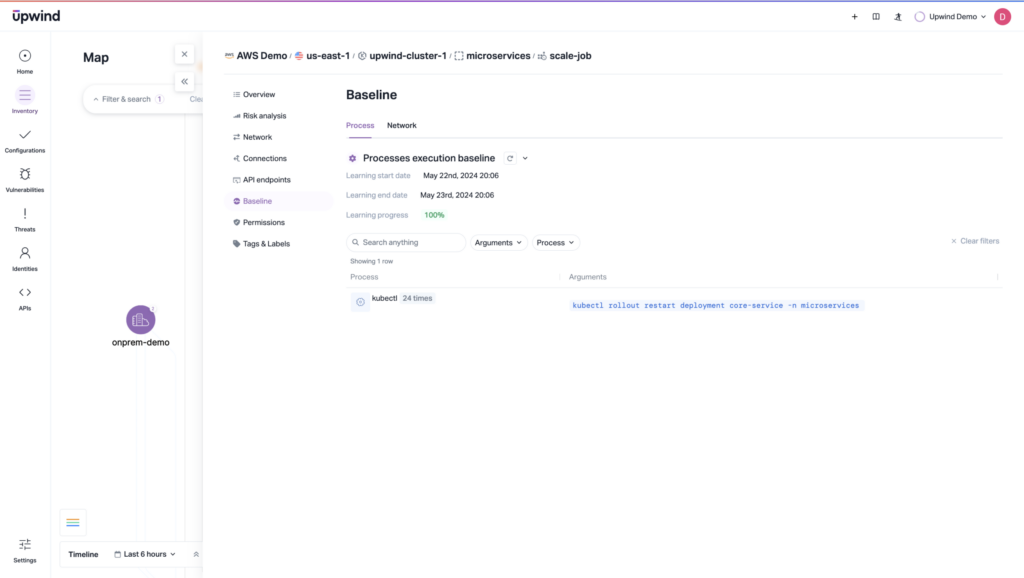
- Establishing dynamic behavioral baselines that are accurate, even as environments change
- Prioritizing risk through behavioral context, cutting down on false positives
- Integrating with SIEM and SOAR, enriching alerts with real-world behavior chains
- Extending behavioral detection into the cloud-native world, from ephemeral workloads to APIs.
The days of teams reactively chasing alerts are over. See how with a demo.
FAQs
How does behavioral analytics reduce false positives compared to traditional security tools?
Behavioral analytics reduces false positives in cybersecurity by focusing on patterns of deviation over time rather than reacting to isolated technical events à la carte. So while traditional tools trigger alerts based on static signatures or threshold violations, behavioral analytics brings context and baseline awareness to every detection, using:
- Contextual baselining
- Signal correlation
- Dynamic risk scoring
- Suppression of normal variance
- Adaptation to environmental shifts
By embedding environmental awareness and context directly into detection logic, teams get more focused on real risks without constant manual tuning.
What’s the difference between UEBA and traditional IAM solutions?
User and Entity Behavior Analytics (UEBA) and traditional Identity and Access Management (IAM) solutions differ in their primary focus.
IAM solutions primarily manage user identities and access privileges, ensuring the right people have access to the right resources. They enforce access policies and authentication, defining permissions based on roles and rules.
UEBA, on the other hand, analyzes user and entity behavior to detect anomalies and potential threats, including insider threats and compromised accounts. It’s about how identities behave once access is granted, not about whether access was granted in the first place.
How long does it take to establish behavioral baselines in cloud environments?
Establishing behavioral baselines in cloud environments can take anywhere from a few hours to several weeks, depending on the size and complexity of the environment and the specific baselining tool used.
Here’s a general guide:
- Initial signal collection: Hours to 7 days to capture normal login patterns, API usage, and workload activity.
- Baseline stabilization: 2 to 8 weeks to refine behavioral models, observing cycles like weekday peaks, weekend lulls, cloud scaling events, and seasonal activity shifts
- Continuous adaptation: After initial stabilization, baselines continue to adapt dynamically. There’s always new user onboarding, new deployments, and lengthier seasonal variations to meld into existing patterns.
Can behavioral analytics detect threats in ephemeral cloud workloads?
Yes, behavioral analytics can effectively detect threats in ephemeral cloud workloads by monitoring and analyzing the unusual activities of these dynamic environments. They’re particularly well-suited for the job since they can track deviations in real time, and these dynamic resources often spin up and down quickly, evading the purview of traditional, signature-based tools.
Here are some reasons why behavioral analysis makes the most sense in cloud-native environments:
- Rapid baseline formation: Lightweight runtime sensors can observe and baseline ephemeral resources within hours of launch.
- Focus on runtime behaviors: Behavioral analysis isn’t reliant on workload lifespan to work.
- Detection of lateral movement: Even brief, abnormal communications between ephemeral resources can be detected as abnormal.
- Container and serverless visibility: Again, behavioral analysis is adapted to cloud architectures, monitoring application behavior across microservices without static agents or full file scans.
- Resilience to evasion: Attackers can’t hide malicious activity by using short-lived cloud instances.
How does behavioral analytics complement other cloud security tools like CSPM and CWPP?
Behavioral analytics complements cloud security tools like Cloud Security Posture Management (CSPM) and Cloud Workload Protection Platforms (CWPP) by providing activity-based detection to what may otherwise be a static or configuration-based security approach.
Both tools harden the environment, but behavioral analytics focuses on catching threats after a breach or misuse begins:
- It goes beyond configuration drift: Behavioral analytics detects when a properly configured resource starts behaving abnormally.
- It doesn’t need attacks to come from known sources: It detects suspicious behavior, even those that exploit zero-day or insider misuse.
- It detects in real time: CSPM and CWPP provide periodic snapshots, not continuous runtime behavior monitoring.
- It identifies identity misuse: Behavioral analytics spots credential misuse, lateral movement, and insider threats that are often missed in static scanners.
- It feeds smarter response workflows: Behavioral analytics feeds contextualized, real-time data to SOAR or incident response playbooks triggered by CSPM and CWPP findings so teams can prioritize posture violations and workload risks that need immediate attention.
How do you do behavioral attack detection from baseline to investigation?
Start by establishing what normal looks like for each user, correlating user behavior, identity and access permissions, and external threat intelligence. Then detect real-time deviations, like unusual login times, unfamiliar locations, or privilege escalation attempts. Correlate signals to cut false positives: failed logins alone may not matter, but failed logins plus a successful login and critical server access could indicate a brute-force attack. Finally, classify each anomaly as point, contextual, or collective, judge whether it’s intentional, and investigate with explainable AI and human review before responding with targeted controls like disabling a likely compromised account.