
Cloud teams are moving fast on Azure PaaS to reduce operational overhead—serverless containers with Azure Container Apps and managed web apps with Azure App Services. But that speed often comes with a tradeoff: security visibility and detection can lag behind because you don’t have the same host access or deployment patterns you’d expect in Kubernetes or traditional VM-based workloads.
Upwind now extends runtime protection to both Azure Container Apps and Azure App Services, bringing the same real-time visibility, detections, and risk prioritization you rely on for containers and Kubernetes—now tailored for Azure’s PaaS application layers.
What you get with Upwind runtime protection for Azure
1) Discover assets automatically
Once connected, Upwind can discover Azure Container Apps and Azure App Services assets and surface them directly in the platform—so these workloads are no longer “outside” your runtime coverage.
2) Visualize apps and connections in the Map
Azure PaaS environments can feel abstract: apps talk to services, services talk to APIs, and dependencies spread quickly.
Upwind makes it concrete by showing:
- Applications and their connections
- Communication paths across your environment
- A clearer picture of blast radius when something suspicious happens
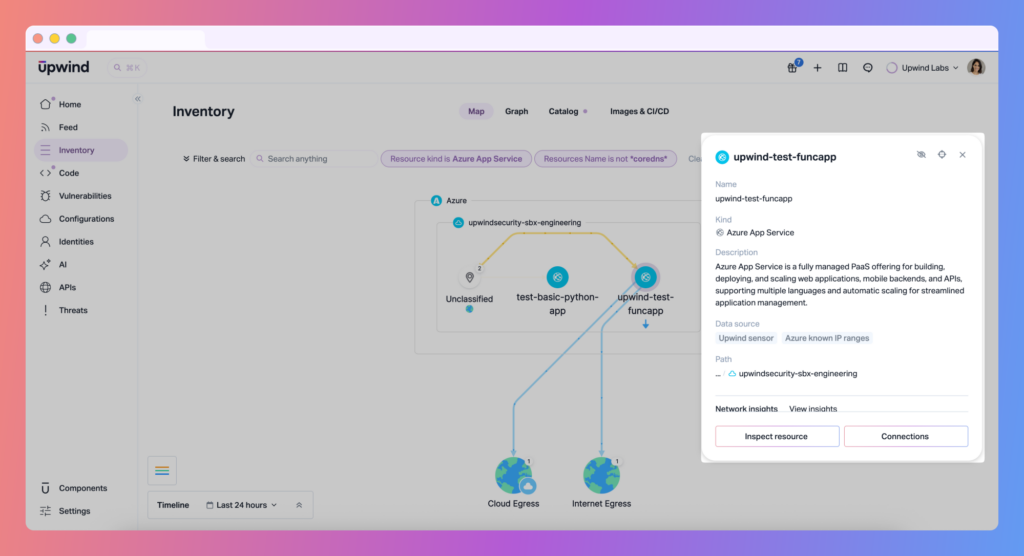
3) Deep runtime visibility: process + network activity
Upwind continuously collects runtime activity so you can see:
- Process behavior (what’s running, how it’s behaving)
- Network activity (who is talking to whom, when, and how)
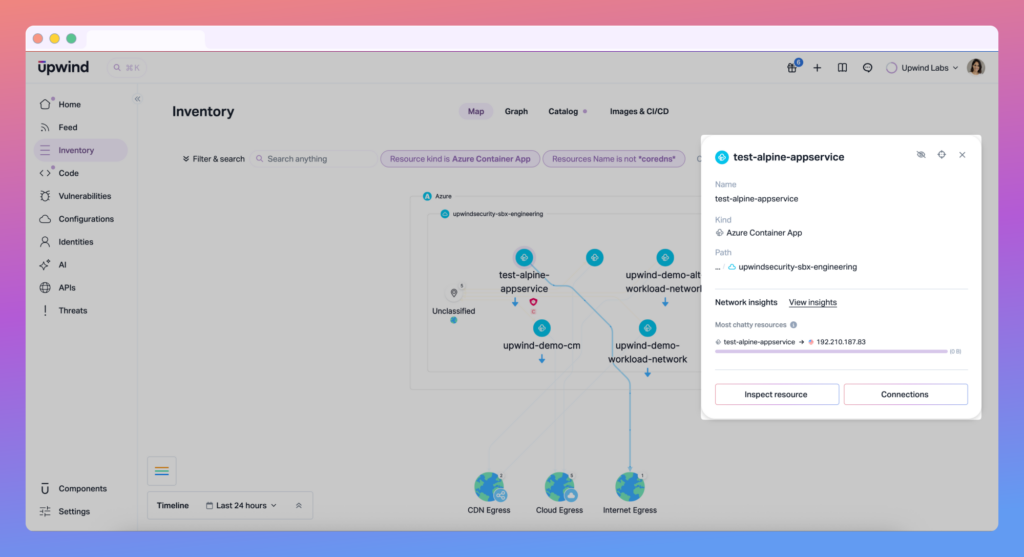
This is critical for PaaS workloads where static configuration checks or pre-deploy scanning alone can’t capture what’s actually happening in production.
4) Real-time detections and risk prioritization
Runtime activity feeds Upwind’s detections so you can:
- Identify threats as they happen
- Prioritize issues with runtime evidence
- Move from “possible exposure” to actionable risk
Why this matters for serverless container and PaaS application security
Azure Container Apps and App Services are designed to abstract infrastructure complexity—great for developers, challenging for security.
By extending runtime coverage to these platforms, Upwind helps you:
- Maintain consistent runtime security across Kubernetes, containers, and Azure PaaS
- Reduce blind spots introduced by “managed” execution environments
- Detect suspicious behavior based on real execution, not assumptions
Flexible deployment options for Azure Container Apps
To support different environment sizes and onboarding preferences, Upwind provides two ways to connect Azure Container Apps:
Option 1: Cluster Manager + Tracer (recommended)
Best for: larger environments or teams that want centralized operations
This model enables:
- Centralized management
- Full runtime visibility across all applications
- Aggregation and standardization of runtime signals
Option 2: Tracer Only
Best for: smaller environments, fast onboarding, or direct setup
This model allows:
- Direct reporting to the backend
- A lighter operational footprint for getting coverage quickly
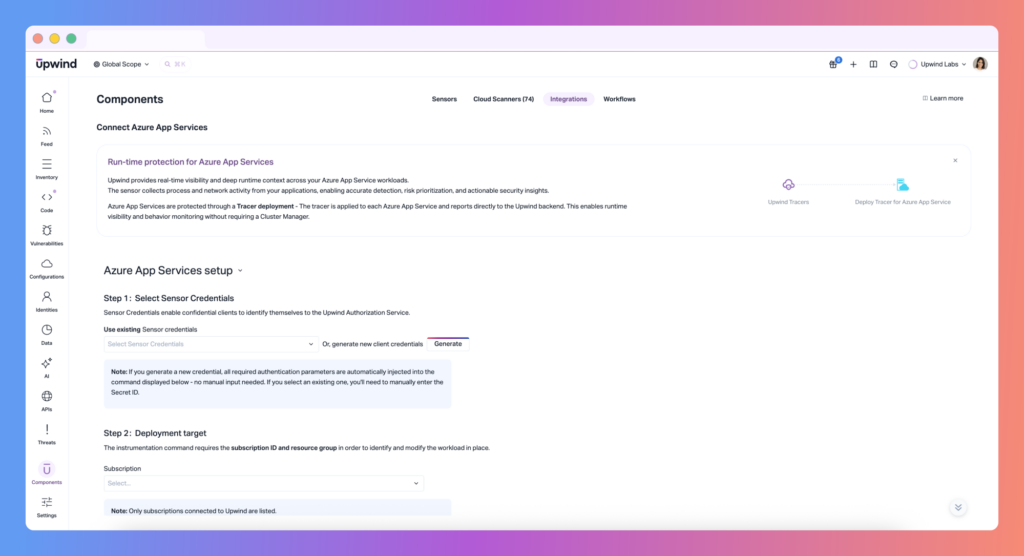
Azure App Services runtime monitoring with the Upwind Tracer
For Azure App Services, Upwind supports runtime monitoring through Tracer deployment, enabling you to:
- Discover protected App Services automatically
- Visualize them in the Map
- Turn on detections with deep process and network visibility
- Deploy protection for a single application or in bulk across the environment
What teams can do immediately with this feature
- Spot suspicious runtime behavior in App Services and serverless containers
- Trace unexpected outbound connections from a single app to external endpoints
- Validate whether a workload is performing actions it shouldn’t (process execution, unusual network patterns)
- Prioritize risk based on runtime context, not just inventory
See It It In Action
If you’d like to see how this feature fits into your environment – or to explore how Upwind can help you prioritize and remediate risk more effectively – schedule a customized demo with us. We’ll walk through your use cases, integrations, and security goals to show how Upwind delivers actionable cloud security at scale.