
Cloud Security has changed
Teams are moving faster, architectures are getting more dynamic, and the old way of securing cloud environments with disconnected tools and static findings is no longer enough. Security leaders need more than posture snapshots. They need real-time context, runtime intelligence, and the ability to focus on what is actually exploitable.
That is why we are excited to announce Upwind’s partnership with Microsoft.
Together, Upwind and Microsoft are delivering a more unified security experience for Azure customers, combining runtime protection, compliance, posture management, and vulnerability detection into a seamless solution built for modern cloud environments.
This partnership marks an important step forward for organizations that want stronger security across Azure without adding more complexity to already stretched security teams.
Why this partnership matters
For many security teams, Azure security today still means juggling multiple products, siloed alerts, and too much manual investigation.
“Cloud innovation is accelerating faster than traditional security platforms can keep up,” said Amiram Shachar, CEO and co-founder of Upwind. “Upwind solves that problem, and by partnering with Microsoft we’re embedding our runtime-first protection directly into the fabric of Azure, from audit logs to container registries, giving customers the ability to discover and act on threats before they become breaches. This is both an integration and a redefinition of how cloud security should work, setting a new benchmark for protecting enterprises across Azure and their mutli-cloud investments.”
You might have one tool surfacing misconfigurations, another scanning registries, another sending alerts from runtime, and still another trying to make sense of cloud logs. The result is familiar: too much noise, not enough context, and long hours spent figuring out what actually matters.
Upwind and Microsoft are changing that.
By partnering closely with Microsoft, Upwind is helping bring together critical Azure security signals into a unified experience. That includes:
- Azure cloud audit logs
- CSPM frameworks
- Azure Container Registry scanning
- Streamlined onboarding of Azure cloud assets
- Integrations with Microsoft Sentinel, Sentinel Graph, and Microsoft Defender for Cloud
- Unmatched visibility across all your assets, multi-cloud, powered by Upwind runtime fabric
The goal is simple: give customers immediate visibility into risk across their Azure environments, along with prioritized, actionable insights they can use right away.
Instead of stitching together fragmented signals from multiple tools, security teams can work from a single platform that connects posture, runtime behavior, vulnerabilities, and threats in context.
Deep Azure alignment, simplified buying
This partnership is not just about integration. It is also about making adoption easier for customers.
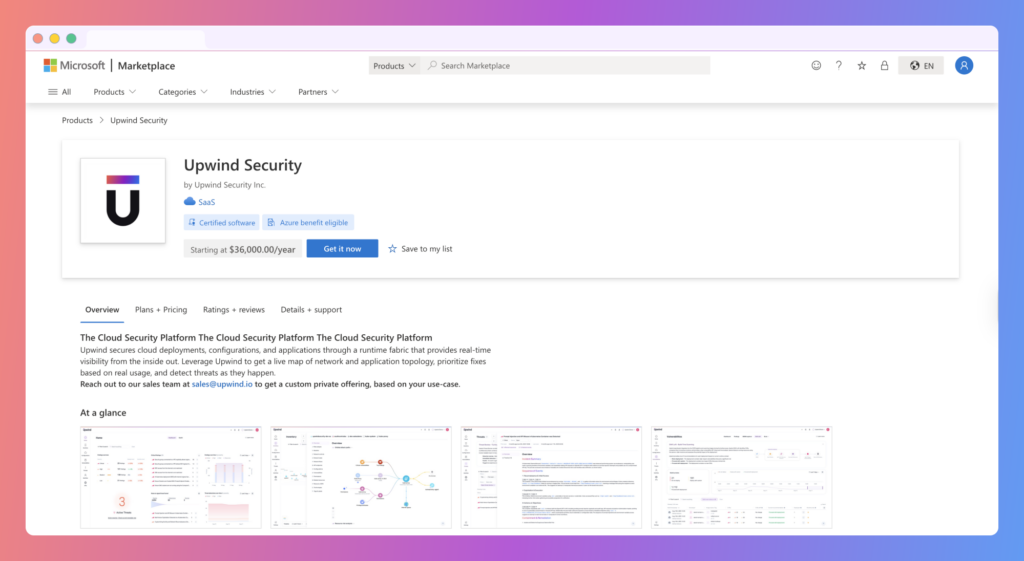
Upwind is available on the Microsoft Marketplace, with co-sell status and full Microsoft Azure Consumption Commitment decrement eligibility. That makes procurement and deployment more streamlined for enterprises already invested in the Microsoft ecosystem.
For customers, this means faster time to value and an easier path to adopting a modern runtime security platform inside existing Azure strategies.
And this is only the beginning.
In the coming months, the partnership is expected to expand into additional areas including identity protection, internet exposure, and GenAI workload security, helping customers secure even more of the modern cloud attack surface.
Bringing runtime-first security to Azure
What makes this partnership especially meaningful is the runtime-first approach behind it.
“Our partnership with Upwind highlights Microsoft’s commitment to equipping enterprises with the cloud runtime security foundation,” said Tom Davis, Partner at Microsoft Startups at Microsoft. “By bringing runtime-first protection into Azure-native services and the Microsoft Marketplace, we’re enabling customers to, for the first time, pinpoint the vulnerabilities that matter most in real time, cut through the alert noise that slows down security teams, and act on what’s truly exploitable.”
Traditional cloud security platforms often rely heavily on static rules, posture checks, or outside-in scanning. Those approaches can be helpful, but they rarely tell the full story of what is happening inside a live cloud environment.
Upwind was built differently.
Our platform combines agentless visibility with eBPF-powered runtime detection, helping teams understand not just what exists in their environment, but what is actually running, communicating, exposed, and at risk in real time.
Runtime context matters.
It helps security teams answer questions that posture tools alone cannot:
- Which vulnerabilities are truly exploitable?
- Which workloads are communicating in risky ways?
- Which exposed assets are actually active?
- Which findings deserve immediate attention and which can wait?
By bringing this runtime-first approach into Azure, Upwind and Microsoft are helping organizations reduce blind spots and make faster, smarter security decisions.
One security experience, not a collection of tools
One of the biggest challenges in cloud security today is fragmentation.
Security teams are expected to manage posture, vulnerability management, threat detection, workload protection, compliance, and identity risk, often across separate products and workflows. That fragmentation slows response times and makes it harder to prioritize.
With this partnership, Upwind is delivering a more connected approach.
By unifying posture management, workload protection, threat detection, vulnerability management, and identity security into one experience, Upwind helps teams cut through noise, reduce false positives, and focus on the risks most likely to become real incidents.
For Azure customers, that means less time chasing alerts and more time fixing what matters.
It also means security can move at cloud speed, without sacrificing visibility or control.
Built for real enterprise environments
This partnership is especially relevant for organizations running critical workloads in Azure, including teams in financial services, healthcare, and fast-moving digital-native businesses.
These environments demand strong protection, but they also demand speed.
Security cannot become a blocker. It has to work with the business, support engineering velocity, and provide clear, accurate answers in real time.
That is where Upwind stands apart.
Customers choose Upwind because we help them protect workloads from the inside out. Our runtime-first platform gives teams the context needed to prioritize accurately, investigate faster, and respond before risks turn into breaches.
And because Upwind takes a multi-cloud approach, customers can extend that same level of protection across Azure and other leading cloud platforms. That includes coverage for modern architectures such as containers, Kubernetes, and serverless workloads, where traditional tools often fall short.
A strong signal for the future of cloud security
This announcement is about more than a partnership between two companies.
It reflects a bigger shift happening in the market.
Cloud environments are increasingly dynamic. Applications are distributed. AI workloads are expanding. Threats are moving faster. In that world, security teams need platforms that understand live cloud behavior, not just static cloud configurations.
That is the future Upwind is building toward.
As Amiram Shachar, CEO and co-founder of Upwind, put it, cloud innovation is accelerating faster than traditional security platforms can keep up. By partnering with Microsoft, Upwind is embedding runtime-first protection directly into the fabric of Azure, helping customers discover and act on threats before they become breaches.
That is exactly the kind of shift security teams have been waiting for: less guesswork, more context, and a clearer path from detection to action.
Trusted by customers, validated by momentum
This partnership comes at an exciting moment for Upwind.
With 900% year-over-year revenue growth and 200% logo growth, Upwind continues to gain momentum among enterprises looking for a modern alternative to legacy cloud security approaches.
Customers are seeing value quickly.
As Shahab Siddiqui, Global Head of Cyber Security at Petrofac, shared, within hours of connecting to the platform, the team already had an actionable list of recommendations to strengthen AKS security. That early impact, combined with Upwind’s growing partnership with Microsoft, gives customers confidence that runtime-first security can become a deeply integrated part of their Azure environment.
That market momentum has also been recognized across the industry, with strong analyst recognition and customer ratings that reflect the growing demand for real-time, runtime-aware cloud security.
Smarter way to secure Azure
Security teams do not need more tools. They need better answers.
The Upwind and Microsoft partnership is designed to deliver exactly that for Azure customers: a more unified, more intelligent, and more actionable security experience built for how modern cloud environments actually run.
By combining Azure-native integrations with Upwind’s runtime-first security platform, organizations can gain better visibility, improve prioritization, reduce noise, and protect critical workloads with greater confidence.
For cloud security teams, architects, and CISOs, this is an exciting step forward.
Because the future of cloud security is not just seeing more.
It is understanding what matters most, in real time.