
It was a regular Thursday when Lisa, a DevOps lead at a mid-sized fintech company, got an alert: Log4Shell, a zero-day vulnerability in Log4j, was being exploited. Confident in their security posture, she checked the SBOM. No Log4j. But as network anomalies piled up, a manual scan revealed the truth – Log4j was buried in a forgotten third-party module, hidden deep in the dependency tree. Her SBOM was static, outdated, and missed transitive components. The team had been flying blind.The next few days were a blur of emergency patches and damage control.
Upwind Security ensures this scenario doesn’t happen to you by supercharging your SBOM with network and runtime awareness – providing you a prioritized list of resources impacted by zero day vulnerabilities and enabling you to remediate critical risks within minutes, rather than days.
What is an SBOM?
An SBOM is a detailed list of all components in a piece of software. SBOMs are most commonly generated through the build process with tools that are integrated into a CI/CD pipeline, like SPDX or CycloneDX. They are also mandated for US federal agencies and contractors through the United States Executive Order 14028 and the EU Cyber Resilience Act in the European Union.
Having an SBOM is critical for several reasons. It helps:
- Ensure compliance by tracking licenses
- Improve transparency for customers and regulators
- Identify known vulnerabilities for better security
- Manage software supply chain risks
These capabilities make SBOMs essential tools for modern software development and operations.
An SBOM represents a snapshot in time of the software version, software dependencies, and build context. In this way, an SBOM is like a receipt; it’s accurate when printed, but it’s not automatically updated to reflect changes to software once it’s been built. Static SBOMs, while essential for improving software supply chain transparency, have shortfalls stemming from a failure to reflect what’s deployed in your environment right now, which is the problem Lisa had in our example.
Supercharging SBOM with Upwind Security
The Upwind Platform creates SBOMs at runtime, rather than only in CI/CD pipelines. By doing so, Upwind empowers you to track dependencies and rapidly identify affected software components with:
- Real-Time Monitoring and Drift Detection: By continuously monitoring deployed applications, Upwind detects newly disclosed vulnerabilities within live dependencies, rather than only what was reported at build. Upwind tracks and verifies that operational dependencies align with documented SBOMs, flagging any drift, changes, or misconfigurations that could lead to compliance issues.
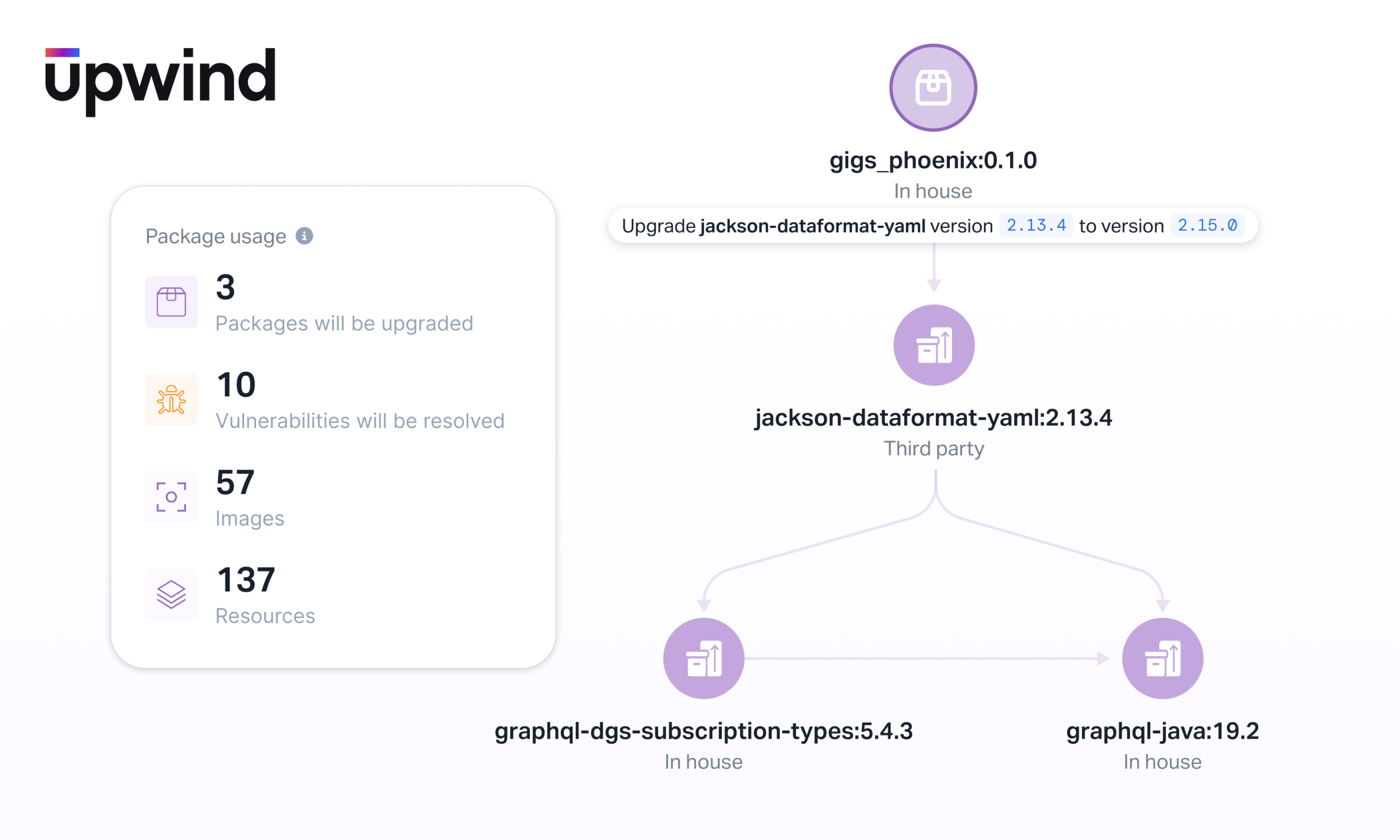
- Comprehensive Package Inventory: Upwind enables a detailed view of all packages within your environment, including their real-time dependencies. This allows for efficient searching by the framework, package manager, or usage frequency, facilitating quick identification of components across containers, virtual machines, and serverless functions.

- Prioritization. Upwind correlates SBOM components with known vulnerabilities and prioritizes them based on exposure, reachability, and runtime activity, allowing you to focus on what’s most important and reduce alert fatigue from excess noise.

Zero-Day Defense Through Network-Aware Runtime SBOMs
Having a runtime-enabled SBOM provides a powerful edge against zero-day exploits, especially within modern and constantly changing distributed systems. A traditional SBOM shows what could be in use. Runtime context shows what is in use right now. It also reveals how it’s being used and where. This transforms SBOMs from a static list of components into a live actionable, security-relevant asset that reflects what’s actually happening in your environment.
Upwind further enhances the effectiveness of runtime SBOMs with advanced network security measures. This provides a comprehensive defense against zero-day attacks by offering real-time visibility into network flows and topology. It also establishes behavioral baselines for every resource based on criteria such as process execution and file access. This allows security teams to understand cloud workload behaviors, contextualize risks, and prioritize critical threats.
The Upwind Threat Feed
To highlight Upwind’s runtime and network awareness, the Upwind Threat Feed is accessible from the Threats module. The Threat Feed provides continuously updated information about new and emerging threats, including zero-day vulnerabilities. It offers detailed analyses and identifies specific images and packages in your environment that may be susceptible, enabling security teams to identify and remediate zero day vulnerabilities in minutes, not days.

Bringing SBOMs into the Real World
Static SBOMs might work for planning and compliance, but they’re not enough for real-time decision-making during fast-moving zero-day attacks.
Upwind supercharges SBOMs by bringing them into the real world, using runtime awareness with network insights to reflect the true state of your environment rather than a snapshot of what happened at build. By continuously monitoring and reporting on deployed applications, then correlating them with up-to-date vulnerability data to provide prioritization inside the Upwind platform, the Upwind SBOM Explorer becomes a critical advantage in detecting and responding to emerging threats.
Don’t wait until you’re in Lisa’s shoes. See how Upwind can give your team the visibility and speed needed to respond before zero days take hold. Schedule a demo or reach out at [email protected].