
We are excited to announce that Upwind now supports Google Cloud Run. This addition reflects our commitment to delivering comprehensive, modern cloud security – no matter where or how your applications run. With this update, all core capabilities within the Upwind Platform are now available for workloads deployed on Google Cloud Run.
What is Google Cloud Run?
Google Cloud Run is a fully-managed serverless platform that lets you run containerized applications on top of Google Cloud. It handles scaling, networking, and infrastructure so you can focus on code. Google Cloud Run is optimized for stateless workloads like APIs, websites or background processing, but it can also support database access, caching, and AI/ML powered services. Think of it as the easiest way to run container images on Google Cloud.
Why It Matters for Security Teams
As adoption of serverless computing and Google Cloud Run continues to grow, so does the need to secure serverless environments without introducing friction or operational overhead. That’s why we’ve extended the full power of Upwind – real-time detection, posture insights, image scanning, and more – to protect your Cloud Run workloads.
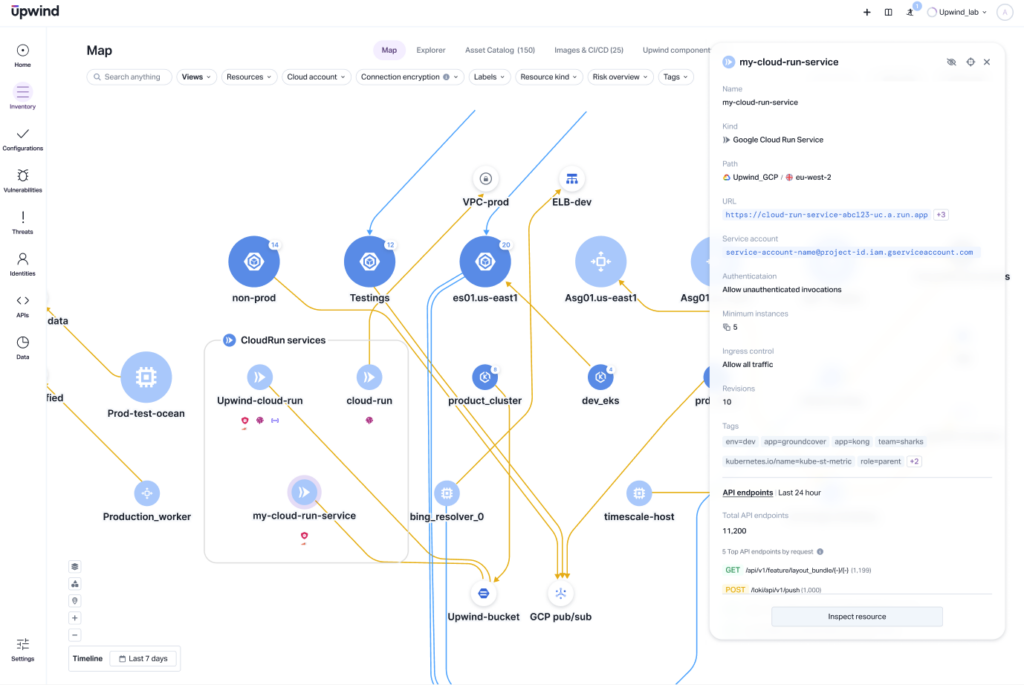
Upwind’s support of Google Cloud Run includes:
- Proactive Posture & Configuration Management: Surface findings for Google Cloud Run resources such as misconfigurations, exposed secrets, potential compliance breaches, malware, and external exposure risks – automatically and continuously.
- Real-time Threat Detection & Response: Detect threats targeting Google Cloud Run workloads in real time, and view contextual runtime detections in the Threads tab.
- Vulnerability Management: Identify and prioritize vulnerabilities in Cloud Run workloads using real-time & runtime insights and the Upwind Vulnerability Funnel.
- Cloud Run Inventory: Automatically discover all serverless functions and container workloads running on Cloud Run in the Assets Tab, with compute, data & scanned image visibility in the Images Tab.
- Monitor Real-Time Communication: Visualize how Cloud Run functions interact with other cloud resources in real-time using the Upwind Topology Map, including detailed network path and associated resource risk summaries.
- Proactive Posture & Configuration Management: Surface findings for Google Cloud Run resources such as misconfigurations, exposed secrets, potential compliance breaches, malware, and external exposure risks – automatically and continuously.
How Does Upwind Support Google Cloud Run?
Unlike traditional workloads, Google Cloud Run doesn’t offer a node layer for deploying Upwind’s eBPF sensor.. To overcome this, the Upwind Platform uses the same innovative tracer technology we pioneered for AWS Fargate. The Upwind Tracer provides deep visibility into Google Cloud Run environments, enabling:
- Process Communication Monitoring: Understand how processes within a container interact, detect anomalies, alerting on suspicious or malicious activity.
- Network Visibility: Track all inbound and outbound network traffic to identify potential threats and data exfiltration attempts.
- File Activity Tracking: Monitor file read, write, and execute operations in real-time, to flag unauthorized access or modification.
To complement the Upwind Tracer, the Upwind Platform also includes our Agentless Google Cloud Scanner for vulnerability management. This scanner analyzes container images in the Google Artifact Registry, identifying vulnerabilities before they reach production, and correlates vulnerability findings with runtime insights for prioritization.
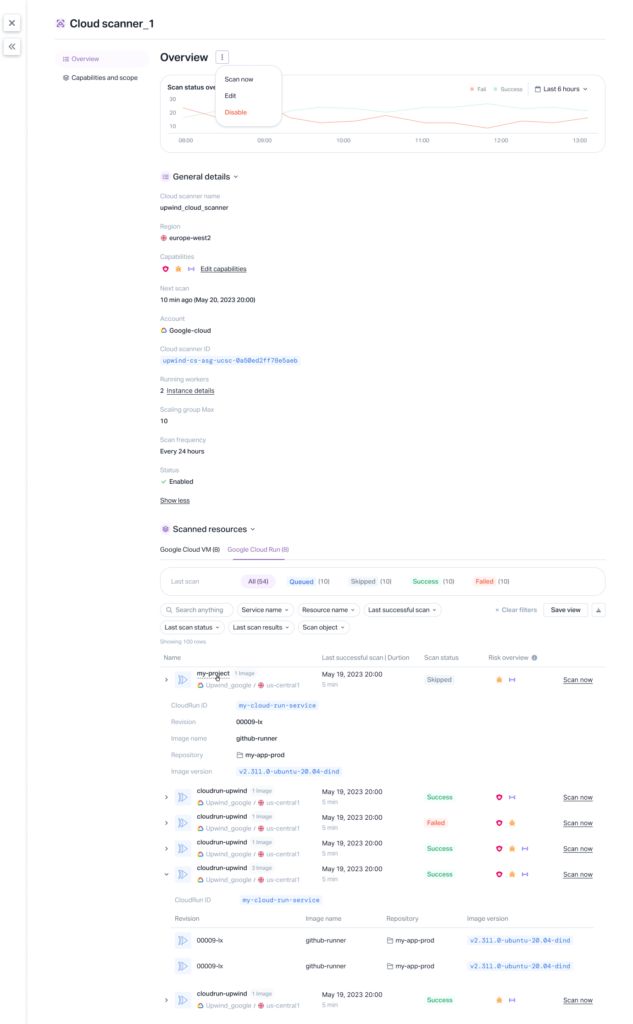
Get Started with Upwind’s Google Cloud Run Security
Upwind’s support for Google Cloud Run makes it easier than ever to secure serverless environments in Google Cloud. Whether you’re deploying microservices, APIs, or event-driven workloads, Upwind ensures visibility and protection without compromising speed or simplicity.
To learn more about Upwind and our support for Google Cloud Run, schedule a demo with us.