Get a Demo
Under Attack?
Pattern of outlined buckets with center one in green, surrounded by lighter outlines. Upwind logo in top left corner.

Easily Visualize S3 Bucket Communication on the Upwind Topology Map

<br />
<b>Warning</b>:  Undefined variable $photo in <b>/nas/content/live/landing173/wp-content/themes/bricks/includes/elements/code.php(236) : eval()'d code</b> on line <b>24</b><br />
<br />
<b>Warning</b>:  Trying to access array offset on value of type null in <b>/nas/content/live/landing173/wp-content/themes/bricks/includes/elements/code.php(236) : eval()'d code</b> on line <b>24</b><br />
Denise Ashur February 26, 2025

We are excited to announce a powerful new capability in the Upwind platform – enhancing security and operational efficiency by allowing you to easily visualize specific S3 buckets that resources are communicating with in the Upwind Topology Map. 

Upwind previously provided the ability to discover the specific S3 buckets that your assets are communicating with, enabling better understanding of attack paths, communication to sensitive data sources and asset distribution – viewable when drilling down into a specific resource overview. With this new update, you can now visualize these S3 bucket communications directly on the Upwind Topology Map, making it even easier to track interactions and potential risks such as data exfiltration, misconfigurations, and unauthorized access in real time.
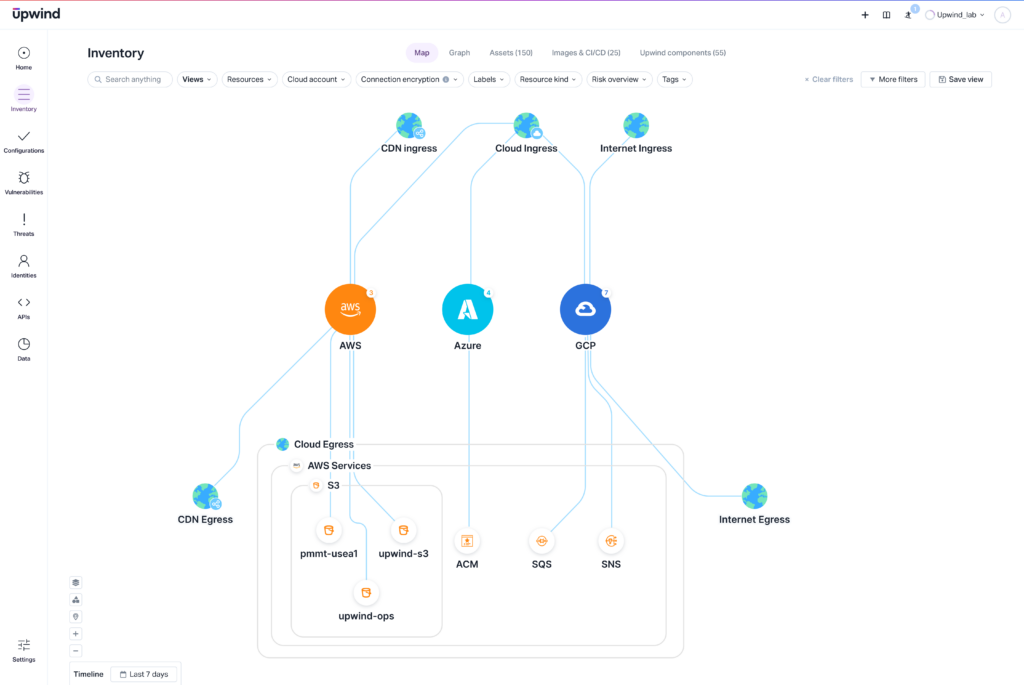
A software interface showing a network diagram with interconnected nodes representing CDN Ingress, Cloud Ingress (AWS, Azure, GCP), and Internet Ingress. Paths lead to Cloud Egress and Internet Egress, with various services like SNS and ACM depicted.

Key Benefits of Upwind’s Topology Map for S3 Buckets
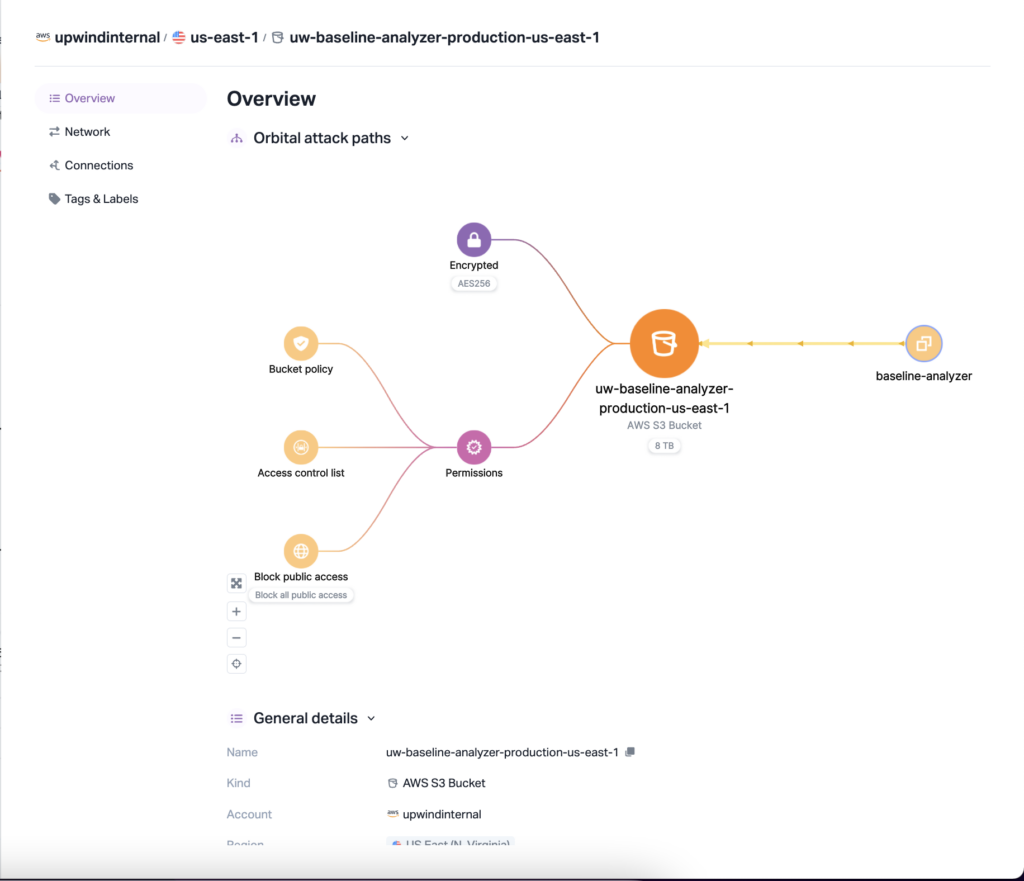
Flowchart showing AWS S3 bucket uw-baseline-analyzer-production-us-east-1 linked to baseline-analyzer. Nodes include Access control list, Block public access, and Permissions, all feeding into Blocked policy and Encrypted states.

With the Upwind Topology Map, you can:

  • View real-time resource communication to specific S3 buckets 
  • Identify suspicious communication or irregular activities that could impact your S3 buckets
  • Identify attack paths to sensitive data

Leveraging Runtime S3 Data for Prioritized CSPM Findings

Leveraging this granular S3 data, Upwind is also able to aggressively prioritize posture findings. Traditionally, CSPM alerts provide numerous alerts on S3 buckets by identifying S3 buckets that are exposed to the internet. However, those alerts often provide little to no environmental context, making it difficult for teams to understand the potential impact of the finding. Upwind solves this problem by deeply prioritizing S3 bucket posture findings, leveraging runtime context including:

  • who talks to a specific S3 bucket 
  • what type of data resides in the S3 bucket
  • which sensitive resources communicate with this bucket 
  • when the bucket first became exposed

By correlating this runtime context with S3 posture findings, Upwind cuts through the noise, automatically surfacing high-impact misconfiguration findings that represent the greatest risk to your environment based on real usage of your applications that run in the cloud.

Proactively Secure S3 Buckets with Upwind

Use Upwind’s runtime S3 awareness to gain even more context and visibility into your asset communication, track communication between resources, prioritize S3 posture findings, and respond to S3 bucket risks and threats in real time. For example, a media streaming company can use this feature to monitor unauthorized attempts to access content stored in S3 buckets, ensuring that copyrighted material remains protected and preventing data leaks.

To learn more about how Upwind proactively identifies attack paths and tracks real-time resource communication, schedule a demo.
Contents

Further Reading

OpenAI Breach

Everyone Read the OpenAI Breach as a Model Story, But It Was a Runtime Story

Key Takeaways Autonomous AI agents can now break out of a sandbox, cross an internal network, and breach a production system with no human at the keyboard. OpenAI's evaluation that hacked Hugging Face this month is the clearest proof on record. Most of the coverage read it as a story about a model turning dangerous.…
upwind-identities

Introducing the Upwind Identity Graph: End-to-End Identity Security

Identity used to be treated as a directory problem: find the user, inspect the groups, review the assigned roles, and decide whether the account has too much access. That model no longer matches the cloud. A single person may authenticate through Okta, inherit permissions from multiple groups, receive role assignments in more than one cloud,…
AI-Graph

Introducing the Upwind AI Graph: Extending AI Inventory Beyond Cloud Infrastructure

As enterprise adoption of artificial intelligence accelerates, modern AI infrastructure has expanded far beyond traditional cloud perimeters. Securing enterprise AI today requires complete visibility across four distinct operational layers: Traditional cloud security tools stop at the cloud provider boundary. When enterprise teams connect directly to external AI Providers, security teams lose sight of access paths,…
Add the Upwind RSS Feed to Slack
Connect the Upwind RSS Feed to your Slack.
Follow the how-to here.
Threat RSS
Add the Upwind RSS Feed to Slack
Connect the Upwind RSS Feed to your Slack.
Follow the how-to here.
Main RSS