Get a Demo
Under Attack?
A grid of light purple shopping bag icons with one prominent dark purple bag icon in the center. The word upwind is in the top left corner. The background is white with a mix of solid and outlined icons.

Location and Paths Forensics for your Vulnerability Findings

<br />
<b>Warning</b>:  Undefined variable $photo in <b>/nas/content/live/landing173/wp-content/themes/bricks/includes/elements/code.php(236) : eval()'d code</b> on line <b>24</b><br />
<br />
<b>Warning</b>:  Trying to access array offset on value of type null in <b>/nas/content/live/landing173/wp-content/themes/bricks/includes/elements/code.php(236) : eval()'d code</b> on line <b>24</b><br />
Denise Ashur February 13, 2025

Location and Paths Forensics for your Vulnerability Findings

We are excited to introduce a new functionality in the Upwind platform that directly addresses a key challenge in vulnerability management: quickly pinpointing the location of specific package versions. With this enhancement, you can now effortlessly track where your vulnerabilities reside, eliminating guesswork and speeding up your response time.

Understanding the full impact and scope of a vulnerability is critical to taking effective action. Upwind has always provided deep context for every new vulnerability finding, including:

  • CVE: Information about the unique CVE and its potential impact on your environment.
  • Package: The package where this vulnerability is found in your environment.
  • Image: The image running in the vulnerable package.
  • Resource: The resource that is impacted by this finding.
  • Build context: Comprehensive context about build-time changes that impact this vulnerability, including the specific pull request and developer.
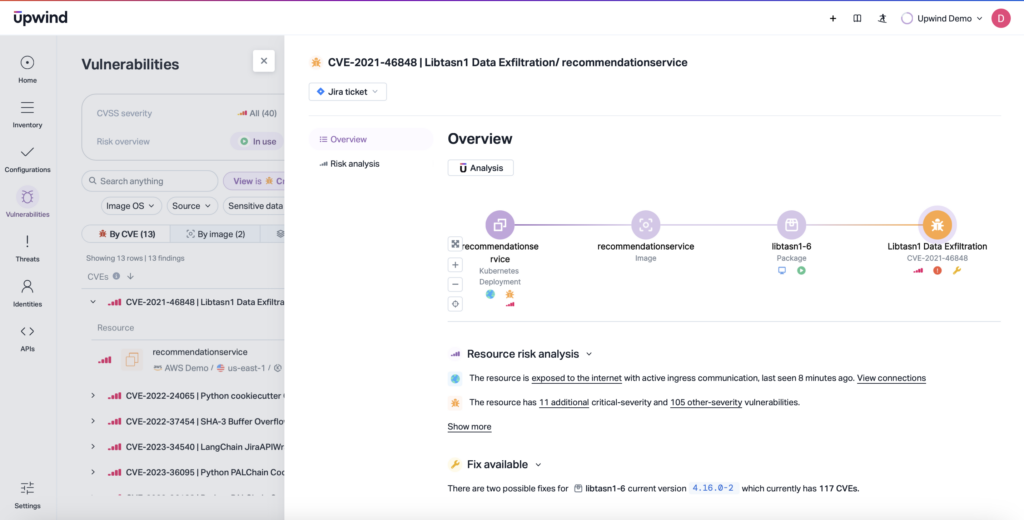
Screenshot of the Upwind dashboard showing a vulnerability analysis. On the left, it lists vulnerabilities with CVE-2021-44832 highlighted. The main section displays an overview and risk analysis of the liberant1-data exfiltration service.

Building on these capabilities, our latest update now delivers even deeper context by showing the precise package version location. This gives you:

  • Package location display: the finding details now show the exact location of the package version
  • Powered by SBOM: This data is sourced directly from the SBOM generated by Upwind, making it easier to track and resolve vulnerabilities quickly
  • Faster debugging: No more searching for where the affected package version is stored – it’s now visible at a glance.
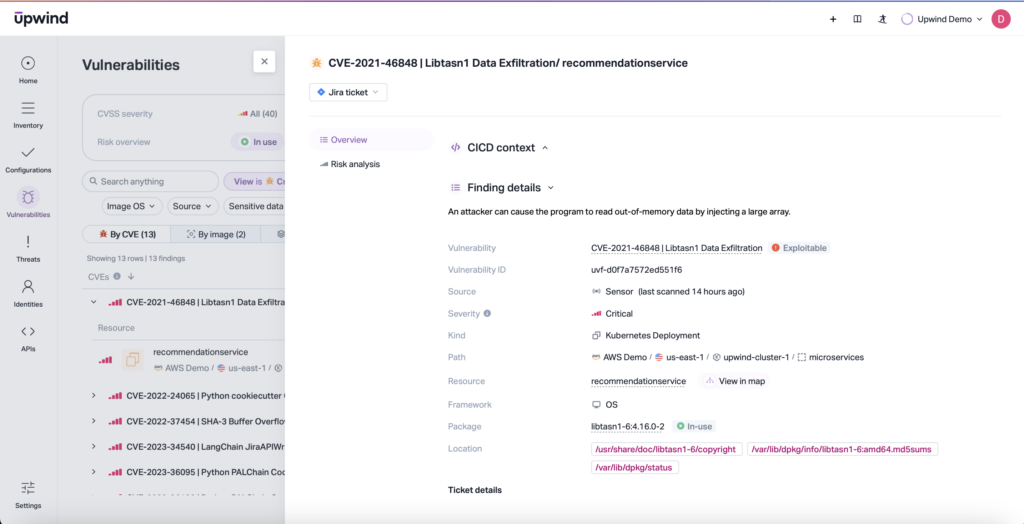
Screenshot of a vulnerability report from Upwind titled CVE-2021-46848 | LibBami Data Exfiltration. The status is Open, severity is Critical, and the affected resource is a Kubernetes deployment. Various tabs and options are visible.

Use Upwind’s vulnerability management capabilities to quickly prioritize your most critical risks, streamline investigations with ease, and achieve peace of mind by reducing your mean time to remediation. To learn more about how Upwind supercharges vulnerability management, schedule a demo today.

Contents

Further Reading

upwind-identities

Introducing the Upwind Identity Graph: End-to-End Identity Security

Identity used to be treated as a directory problem: find the user, inspect the groups, review the assigned roles, and decide whether the account has too much access. That model no longer matches the cloud. A single person may authenticate through Okta, inherit permissions from multiple groups, receive role assignments in more than one cloud,…
AI-Graph

Introducing the Upwind AI Graph: Extending AI Inventory Beyond Cloud Infrastructure

As enterprise adoption of artificial intelligence accelerates, modern AI infrastructure has expanded far beyond traditional cloud perimeters. Securing enterprise AI today requires complete visibility across four distinct operational layers: Traditional cloud security tools stop at the cloud provider boundary. When enterprise teams connect directly to external AI Providers, security teams lose sight of access paths,…
ChatGPT Image Aug 4, 2026, 08_46_20 AM

Keyv Supply Chain Compromise: An npm Worm That Takes Its Orders From an Ethereum Smart Contract

Executive Summary On August 4, 2026 at 09:35 UTC, [email protected] was published to npm carrying a credential stealer, an npm worm, and a persistence mechanism designed to detonate during incident response.  Keyv ranks #274 by npm reach and is present in 84,759 customer environments, and the release shipped with valid GitHub OIDC provenance and a…
Add the Upwind RSS Feed to Slack
Connect the Upwind RSS Feed to your Slack.
Follow the how-to here.
Threat RSS
Add the Upwind RSS Feed to Slack
Connect the Upwind RSS Feed to your Slack.
Follow the how-to here.
Main RSS