Upwind helps you achieve faster time-to-value on Google Kubernetes Engine (GKE) by continuously monitoring workloads, detecting threats in real time, and enforcing posture and compliance through frameworks such as Center for Internet Security Google Kubernetes Engine benchmarks (CIS GKE). Our support enables you to achieve faster time-to-value with the CIS GKE benchmark by utilizing the same industry-leading real-time and runtime features you can already use for other compliance frameworks such as HIPPA, SOC2, or ISO/IEC 27001.
Why CIS Benchmarks Matter—And Why They’re Hard
Imagine this: your GKE environment passed a CIS benchmark scan yesterday, but then overnight, a new deployment introduced a risky misconfiguration. One of our customers with a sprawling Google Cloud environment told us, “Before Upwind, we had no idea when drift happened. It could be hours or days before anyone noticed.”
CIS Benchmarks are globally accepted best practices for securing systems and applications, but they only work if you’re continuously checking against them. First introduced by the Center for Internet Security (CIS) in 2000, they’ve become foundational for organizations looking to reduce risk and meet security and compliance standards.
But implementing them—especially in dynamic, multi-cloud environments—isn’t simple. In today’s fast-moving cloud, resources are spun up, modified, and torn down constantly. Keeping pace with a static checklist isn’t enough.
What’s needed is continuous, real-time validation to stay aligned with CIS benchmarks as your environment evolves.In fact, even though most organizations operate in the cloud and use security frameworks, 60% still acknowledge “significant” gaps in their cloud infrastructures (40+ Cloud Security Statistics You Need to Know in 2024, Adivi). That’s why relying on static scans or outdated tooling isn’t enough. What’s needed is a system that evolves as fast as your environment does.
What Is CIS GKE?
CIS GKE is the CIS benchmark for securing Google Kubernetes Engine. It covers best practices for:
- Node and cluster configuration
- API server settings
- Pod security policies
- Identity and access controls
Following CIS GKE helps reduce your GKE attack surface and align with broader standards like PCI DSS, HIPAA, and NIST.
But GKE environments are complex and constantly changing. True alignment with CIS GKE requires full visibility across every cluster component – in real-time – not just periodic scanning.
Upwind Brings Runtime Security to CIS GKE
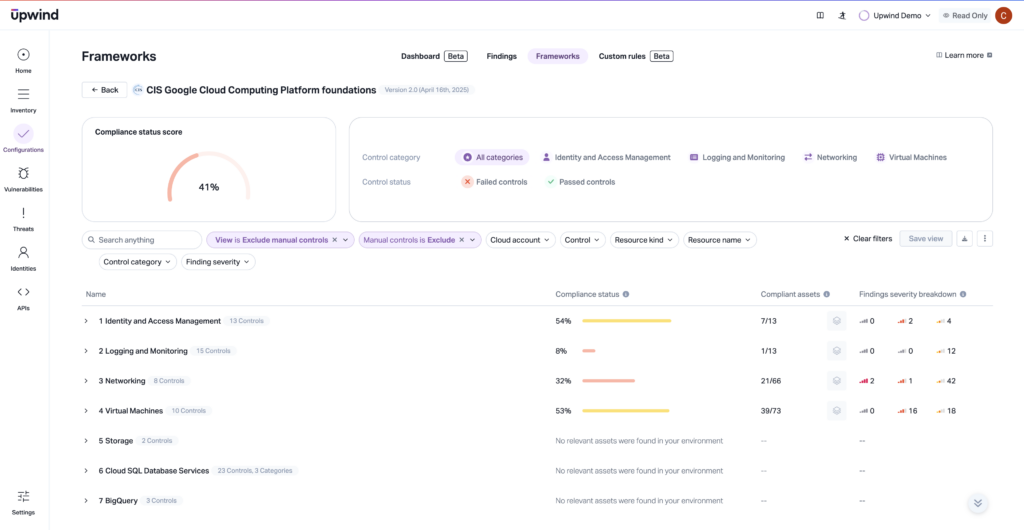
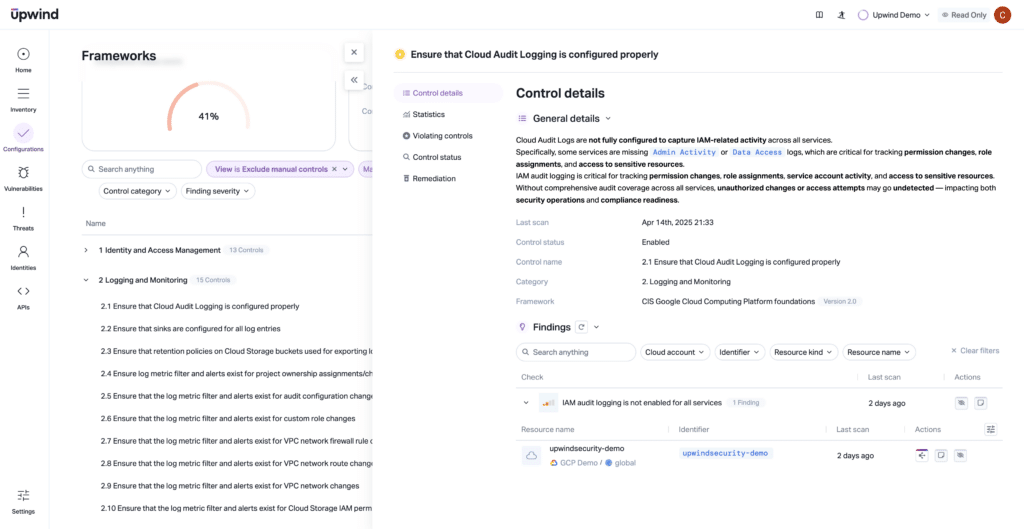
Available now in the Upwind platform, our support for CIS GKE uses the same real-time, context-aware approach we bring to other major compliance standards. We help you identify and fix issues as they happen, not after the fact. That means:
- Continuous Misconfiguration Monitoring: Upwind continuously scans your GKE environments for CIS GKE violations—no manual tuning required. You get instant, actionable insights that help you close posture gaps fast.
- Historical Compliance Visibility: Track when posture drift occurred, which assets were affected, and how policy changes impacted compliance. With time-based context, you can quickly pinpoint the root cause of violations and respond with confidence.
- Real-Time Threat Context: Posture alone isn’t enough. Upwind gives you live, runtime context—so when something goes wrong, you know whether it’s a theoretical misconfiguration or an active risk. This reduces false positives and accelerates mean time-to-resolution.
Learn More
As cloud environments grow more dynamic and complex, securing them can no longer be a static, one-time effort. Runtime visibility and real-time monitoring are no longer “nice-to-haves.” They’re essential for staying ahead of threats, achieving fast time-to-value, and maintaining continuous compliance. CIS Benchmarks are no different. With the addition of CIS GKE support, Upwind brings the power of runtime security to one of the most widely used Kubernetes platforms. This not only strengthens real-time protection, but also simplifies audit readiness and reduces the risk of compliance drift in fast-moving environments.
Want to achieve faster time-to-value with CIS GKE? Schedule a demo or drop us a line at [email protected], to learn about how.