As serverless computing continues to gain momentum, developers and DevOps teams are increasingly turning to Microsoft Azure Functions to build scalable, event-driven applications with minimal infrastructure overhead. However, the very benefits of serverless – rapid deployment, fine-grained event handling, and abstracted infrastructure – introduce new challenges for security teams. These environments are harder to monitor and often leave teams blind to critical risks. That’s where Upwind steps in.
We’re excited to announce that Upwind Security now supports scanning for Microsoft Azure Functions, providing automatic and instant cloud security tailored to the unique needs of serverless environments.
What are Azure Functions?
Microsoft Azure Functions are a serverless compute service that enables developers to run small pieces of code, known as “functions,” without having to manage the underlying infrastructure. Designed for event-driven programming, Azure Functions can be triggered by a variety of sources such as HTTP requests, database changes, messages in a queue, or scheduled events.
This allows developers to build scalable and responsive applications, automating workflows and processing data. Since resources are automatically allocated and scaled based on demand, Azure Functions help optimize cost and performance, making them ideal for microservices, background tasks, and real-time data processing.
This level of abstraction, while efficient for development, often leaves security teams with limited control or visibility.
Why Azure Functions Need Specialized Security
Because Azure Functions are short-lived and stateless, traditional security tools often struggle to provide visibility and protection.
The challenges of scanning Azure Functions include:
- Ephemeral nature of functions: Difficult to scan during short execution windows.
- High-level abstraction: Limited visibility into the underlying infrastructure.
- Wide integration footprint: Functions are often connected to APIs, queues, and data stores, expanding the potential for misconfigurations and vulnerabilities.
Upwind Security’s Approach
Our hybrid approach combines sensor-based visibility with agentless scanning to protect dynamic, serverless environments like Azure Functions. By integrating with your Azure environment, Upwind is able to continuously analyze how functions behave, what resources they interact with, and whether any behavior deviates from what’s expected.
Key Capabilities include:
- Cloud Configuration Scanning: Automatically identifies misconfigurations in Azure Function settings, such as overly permissive identities, unencrypted data storage, or lack of environment-specific controls.
- Vulnerability Scanning: Scans the dependencies and packages used in your functions to identify known vulnerabilities (CVEs) and flag risky versions.
- Malware Detection: Identifies harmful content within function images and ZIP archives, including known malware signatures, suspicious binaries, and scripts that may be used for lateral movement or data exfiltration.
- Secrets Exposure Detection: Detects sensitive information within environment variables and deployment configurations.
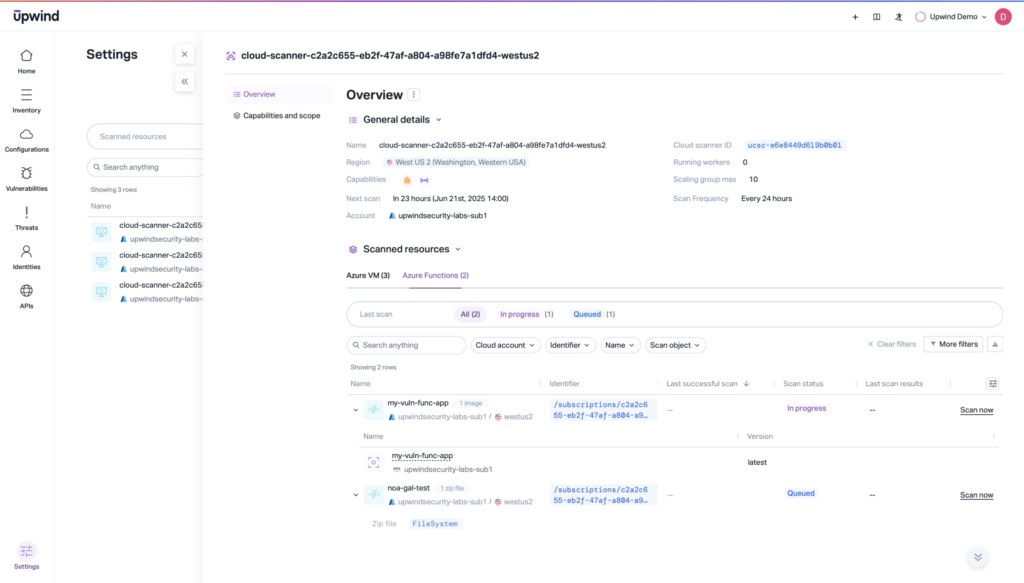
Upwind Provides Automatic Azure Function Coverage
Setting up the Upwind Platform for Azure Functions monitoring is effortless and automated. You can learn more in our onboarding guide. Our agentless Cloud Scanners for Microsoft Azure can be easily deployed via Terraform and enable native scanning. Just complete the guided onboarding, define your scope, and secure your functions. No manual setup required.
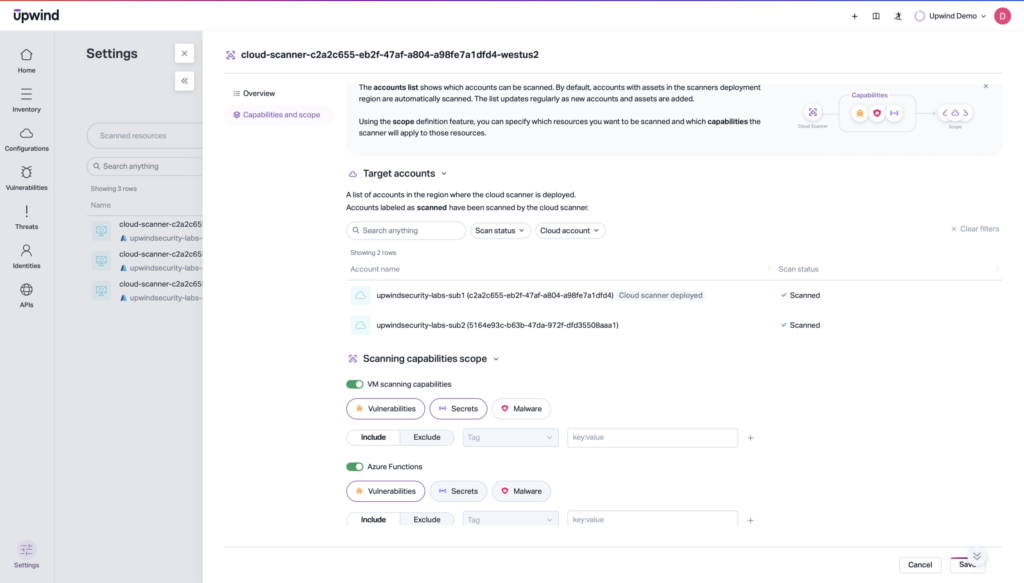
Why This Matters
As organizations accelerate their move to serverless, attackers are following. Without the right visibility, it’s easy for a small misstep to become a major breach vector. Lack of visibility into issues like missing permissions boundaries or misconfigured bindings can turn a small oversight in Azure Functions into a serious risk, exposing sensitive keys or enabling unauthorized access to critical systems. According to recent industry reports, 37% of serverless breaches involved over-permissive function roles.
Upwind’s Azure Function scanning helps organizations stay ahead of threats without slowing down innovation. Upwind detects these kinds of weaknesses in serverless scenarios and alerts teams immediately – before attackers can exploit them in production.
Learn More
Whether you’re building microservices, data processing pipelines, or event-driven APIs on Azure, Upwind gives you the visibility and protection needed to operate with confidence. Don’t wait for a misconfiguration to turn into a breach – schedule a demo today.