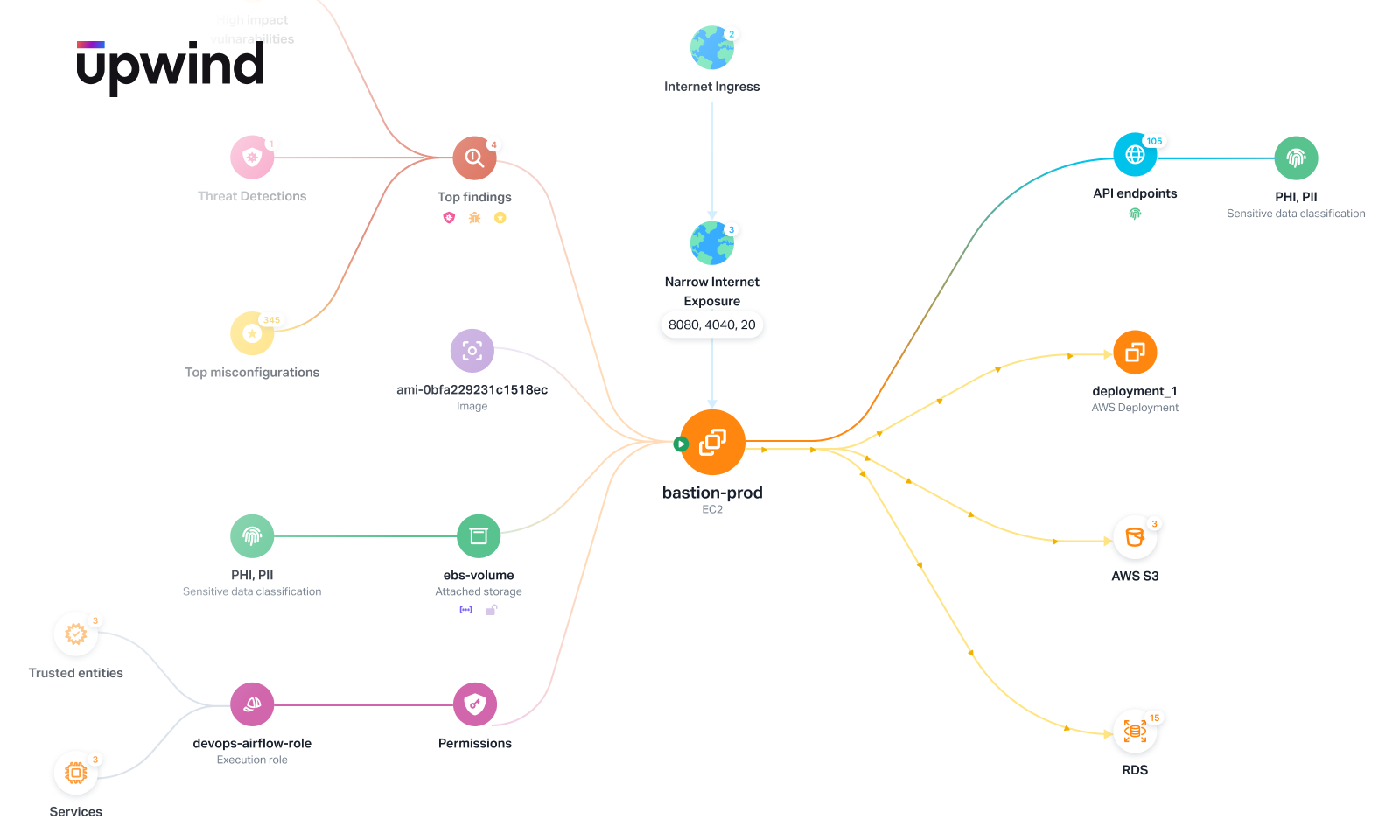

Most cloud security platforms are built on static assumptions – scanning code, configs, and assets to guess where risk might exist. At Upwind, we took a fundamentally different approach: we built our platform on runtime.
By capturing real-time signals directly from the kernel, Upwind delivers deep, continuous visibility into how workloads, APIs, identities, and data actually behave in production. This isn’t just a more accurate way to secure the cloud, it’s a more efficient one. Because runtime is the foundation, Upwind doesn’t require bolt-on modules or standalone tools. Instead, we unify what would traditionally require two or three separate products – like CSPM, API security, and threat detection – into a single platform.
In this article, we dive into how Upwind empowers security teams to get better outcomes with fewer tools, lower operational overhead, and full-stack visibility that keeps up with the speed of their environments.
Runtime Context Across the Entire CNAPP Stack
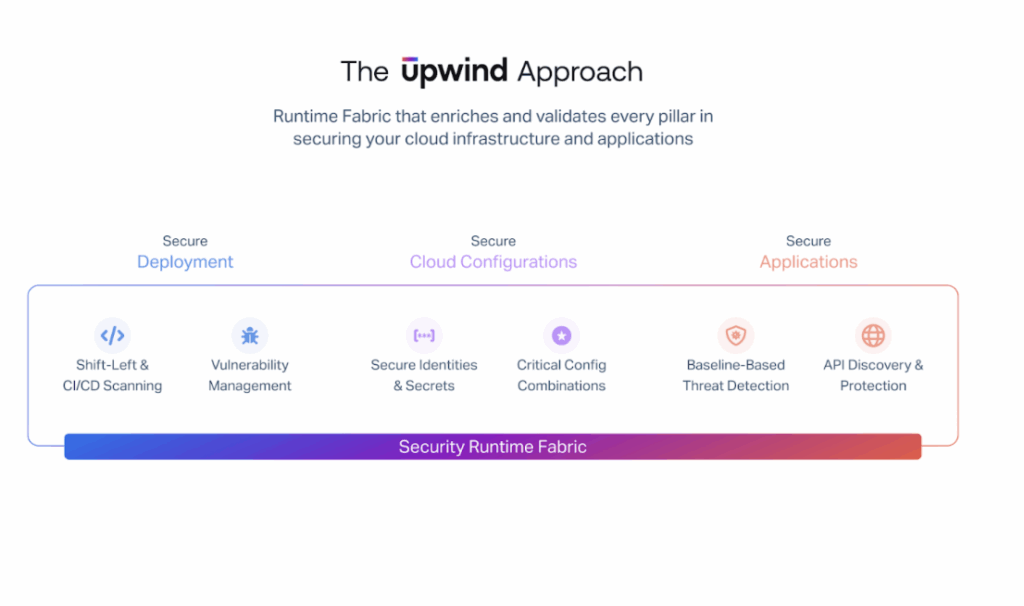
Most platforms in the CNAPP space take a “static-first” approach. They rely heavily on scanning tools and static analysis to generate posture reports, similar to traditional CSPM or SAST tools. They focus on inventory, misconfigurations, CVE databases, and CSPM rules – which often results in alerts with no clear prioritization, and no context to guide action. Upwind flips the model. By using runtime data as our foundation, we inject live production awareness into every layer of our platform:
- Posture and vulnerability management: Discover what vulnerabilities exist and which ones are actually being executed in production. This results in fewer false positives, smarter prioritization, and a clearer path to remediation.
- Threat detection and response: Observe real behavior at the system level including file writes, privilege escalations, network beacons, and connect it to the applications, services, and APIs involved.
- Data and identity monitoring: Track which workloads access sensitive data at runtime and identify misuse or drift from intended behavior.
- API security: Analyze API behavior live, from within the workload, without requiring access to API gateways.
API Security: A Perfect Example of Runtime Blindness
APIs have become a leading attack vector for many modern organizations. But the market is crowded, and most solutions fall into one of two categories:
- Point Solutions
- Point solutions specialize in API security through traffic gateways and proxies. They offer API discovery, DAST/fuzzing, and some behavioral protections, but often introduce complexity, integration requirements, and volume-based limitations.
- Add-ons in Broader Platforms
- Broader platforms typically offer static API inventory through code scanning or traffic analysis, but lack true runtime insight. They can tell you what APIs exist, but not how they’re actually behaving or whether they’re being attacked.
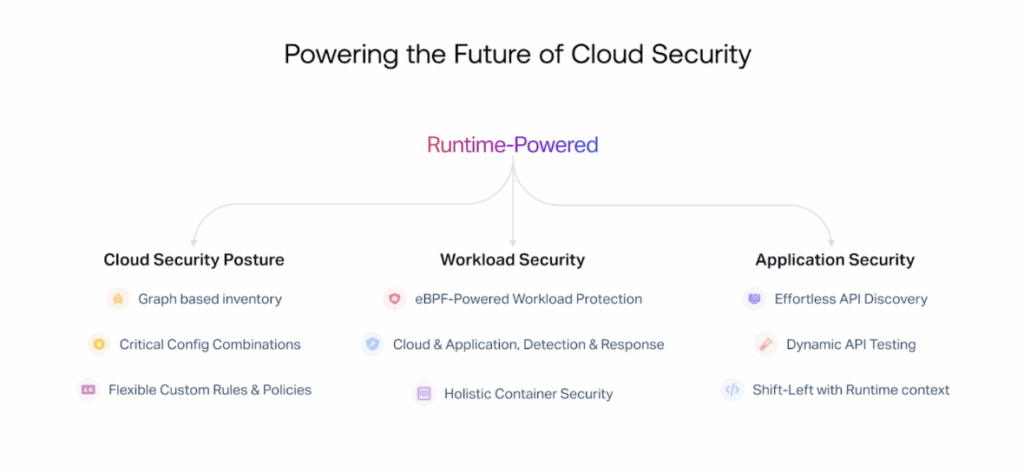
In contrast, our light-weight, high-performance eBPF sensor addresses the runtime gap left by point solutions and static analysis tools. While those approaches either introduce latency and integration overhead or lack execution context entirely, ours delivers real-time kernel-level visibility without those tradeoffs. We continuously observe traffic from Layers 3, 4 and 7, including API calls directly at the kernel level. This continuous context gives us the ability to provide users with:
- Real-time discovery of shadow APIs and version drift, without relying on outdated specs.
- Live behavioral analysis that shows how APIs are being used, misused, or attacked.
- Correlation across the stack, linking API calls to suspicious process activity, network traffic, or data access.
This deep API protection is baked into the Upwind CNAPP and is continuously correlated with cloud workload behavior. Because this is built into the broader CNAPP, it eliminates the need for a separate API tool for high-fidelity, unified cloud infrastructure and application security.

Case Study: Replacing a Point Solution in an API-Driven Evaluation
We recently worked with a mid-sized financial services company that was actively evaluating API security tools. A new AppSec lead had joined the team, with experience using a well-known point solution. He secured a budget specifically for API Security and began a proof-of-value (POV) process.
Initially, the team had a preferred vendor and a clear project scope. But when we showed how Upwind could deliver identical API outcomes – plus runtime, visibility, posture, and threat detection – the story changed.
“You don’t do it the same way,” he said. “But the outcomes are identical. And I need the outcome.”
Despite the project being scoped for API security, Upwind won the business. In practice, the team got a consolidated platform that now covers far more than just APIs – without the need for additional tools or agents.

Consolidating Tools with Runtime Context
According to a 2025 study from Enterprise Strategy Group, 53% of organizations tend to purchase, or will in the future purchase, security technology platforms rather than best-of-breed products. As we continuously gather feedback from security leaders, the Upwind team is also consistently hearing that consolidation is a key goal for many organizations – both due to cost and to improve operational efficiencies.
When using Upwind, customers often report consolidating 2-4 tools, including:
- Point solutions for API security, DAST, and cloud threat detection
- Static CSPM platforms with no execution context
- Agent-heavy workload monitoring tools
This level of consolidation is possible because the runtime fabric fuels every insight across the platform. This reduces noise, improves operational efficiencyand empowers teams to focus their efforts on critical security findings across APIs, workloads, data, and threats.
Final Word: Runtime Is the Unifier
Upwind operates on the foundational belief that cloud security happens at runtime, and that runtime context enables security teams to work more effectively, avoid alert fatigue, and identify how runtime behavior ties back to posture, identity, APIs, and production workloads. In a world of disconnected tools and static assumptions, runtime is the one unifying truth. It’s the reason Upwind can consolidate multiple categories of tooling into a single, outcome-driven platform.
If you’re thinking about API Security, CNAPP consolidation, or how to simplify your cloud security architecture, we’d love to show you what’s possible. Schedule a personalized demo with us today.